
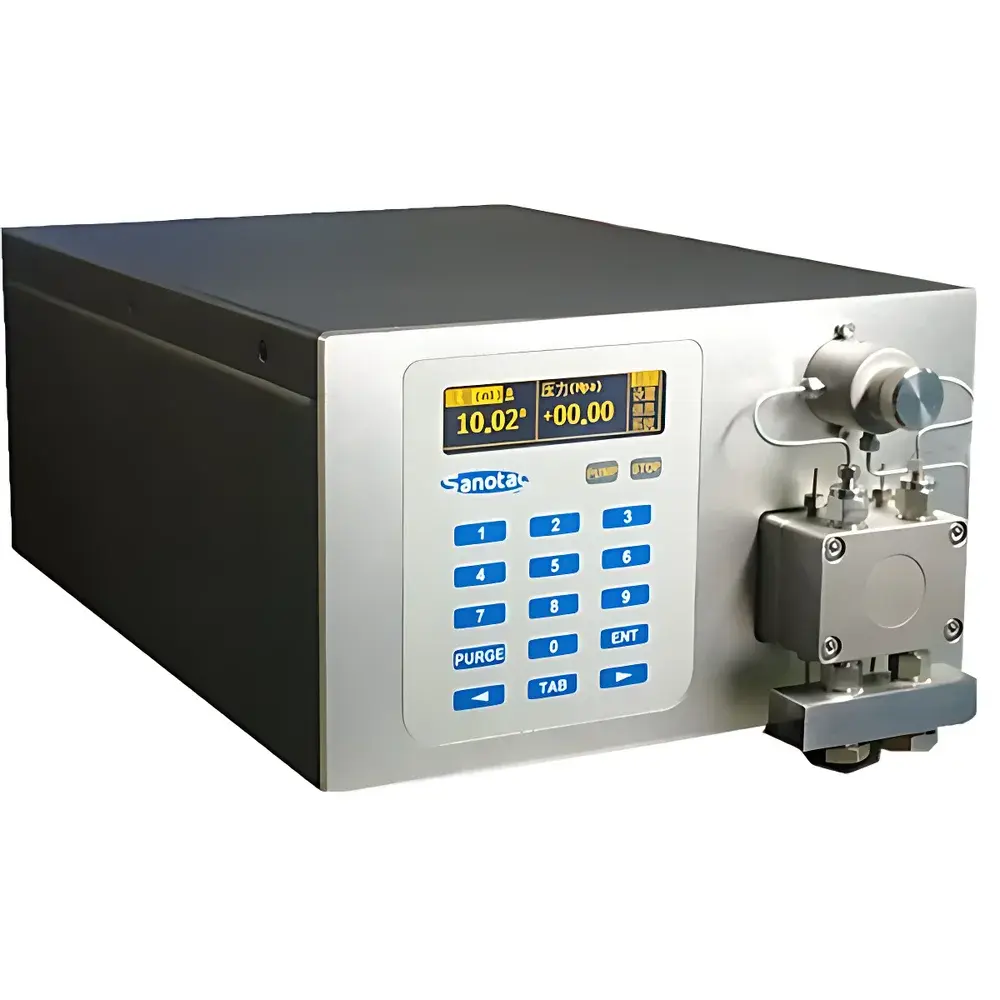
Sanotac TSP1020 High-Pressure Dual-Piston Constant Flow Pump
| Brand | Sanotac |
|---|---|
| Origin | Shanghai, China |
| Manufacturer Type | OEM Manufacturer |
| Product Category | Domestic |
| Model | TSP1020 |
| Price Range | USD 1,400 – 2,800 |
| Flow Rate Range | 0.001–10,000 mL/min |
| Maximum Pressure | 2–42 MPa |
| Pump Head Options | 10 mL (20 MPa rated), 100 mL (20 MPa rated) |
| Construction Materials | 316L Stainless Steel, Titanium, PTFE, PCTFE, Hastelloy C-276, PEEK |
| Control Interface | Embedded microprocessor with 10 user-programmable methods |
| Gradient Capability | Isocratic, linear, step, and composite gradient profiles |
| Pulse Damping | Cam-profile compensation + electronic flow pulsation suppression |
| Sealing Architecture | Floating piston design with imported Swiss check valves |
| Communication Protocol | Open-source RS-485/RS-232 |
Overview
The Sanotac TSP1020 is a high-pressure, dual-piston constant flow pump engineered for precision fluid delivery in demanding analytical and process-scale applications. Based on positive displacement reciprocating piston mechanics, it delivers stable, pulse-minimized flow across an exceptionally wide dynamic range—from trace-level solvent delivery in preparative liquid chromatography to bulk reagent dosing in catalytic reaction systems. Its dual-piston architecture operates in staggered phase timing, enabling continuous flow without mechanical dead volume interruption. The pump is designed to meet the mechanical and chemical robustness requirements of ISO 9001-certified manufacturing environments and supports integration into GLP-compliant laboratories where audit-trail-capable operation and reproducible volumetric accuracy are mandatory.
Key Features
- Microprocessor-controlled dual-piston drive system with real-time solvent compressibility compensation—enabling accurate flow delivery across varying mobile phase compositions (e.g., water/acetonitrile gradients).
- Multi-point flow calibration algorithm: user-performed at up to 10 discrete flow rates per channel, correcting for nonlinearity across the full operational envelope (0.001–10,000 mL/min).
- Low-pressure pulsation design: integrated cam-profile optimization and active electronic flow feedback suppress pressure ripple to < ±0.2% RSD at 1 mL/min (measured per ASTM D3417).
- Modular wetted-path construction: interchangeable pump heads and valve manifolds allow rapid reconfiguration for compatibility with aggressive solvents (e.g., HF, fuming nitric acid) or ultra-high-purity applications (pharmaceutical API synthesis).
- Open communication architecture: native RS-485/RS-232 interface with documented ASCII command set—enabling direct integration with third-party chromatography data systems (CDS), PLC-based reactor controllers, or custom Python/Matlab automation frameworks.
- Extended service life engineering: floating piston assembly reduces radial load on sealing surfaces; combined with sapphire-coated ceramic plungers and Swiss-sourced non-return valves, mean time between maintenance (MTBM) exceeds 12,000 operating hours under nominal 20 MPa conditions.
Sample Compatibility & Compliance
The TSP1020 accommodates diverse fluid chemistries through material-selectable wetted paths—including 316L stainless steel (for general organic/aqueous use), titanium Grade 2 (for chloride-rich or oxidizing media), PTFE/PCTFE (for hydrofluoric acid or strong alkalis), and PEEK (for biocompatible or low-metal-leaching workflows). All configurations comply with EU Machinery Directive 2006/42/EC and carry CE marking. When operated within validated parameter envelopes, the pump satisfies USP chromatographic system suitability criteria for flow accuracy (±0.5% of setpoint) and precision (RSD ≤ 0.1%). Optional firmware upgrade enables 21 CFR Part 11-compliant electronic signatures and audit trail logging when paired with compliant host software.
Software & Data Management
The embedded controller supports 10 stored method files—each defining flow rate ramping, gradient slope, hold times, and pressure limit thresholds. All parameters are editable via intuitive keypad navigation or remote command string transmission. Raw operational logs (timestamped flow, pressure, temperature, error codes) are exportable via USB-C as CSV. For enterprise integration, Sanotac provides a publicly documented Modbus RTU register map and TCP/IP Ethernet gateway module (optional), allowing seamless ingestion into LIMS or MES platforms. No proprietary runtime or license fees apply—consistent with open instrumentation principles advocated by the Analytical Instrumentation Association (AIA).
Applications
- HPLC/UHPLC and preparative LC systems requiring high-pressure stability and gradient fidelity.
- Catalytic reaction engineering: precise co-injection of catalysts, ligands, and substrates into stirred-tank or fixed-bed reactors (e.g., Fischer–Tropsch, hydrogenation, asymmetric epoxidation).
- Supercritical fluid processing: CO₂ or ethane delivery at >10 MPa for extraction, impregnation, or particle formation.
- Electrochemical flow cells: controlled electrolyte replenishment in fuel cell testing or battery electrolyte screening rigs.
- Continuous pharmaceutical manufacturing: API crystallization, nanoparticle synthesis, and inline blending per ICH Q5D and Q8(R2) guidelines.
- Environmental simulation chambers: metered introduction of calibrated VOC or NOₓ streams for sensor calibration or atmospheric chemistry studies.
FAQ
What is the maximum allowable backpressure for the 10 mL pump head?
The 10 mL displacement head is rated for continuous operation up to 20 MPa; short-term excursions to 22 MPa are permissible with active thermal monitoring.
Can the TSP1020 be used with corrosive halogenated solvents such as bromotrifluoroethylene?
Yes—when configured with PCTFE or Hastelloy C-276 fluidic components and fluorocarbon-compatible seals (e.g., Kalrez® 6375), it maintains integrity at 15 MPa and 60 °C.
Is gradient delay volume specified, and how is it minimized?
Delay volume is < 120 µL for the standard mixer configuration; optional low-volume mixing tees reduce it to 45 µL—critical for fast-gradient UHPLC methods.
Does the pump support real-time pressure override during method execution?
Yes—via external TTL or 0–10 V analog input, enabling hardware-triggered pressure limiting in exothermic reaction control loops.
Are calibration certificates traceable to NIST or equivalent national metrology institutes?
Factory calibration uses gravimetrically verified reference standards accredited to ISO/IEC 17025; on-site recalibration kits with NIST-traceable flow meters are available upon request.



