
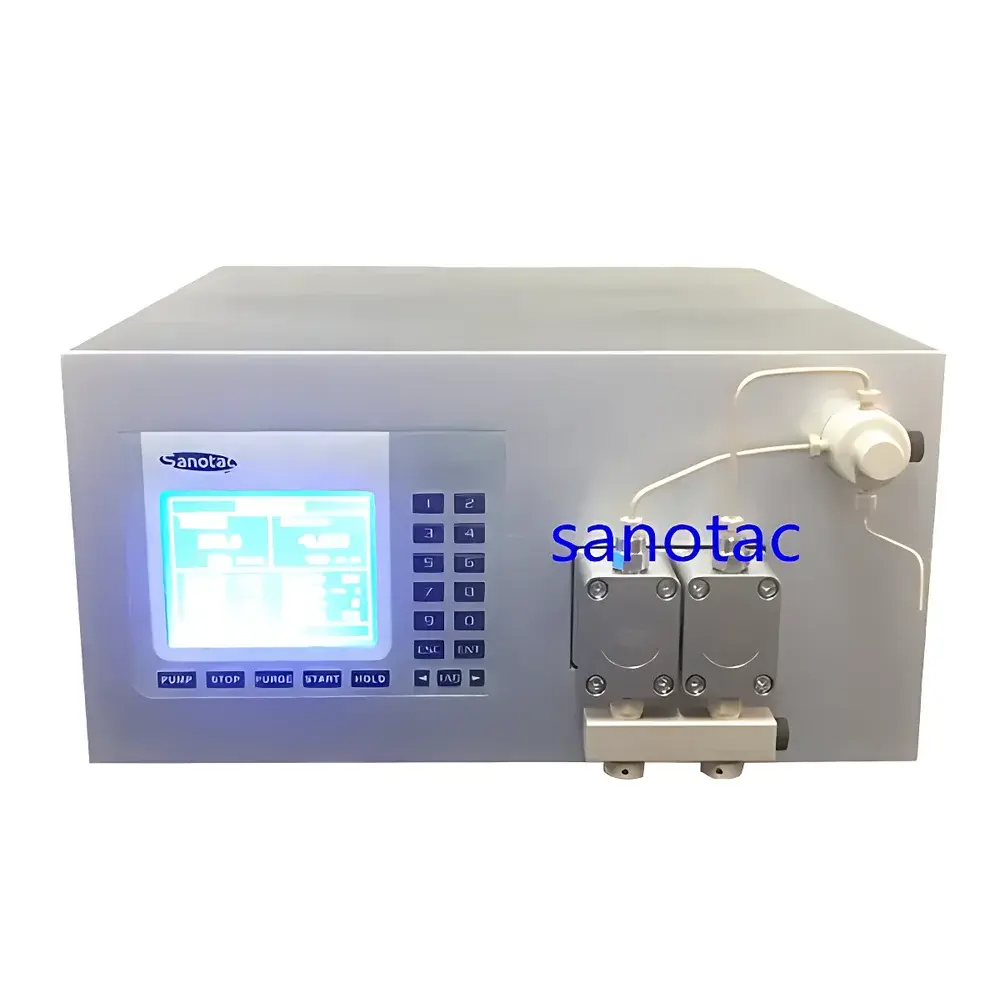
Sanotac GS-1020 High-Pressure Constant-Flow Pump for Tubular Reactor Systems
| Brand | Sanotac |
|---|---|
| Origin | Shanghai, China |
| Manufacturer Type | OEM Manufacturer |
| Region of Origin | Domestic (China) |
| Model | GS-1020 |
| Price Range | USD 1,400 – 2,800 |
| Flow Mode | Dual Parallel Plunger |
| Flow Range | 0.01–100.00 mL/min |
| Increment | 0.01 mL/min |
| Flow Accuracy | ±0.5% |
| Flow Precision (RSD) | ≤0.1% |
| Max Pressure | 20 MPa |
| Pressure Pulsation | ≤0.2 MPa |
| Wetted Materials | 316L Stainless Steel, Sapphire, PTFE, Ceramic |
| Tubing Connection | 1/16″ Standard |
| Display | 256×64 Dot Matrix OLED |
| Control Interface | Front Panel + RS232/USB Computer Remote Control (Open Protocol) |
| Power Supply | 85–264 VAC, 50 Hz |
| Dimensions | 370 × 240 × 152 mm |
Overview
The Sanotac GS-1020 is a high-pressure, dual-plunger constant-flow pump engineered for precise, stable fluid delivery in continuous-flow chemical reaction systems—particularly tubular reactors requiring consistent reagent feed under elevated pressure conditions. Operating on the principle of positive displacement via synchronized parallel plunger motion with floating plunger architecture, the GS-1020 delivers exceptional volumetric accuracy across a wide dynamic flow range (0.01–100.00 mL/min) while maintaining pressure stability up to 20 MPa. Its design integrates microprocessor-based flow control, solvent compressibility compensation, and multi-point flow calibration—enabling reliable operation in applications where flow-induced process variability must be minimized, such as catalytic fixed-bed reactions, supercritical fluid processing, and kinetic studies in segmented or laminar-flow reactor configurations.
Key Features
- Dual parallel plunger system with floating plunger mechanism reduces seal wear and extends service life of high-pressure sealing components.
- Microprocessor-controlled flow regulation with real-time solvent compressibility correction ensures accurate delivery across varying solvent viscosities and compressibilities.
- Multi-point flow curve calibration enables traceable, reproducible flow performance from ultra-low (0.01 mL/min) to high-flow (100 mL/min) regimes.
- Low-pressure pulsation (<0.2 MPa) achieved through cam-profile optimization and active electronic pulse suppression—critical for minimizing backpressure fluctuations in sensitive reaction environments.
- Chemically inert wetted path constructed from 316L stainless steel, sapphire check valves, PTFE seals, and ceramic plungers—compatible with aggressive solvents, acids, bases, and supercritical CO₂.
- Open communication protocol (RS232/USB) supports bidirectional remote control and integration into third-party laboratory automation platforms or custom LIMS environments.
- Front-panel interface with 256×64 OLED display and 10 programmable user methods for rapid method recall and gradient sequence execution (isocratic, linear, stepwise).
Sample Compatibility & Compliance
The GS-1020 is compatible with a broad spectrum of process fluids—including aqueous solutions, organic solvents (e.g., methanol, THF, DCM), ionic liquids, catalyst slurries, and supercritical fluids—when used within specified pressure and temperature limits. Its wetted materials conform to ASTM F2136 (biocompatibility of elastomers) and USP Class VI requirements for polymer components (PTFE, PCTFE). The pump’s mechanical design meets ISO 13849-1 Category 3 PL d safety standards for industrial equipment. While not intrinsically rated for hazardous area use, it may be deployed in ATEX Zone 2 environments when installed with appropriate ventilation and grounding per IEC 60079-14. Data integrity features—including audit-trail-capable parameter logging and firmware version tracking—support GLP/GMP-aligned workflows compliant with FDA 21 CFR Part 11 when integrated with validated software systems.
Software & Data Management
The GS-1020 supports both standalone operation and computer-controlled sequencing via an open ASCII-based command protocol. Users can develop custom control scripts in Python, LabVIEW, or MATLAB to orchestrate multi-pump synchronization, time-resolved gradient profiles, or feedback-triggered flow adjustments (e.g., pressure-responsive rate modulation). Internal memory stores up to 10 preconfigured methods with independent settings for flow rate, gradient shape, hold time, and purge cycles. All operational parameters—including real-time pressure, flow deviation, and motor load—are accessible via serial query and exportable in CSV format for post-run analysis. Firmware updates are performed via USB without external programming hardware, ensuring long-term maintainability and regulatory traceability.
Applications
- Continuous-flow catalysis in tubular and multi-tubular fixed-bed reactors (e.g., Fischer–Tropsch synthesis, ammonia oxidation, hydrogenation).
- Supercritical fluid extraction (SFE) and impregnation using CO₂ or ethane at pressures up to 20 MPa.
- High-pressure polymerization initiation (e.g., ethylene copolymerization, ring-opening metathesis).
- Electrochemical flow cell feeding with precise stoichiometric control for battery electrolyte screening.
- Microreactor and millireactor arrays requiring synchronized, low-pulsation reagent introduction.
- Process intensification studies involving reactive extrusion, foaming, and flash nanoprecipitation.
FAQ
What is the maximum allowable operating temperature for the GS-1020’s fluid path?
The pump is rated for continuous operation with fluids up to 60 °C; short-term exposure to 80 °C is permissible if ambient cooling is maintained.
Can the GS-1020 be used with abrasive slurries containing solid catalysts?
Yes—provided particle size remains below 5 µm and concentration does not exceed 5 wt%, using optional ceramic-plunger and sapphire-valve configurations.
Is gradient mixing performed internally or externally?
The GS-1020 is a single-solvent pump; gradient formation requires external low-dead-volume mixing tees or a secondary pump in a binary configuration.
Does the pump support automatic leak detection or pressure fault shutdown?
It includes over-pressure cut-off (configurable threshold) and motor stall detection, but lacks integrated fluid-leak sensors; external pressure transducers are recommended for closed-loop safety interlocks.
How often does the pump require recalibration for flow accuracy verification?
Annual calibration against a gravimetric standard is recommended per ISO/IEC 17025 guidelines; field verification using certified flow meters can be performed quarterly.



