
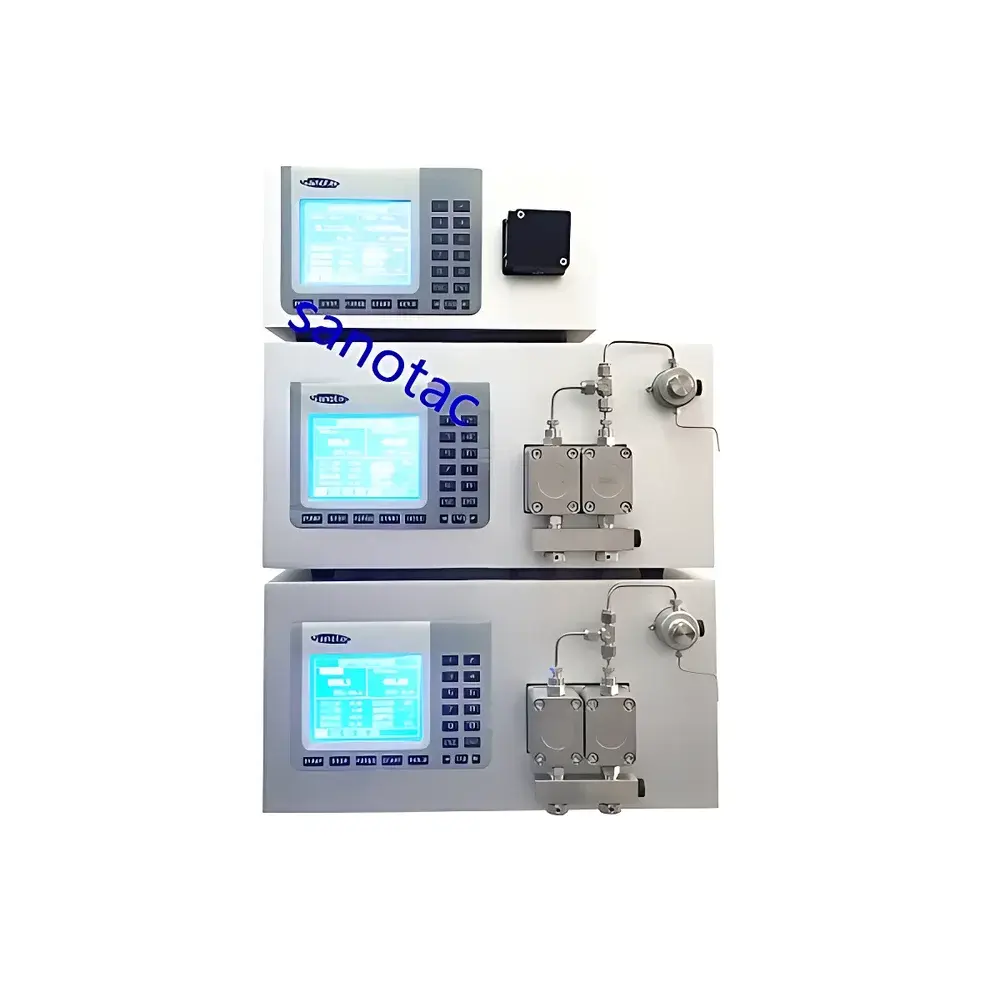
Sanotac Pilot1000 Series Preparative Liquid Chromatography System
| Origin | Shanghai, China |
|---|---|
| Manufacturer Type | Authorized Distributor |
| Origin Category | Domestic (PRC) |
| Model | Pilot1000 |
| Price Range | USD 7,000 – 14,000 |
| Instrument Type | Static Axial Compression System |
Overview
The Sanotac Pilot1000 Series Preparative Liquid Chromatography System is a modular, high-pressure preparative chromatography platform engineered for scalable purification across research, process development, and pilot-scale manufacturing. It operates on the principle of reversed-phase, normal-phase, or ion-exchange liquid chromatography—utilizing static axial compression technology to maintain column integrity under sustained high backpressure (up to 10 MPa). Unlike dynamic compression systems, the Pilot1000 employs a mechanically stabilized, non-oscillating axial load mechanism that ensures uniform bed density and minimizes channeling during extended gradient runs. This architecture is especially critical for isolating thermally labile natural products (e.g., flavonoids, alkaloids), synthetic intermediates, and moderately sized biomolecules—including peptides and modified oligonucleotides—where reproducible retention time, peak symmetry, and recovery yield are governed by consistent column packing homogeneity.
Key Features
- Microprocessor-controlled dual-piston reciprocating pump with real-time chamber pressure feedback, compensating for solvent compressibility and refill dynamics to deliver flow accuracy of ±0.5% across the full 0.01–1000.00 mL/min range.
- Flow pulsation suppression via cam-profile compensation, achieving ≤0.2 MPa pressure ripple—critical for low-noise UV detection and stable baseline performance in multi-wavelength quantification.
- Floating plunger design with PEEK or 316L stainless steel wetted materials (user-selectable), extending seal service life under continuous high-pressure operation.
- 10 programmable user methods supporting independent gradient profiling (step, linear, or custom), flow ramping, and on-the-fly parameter adjustment without system interruption.
- Dual-wavelength UV-Vis detector with deuterium/tungsten lamp auto-switching, 190–800 nm spectral coverage, ±1 nm wavelength accuracy, and 0–2 AU linear absorbance range—enabling concurrent monitoring of primary analyte and co-eluting impurities.
- Modular interface compatibility: USB 2.0 and RS-232 ports support direct integration with Windows 7/8/10-based control software compliant with FDA 21 CFR Part 11 and CFDA GxP data integrity requirements.
Sample Compatibility & Compliance
The Pilot1000 accommodates both stainless steel and high-pressure borosilicate glass columns (ID 10–100 mm), supporting static axial compression loading for columns up to 1 L internal volume. It accepts solid-phase loading (via dry-load cartridges or slurry packing) and liquid-phase injection (with standard 10 mL loop; optional loops from 1–100 mL). The system meets material compatibility standards for common organic solvents (acetonitrile, methanol, THF, dichloromethane) and aqueous buffers (pH 2–9). Its hardware and firmware architecture supports ALCOA+ data governance principles, including electronic signatures, audit trails, role-based access control, and immutable method/data archiving—facilitating GLP-compliant documentation and regulatory submissions per ICH M7, USP , and ISO/IEC 17025 frameworks.
Software & Data Management
The native PC workstation software provides graphical method editor, real-time chromatogram overlay, peak tracking with retention time locking, and customizable report templates (PDF/CSV/XLSX export). All acquisition parameters—including gradient tables, flow profiles, wavelength programs, and valve switching sequences—are version-controlled and digitally signed. Raw data files are stored in vendor-neutral formats with embedded metadata (instrument ID, operator, timestamp, environmental logs), ensuring traceability during FDA or NMPA inspections. Software validation packages—including IQ/OQ documentation, UAT protocols, and 21 CFR Part 11 configuration reports—are available upon request.
Applications
- Purification of plant-derived bioactive compounds (e.g., paclitaxel analogs, ginsenosides, curcuminoids) from crude extracts using step-gradient elution.
- Isolation of chiral intermediates in asymmetric synthesis workflows, where baseline separation of enantiomers demands precise gradient reproducibility.
- Desalting and buffer exchange of synthetic peptides prior to lyophilization—leveraging low-UV-absorbing mobile phases and high-flow capacity.
- Process validation support for API purification steps, including mass balance reconciliation, impurity profiling, and forced degradation sample analysis.
- Method transfer from analytical HPLC to preparative scale using retention time normalization and linear velocity scaling algorithms embedded in the software.
FAQ
Does the Pilot1000 support dynamic axial compression (DAC) mode?
No—the Pilot1000 implements static axial compression only. It is not equipped with servo-driven piston retraction or real-time bed re-compaction during runs.
Can the system be integrated into a GMP manufacturing environment?
Yes—when deployed with validated software, calibrated instruments, and documented SOPs, it meets core requirements for Stage 1–2 process development under ICH Q5 and Q7 guidelines.
What column hardware interfaces are supported?
Standard 1/4″-28 UNF and 3/8″-24 UNF porting; compatible with Sanotac’s proprietary compression fittings and third-party columns featuring ISO-KF or SAE J514 flanges.
Is remote monitoring or networked operation possible?
Local Ethernet connectivity is not built-in; however, the USB/RS-232 interface allows connection to a dedicated host PC, which may be remotely accessed via IT-approved VDI or RDP solutions—subject to network security policy review.
What maintenance intervals are recommended for the pump seals and detector lamps?
Pump seals: every 6 months under continuous operation at >5 MPa; detector lamps: deuterium lamp ~1,200 hours, tungsten lamp ~5,000 hours—both monitored via software usage counters and intensity diagnostics.





