
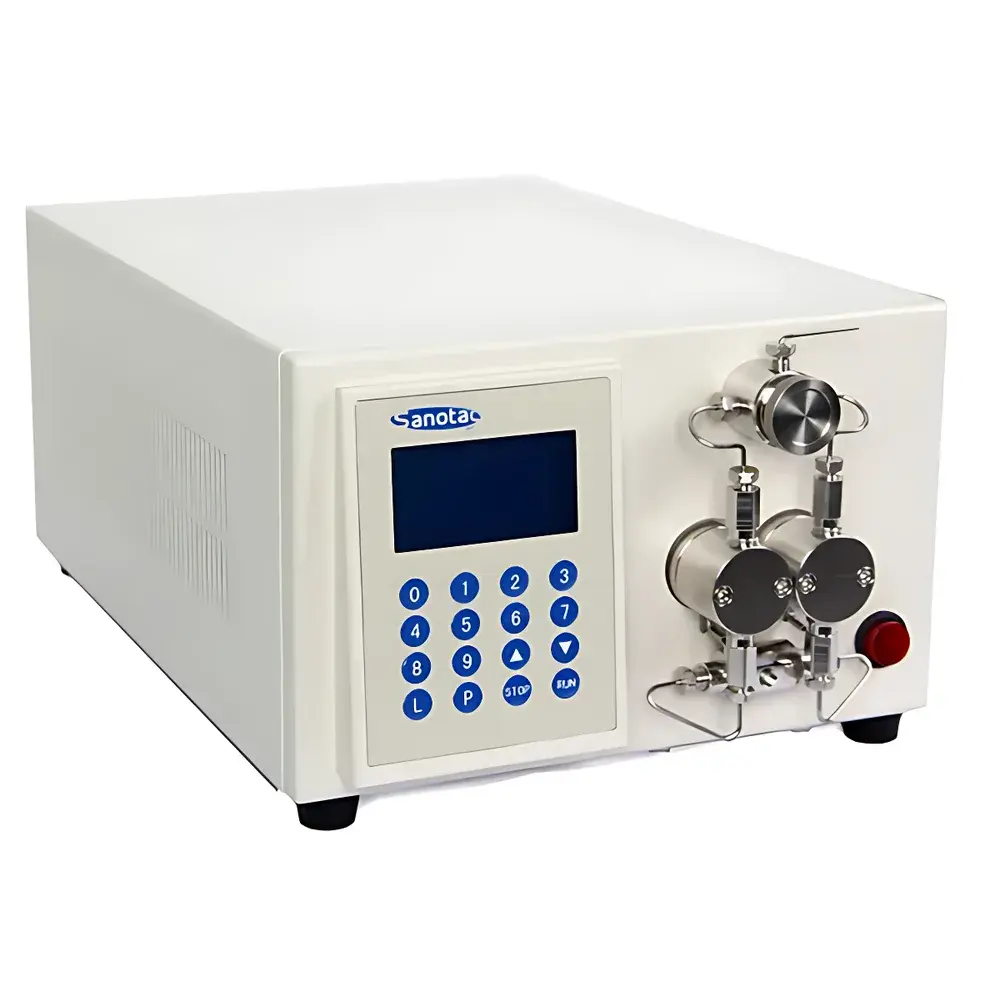
Sanotac SANOTAC Dual-Piston Medium-Pressure Constant Flow Pump
| Brand | Sanotac |
|---|---|
| Origin | Shanghai, China |
| Manufacturer Type | Direct Manufacturer |
| Product Origin | Domestic (China) |
| Model | SANOTAC |
| Price Range | USD 2,800 – 7,000 |
| Pressure Range | 0–2.0 MPa / 0–6 MPa / 0–10 MPa (selectable) |
| Flow Rate Range | 0.1–50.0 mL/min (standard) |
| Pressure Pulsation | ≤ 0.10 MPa |
| Pressure Accuracy | ≤ ±0.05 MPa |
| Flow Setting Error | ≤ ±1% |
| Flow Repeatability | ≤ ±1% |
| Weight | 12 kg |
| Dimensions | 360 mm × 260 mm × 160 mm |
| Wetted Materials | Sapphire balls & plungers, 316L stainless steel, zirconia ceramic, PEEK (optional pump head) |
| Communication Interface | RS232 |
| Safety Features | Built-in overpressure protection, automatic flow calibration |
| Display | Backlit LCD |
| Air Elimination | Integrated degassing module |
| Memory Function | Stores user-defined pressure/flow setpoints |
| PLC Compatibility | Yes |
| Software Capabilities | Real-time pressure curve plotting, dual-mode setpoint entry (numeric + incremental), timer-based operation scheduling, parameter logging, print-ready status reporting |
Overview
The Sanotac SANOTAC Dual-Piston Medium-Pressure Constant Flow Pump is an engineered solution for precise, pulse-minimized solvent delivery in analytical and preparative liquid chromatography systems, reaction synthesis platforms, and continuous-flow chemistry applications. Based on a dual-synchronized piston architecture, the pump operates on positive displacement principles with active compensation between compression and suction strokes—ensuring stable hydraulic output under variable backpressure conditions up to 10 MPa. Its design prioritizes long-term metrological integrity: sapphire-plunger assemblies resist wear and chemical degradation across organic, aqueous, and mildly corrosive mobile phases; zirconia ceramic check valves provide high-cycle durability; and 316L stainless steel fluid paths comply with ISO 8536-4 and ASTM F899 standards for metallic components in fluid handling systems. The pump meets fundamental requirements for GLP-compliant method development workflows where reproducible flow delivery is critical to retention time stability and peak shape fidelity.
Key Features
- Dual-piston synchronization mechanism reduces pressure pulsation to ≤ 0.10 MPa—critical for baseline stability in UV/VIS and mass spectrometric detection.
- Interchangeable wetted material configurations: standard sapphire/316L/zirconia path; optional PEEK pump head for enhanced compatibility with aggressive solvents (e.g., THF, DMF, concentrated acids).
- RS232 serial interface enables bidirectional communication with host PCs or programmable logic controllers (PLCs), supporting remote start/stop, real-time parameter readback, and firmware-upgradable control logic.
- Integrated overpressure cutoff circuit halts operation if system pressure exceeds user-defined threshold—preventing column damage and seal failure.
- Onboard flow calibration routine allows field verification and adjustment using gravimetric or volumetric reference methods per ISO 4021:2017.
- Backlit LCD panel displays real-time pressure (MPa), setpoint values, elapsed runtime, and error codes—supporting unattended overnight operation.
- Degassing manifold with adjustable venting valve minimizes entrained gas in low-viscosity solvents, reducing bubble-induced flow interruption and detector noise.
Sample Compatibility & Compliance
The SANOTAC pump accommodates a broad range of mobile phases used in HPLC, UHPLC, SFC, and process-scale purification—including acetonitrile, methanol, isopropanol, ethyl acetate, dichloromethane, and buffered aqueous solutions (pH 2–12). All fluid-contact surfaces are certified non-leaching per USP and pass extractables testing per ICH Q5C guidelines. The device conforms to IEC 61010-1:2010 for laboratory electrical equipment safety and includes CE marking for EMC and LVD compliance. For regulated environments, audit trails for flow/pressure setpoint changes can be exported via RS232 and archived in accordance with FDA 21 CFR Part 11 requirements when paired with validated third-party data acquisition software.
Software & Data Management
The embedded firmware supports two operational modes: manual keypad control and external command-driven execution. A dedicated PC application (Windows-compatible, no runtime dependencies) provides graphical visualization of pressure transients over time, configurable alarm thresholds, and timestamped export of operational logs (CSV format). Users may define up to 10 programmable methods—each storing pressure limits, flow profiles, duration timers, and pause/resume sequences. All parameters persist through power cycles due to non-volatile memory storage. The software includes built-in validation reports for flow accuracy verification and supports integration into LIMS environments via OPC UA gateway adapters.
Applications
- Preparative HPLC fraction collection requiring consistent eluent delivery across multi-hour gradients.
- Catalytic hydrogenation and photoredox flow reactors demanding stable reagent stoichiometry at elevated pressures.
- Automated sample introduction in ICP-MS and AAS systems where pulsation-induced signal drift must be minimized.
- Method transfer from analytical to semi-preparative scale, leveraging identical flow dynamics and material compatibility.
- Quality control laboratories performing pharmacopeial assays (USP , EP 2.2.46) requiring documented flow precision and traceable calibration records.
FAQ
What is the maximum allowable inlet pressure for this pump?
The pump is designed for ambient-pressure solvent reservoirs only; inlet pressure must remain ≤ 0.1 MPa (absolute) to ensure proper check valve sealing and prevent cavitation.
Can the pump operate continuously at its maximum rated pressure?
Yes—continuous operation at 10 MPa is supported provided ambient temperature remains within 15–30°C and cooling airflow is unobstructed around the motor housing.
Is flow rate calibration traceable to national standards?
Calibration procedures align with ISO/IEC 17025 requirements; users may perform verification using NIST-traceable flow meters or gravimetric standards (e.g., Class A volumetric flasks and analytical balances).
Does the pump support gradient mixing?
No—the SANOTAC is a single-channel constant-flow unit. Gradient functionality requires integration with an external low-dead-volume mixing tee and synchronized dual-pump configuration.
How often should the sapphire components be inspected?
Under typical HPLC usage (8 hrs/day, 5 days/week), visual inspection of sapphire balls and seats is recommended every 6 months; replacement intervals average 18–24 months depending on solvent aggressiveness and particulate load.



