
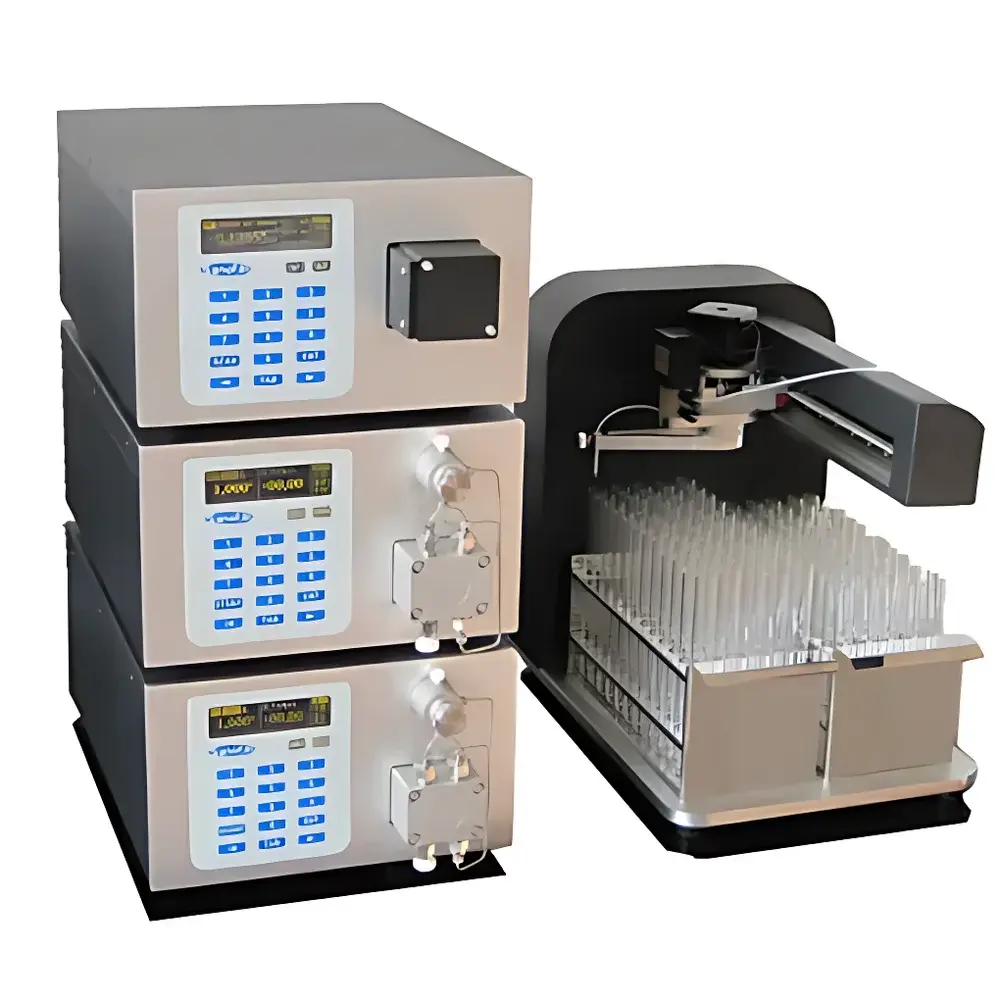
Sanotac LC2200 Binary High-Pressure Gradient Liquid Chromatography System
| Brand | Sanotac |
|---|---|
| Origin | Shanghai, China |
| Manufacturer Type | Original Equipment Manufacturer (OEM) |
| Product Category | Domestic |
| Model | LC2200 |
| Instrument Type | Conventional High-Performance Liquid Chromatograph (HPLC) |
| Application Profile | Dedicated-Use Analytical Instrument |
| Flow Rate Range | 0.001–9.999 mL/min (0.001 mL/min increments) |
| Maximum Operating Pressure | 42 MPa |
| Detector Wavelength Range | 190–700 nm (D₂ + W lamp) |
| Baseline Noise | ≤1×10⁻⁵ AU |
| Baseline Drift | ≤1.5×10⁻⁴ AU/hr |
| Flow Accuracy | ≤±1% |
| Flow Precision | ±0.5% |
| Flow RSD | ≤0.1% |
| Wavelength Accuracy | ±0.2 nm |
| Wavelength Repeatability | ±0.1 nm |
| Detection Range | 0–3 AU |
| Flow Cell Volume | 10 µL |
| Time Constant | 16-step adjustable |
| Auto-Zero | Full-scale |
Overview
The Sanotac LC2200 Binary High-Pressure Gradient Liquid Chromatography System is a robust, benchtop HPLC platform engineered for precision separation and quantitative analysis of small-molecule compounds in pharmaceutical, chemical, food safety, and environmental quality control laboratories. Based on the principles of reversed-phase liquid chromatography (RPLC), the system employs dual high-pressure solvent delivery with real-time gradient programming to resolve complex mixtures across wide polarity ranges. Its modular architecture integrates a microprocessor-controlled binary pump, dual-lamp UV-Vis detector with wavelength-time programming, manual Rheodyne 7725i injection valve, Kromasil C18 analytical column (250 × 4.6 mm, 5 µm), and fully compliant chromatography data system (CDS) software. Designed for routine QC/QA workflows, the LC2200 operates reliably at pressures up to 42 MPa (6090 psi), supporting method transfer from research to regulated environments under GLP and GMP-aligned practices.
Key Features
- Binary high-pressure gradient capability with independent pump synchronization—enables precise, reproducible solvent composition control across 0–100% B gradients, with optional expansion to quaternary configuration via system firmware and hardware interface.
- Dual-lamp UV-Vis detection (deuterium + tungsten) covering 190–700 nm; supports three acquisition modes: fixed-wavelength, dual-wavelength ratio, and time-programmed wavelength switching—minimizing baseline noise (≤1×10⁻⁵ AU) and drift (≤1.5×10⁻⁴ AU/hr) while extending linear dynamic range (0–3 AU).
- Floating plunger design with reinforced ceramic-coated plungers and self-aligning seals—reduces mechanical wear, extends seal life beyond 5,000 hours of continuous operation, and maintains flow stability under variable solvent compressibility conditions.
- High-fidelity fluidic control: dual-servo motor drive with real-time cavity pressure feedback compensates for solvent compressibility and refill dynamics, delivering flow accuracy ≤±1%, precision ±0.5%, and repeatability RSD ≤0.1% across the full 0.001–9.999 mL/min range.
- Intelligent front-panel interface with rotary encoder navigation and contextual soft keys—simplifies method setup, gradient verification via on-screen curve overlay, and real-time pressure/flow monitoring without PC dependency.
- Hot-swappable optical components: rapid lamp and flow cell replacement (<60 seconds) with automatic lamp recognition and spectral validation—maximizing instrument uptime and reducing maintenance downtime.
Sample Compatibility & Compliance
The LC2200 accommodates standard 4.6 mm ID analytical columns (including C18, C8, phenyl-hexyl, and HILIC phases) and supports mobile phases ranging from aqueous buffers (e.g., ammonium acetate, phosphate) to aggressive organic solvents (acetonitrile, methanol, THF). Its wetted parts—including pump heads, check valves, and detector flow cells—are constructed from chemically resistant stainless steel, sapphire, and PEEK—ensuring compatibility with pH 1.5–10.5 mobile phases and low-metal-leaching performance critical for trace-level analysis. The system meets core requirements for ISO/IEC 17025-accredited testing labs and supports audit-ready operation per FDA 21 CFR Part 11 when paired with validated software configurations (electronic signatures, audit trail, user access controls). It is routinely deployed in methods aligned with USP , EP 2.2.46, and ASTM D7260 for purity assessment, assay quantitation, and impurity profiling.
Software & Data Management
The included Sanotac Chromatography Data System (CDS) provides full method development, acquisition, processing, and reporting functionality. It supports ICH Q2(R2)-compliant validation parameters—including system suitability testing (SST) templates, peak symmetry calculation, resolution mapping, and tailing factor evaluation. Raw data files are stored in vendor-neutral .cdf format (compatible with OpenLab CDS, Chromeleon, and Empower import utilities). Audit trail logging records all user actions—including method edits, integration parameter changes, and reprocessing events—with timestamps and operator IDs. Data integrity safeguards include write-protection of raw acquisitions, electronic signature enforcement for report approval, and encrypted local database storage. Optional LIMS integration via ASTM E1384-compliant HL7 or CSV export enables seamless workflow handoff in centralized QA/QC environments.
Applications
- Pharmaceutical QC: Assay determination of active pharmaceutical ingredients (APIs), related substances testing per ICH Q3B, and residual solvent analysis (USP ).
- Food & Beverage: Quantification of preservatives (sorbic acid, benzoic acid), artificial sweeteners (aspartame, sucralose), mycotoxins (aflatoxin B1), and pesticide residues (e.g., organophosphates).
- Environmental Monitoring: Analysis of polycyclic aromatic hydrocarbons (PAHs), phthalate esters, and endocrine-disrupting compounds (bisphenol A, nonylphenol) in water and soil extracts.
- Chemical Synthesis Support: Reaction monitoring, crude mixture profiling, and purification fraction tracking during process development.
- Academic & Teaching Labs: Method development training, retention time prediction exercises, and column efficiency evaluation using van Deemter plots.
FAQ
What is the maximum operating pressure of the LC2200 system, and is it compatible with sub-2 µm particle columns?
The LC2200 supports up to 42 MPa (6090 psi), making it suitable for conventional 3–5 µm particles and select 2.7 µm superficially porous particles (e.g., Halo, Kinetex), but not recommended for sustained use with fully porous sub-2 µm columns requiring >60 MPa.
Does the system support gradient delay volume compensation during method transfer?
Yes—the CDS software includes built-in gradient dwell volume measurement tools and allows manual input of system dwell volume (default 1.2 mL) to align retention times across instruments.
Can the UV detector perform simultaneous dual-wavelength quantitation for multi-analyte methods?
Yes—dual-wavelength mode enables real-time ratio calculation (e.g., 220 nm / 275 nm) for peak purity assessment and co-elution correction without post-run reprocessing.
Is the software compliant with 21 CFR Part 11 out-of-the-box?
The base CDS supports Part 11 elements (audit trail, electronic signatures, role-based access); full compliance requires on-site validation documentation and IT infrastructure alignment per organizational SOPs.
What column oven options are available for temperature-controlled separations?
The LC2200 is compatible with third-party column ovens (e.g., Thermo Scientific, Waters) via standard 1/16″ tubing interfaces; integrated oven modules are available as optional accessories.






