
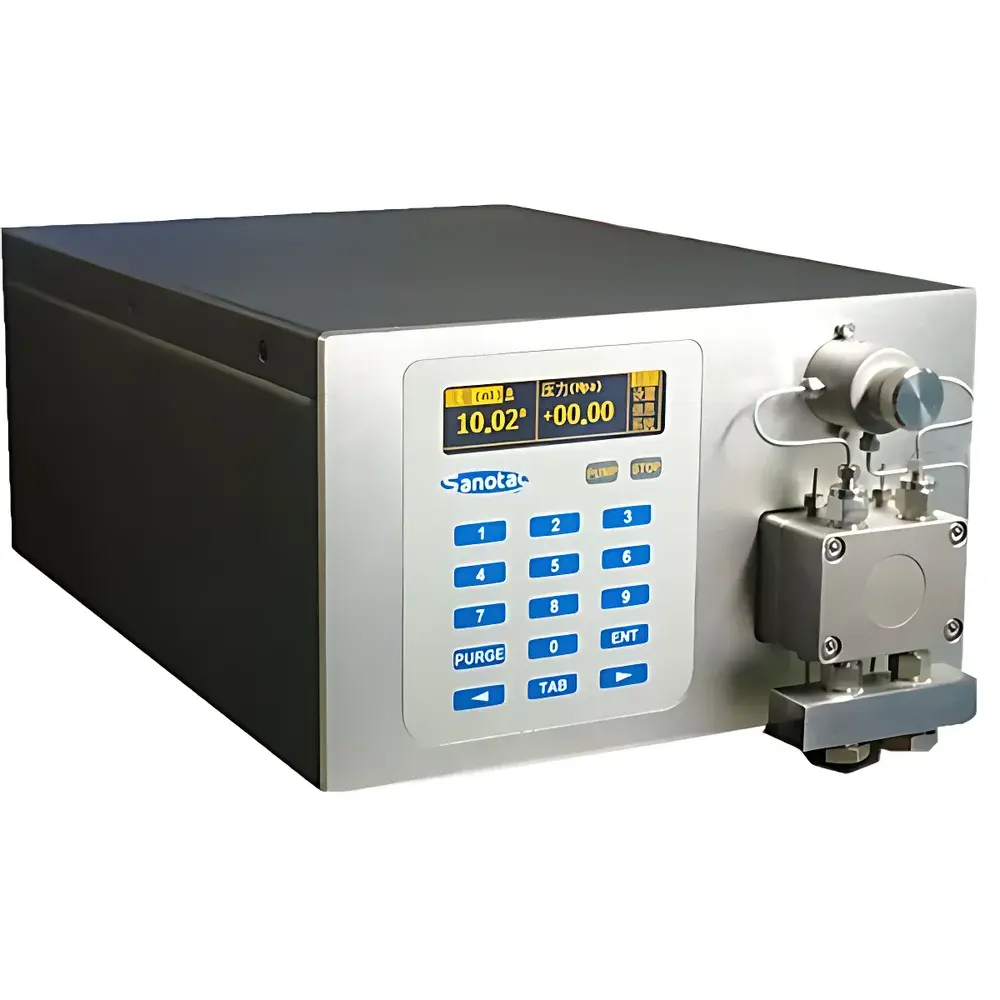
Sanotac SP0502 Semi-Preparative High-Pressure Solvent Delivery Pump
| Brand | Sanotac |
|---|---|
| Origin | Shanghai, China |
| Manufacturer Type | Direct Manufacturer |
| Model | SP0502 |
| Flow Rate | 0.01–50.00 mL/min |
| Increment | 0.01 mL/min |
| Flow Accuracy | ±0.5% |
| Flow RSD | ≤0.1% |
| Pressure Range | ≤2 MPa |
| Pressure Pulsation | ≤0.2 MPa |
| Drive Mechanism | Dual-Piston Series Configuration with Floating Piston Support |
| Tubing Connection | 1/16" Standard Fittings |
| Display | 256×64 Dot Matrix Self-Illuminating LCD with Adjustable Backlight |
| Control Interface | Front-Panel Keypad + RS-232/USB Computer Remote Control |
| Power Supply | 85–264 VAC, 50/60 Hz, 150 W |
Overview
The Sanotac SP0502 Semi-Preparative High-Pressure Solvent Delivery Pump is an engineered precision fluid handling system designed for robust, stable, and reproducible mobile phase delivery in preparative-scale liquid chromatography (LC), flash purification, and parallel synthesis workflows. Operating on a dual-piston series drive architecture with floating piston support, the pump minimizes mechanical wear at critical sealing interfaces—extending seal life while maintaining consistent hydraulic performance across extended duty cycles. Its pressure capability of up to 2 MPa (290 psi) supports medium-pressure chromatographic applications—including silica-based flash columns (up to 50 mm ID), reversed-phase C18 pre-packed cartridges, and ion-exchange resins—without requiring ultra-high-pressure infrastructure. The pump’s core function is volumetric displacement control: each piston stroke is precisely metered via high-resolution stepper motor actuation and position feedback, enabling accurate flow regulation independent of solvent compressibility or backpressure fluctuations within its operational envelope.
Key Features
- Dual-piston tandem configuration with dynamically balanced floating piston support—reduces lateral load on seals and enhances long-term mechanical stability.
- Wide, linear flow range from 0.01 to 50.00 mL/min with 0.01 mL/min resolution—optimized for both low-flow gradient elution and high-throughput sample loading.
- Flow accuracy of ±0.5% and repeatability (RSD) ≤0.1% under isocratic conditions—validated per ISO 5725-2 guidelines using certified flow meters and temperature-stabilized test solvents.
- Low-pressure pulsation (≤0.2 MPa peak-to-peak) achieved through active pulse dampening and synchronized piston phasing—critical for baseline stability in UV detection and fraction collector triggering.
- Self-illuminating 256×64 dot-matrix LCD display with uniform brightness across viewing angles and user-adjustable backlight intensity—enabling clear parameter verification in ambient laboratory lighting or glove-box environments.
- Flexible control architecture supporting standalone operation via tactile keypad or external command via RS-232/USB interface—compatible with common chromatography data systems (CDS) and custom LabVIEW or Python-based automation scripts.
Sample Compatibility & Compliance
The SP0502 is compatible with common LC-grade organic solvents (acetonitrile, methanol, THF, ethyl acetate), aqueous buffers (pH 2–9), and mildly corrosive mobile phases when used with standard 316L stainless steel and PEEK wetted materials. It meets CE marking requirements for electromagnetic compatibility (EN 61326-1) and low-voltage safety (EN 61010-1). While not certified for GMP manufacturing environments, its design supports GLP-aligned documentation practices: all flow and pressure setpoints are digitally logged during computer-controlled runs, and firmware retains audit trail metadata (timestamp, operator ID placeholder, parameter change history) compliant with FDA 21 CFR Part 11 Annex 11 principles when integrated into validated CDS platforms.
Software & Data Management
The pump communicates via ASCII-based command protocol over RS-232 or USB virtual COM port. Sanotac provides a Windows-compatible configuration utility for firmware updates, calibration offset adjustment, and method file import/export (.txt). When interfaced with third-party CDS software (e.g., Chromeleon, Empower, OpenLab), the SP0502 responds to standard SCPI-like commands for flow ramping, pressure limit enforcement, and status polling. All real-time operational parameters—including actual flow rate, measured pressure, motor step count, and error codes—are accessible via serial query, enabling integration into automated QA/QC workflows with traceable digital records.
Applications
- Semi-preparative HPLC purification of natural products, pharmaceutical intermediates, and synthetic peptides (1–5 g scale).
- Automated flash chromatography systems requiring precise gradient formation and multi-solvent switching.
- Process development studies where flow consistency directly impacts fraction purity and column loading efficiency.
- Multi-pump solvent blending for ternary or quaternary mobile phase generation in method scouting.
- Integration into custom-built reaction monitoring setups coupling LC separation with inline UV/Vis or conductivity detection.
FAQ
What is the maximum recommended operating pressure for continuous use?
The SP0502 is rated for continuous operation up to 2 MPa (290 psi); sustained pressure above 1.8 MPa is advised only with full-system validation including tubing integrity, fitting torque, and solvent compatibility.
Can the pump be used with aggressive solvents such as DMSO or concentrated acids?
DMSO is compatible; however, prolonged exposure to >10% TFA, >0.1 M HCl, or oxidizing agents (e.g., perchloric acid) requires optional Hastelloy C-276 pump head components—not standard on the base model.
Is flow calibration traceable to national standards?
Yes—Sanotac provides optional NIST-traceable calibration certificates (ISO/IEC 17025 accredited lab) upon request, covering flow rate verification at three points (1, 25, and 50 mL/min) using gravimetric measurement.
Does the pump support gradient programming natively?
No—the SP0502 is a single-channel isocratic pump; gradient functionality requires external solvent selection valves or integration with a multi-pump binary/quaternary blending system.
What maintenance intervals are recommended for routine operation?
Piston seals should be inspected every 500 hours of cumulative runtime; replacement is typically required every 1,000–1,500 hours depending on solvent abrasiveness and daily pressure profile. Full preventive maintenance (including check valve cleaning and motor alignment check) is advised annually.



