
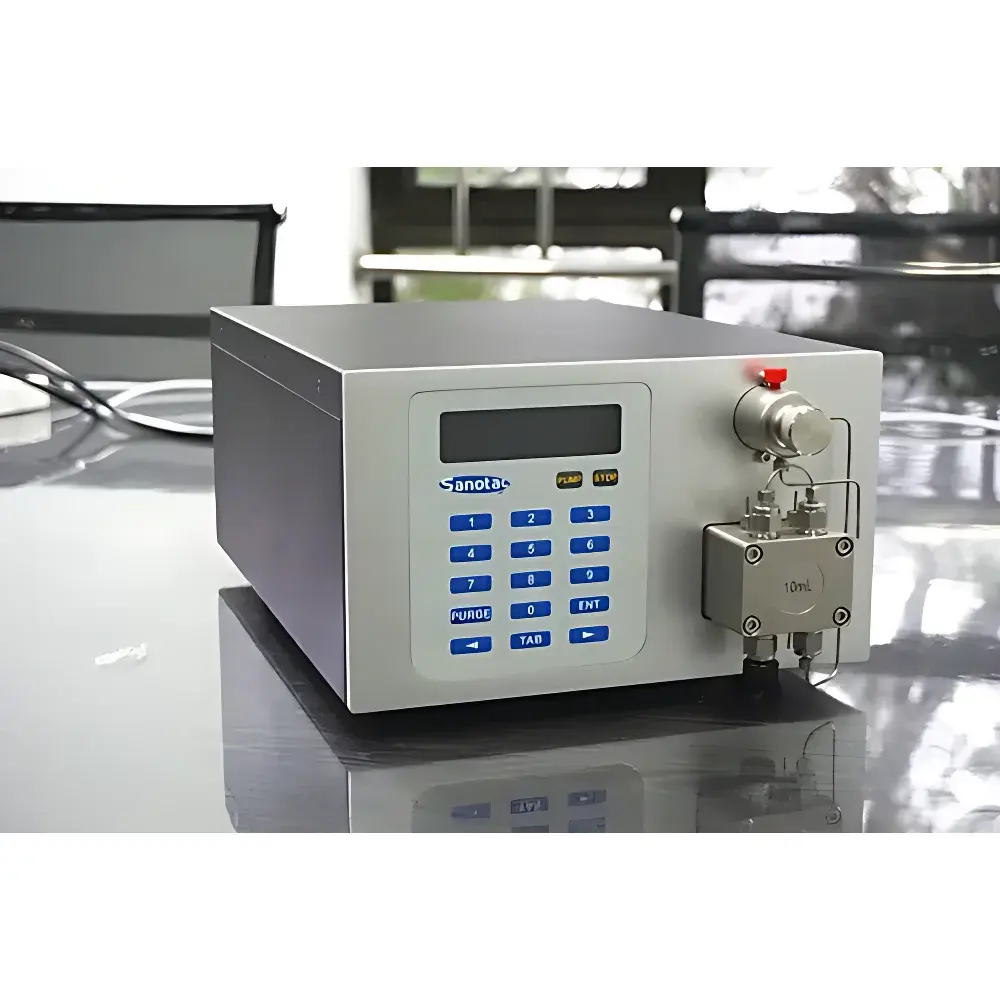
Sanotac N200 High-Pressure Infusion Pump for Nanoliposomal Drug Formulation and Nucleic Acid Delivery Systems
| Brand | Sanotac |
|---|---|
| Origin | Shanghai, China |
| Manufacturer Type | OEM/ODM Manufacturer |
| Country of Origin | China |
| Model | N200 |
| Flow Rate | 0.01–200.00 mL/min |
| Pressure Range | ≤ 10 MPa |
| Pressure Pulsation | ≤ 0.2 MPa |
| Flow Accuracy | ±0.5% |
| Flow Precision (RSD) | ≤ 0.1% |
| Infusion Mode | Dual-piston parallel with floating piston design |
| Increment Resolution | 0.01 mL/min |
| Wetted Materials | 316L stainless steel, ruby, PTFE, ceramic |
| Tubing Connection | 1/16" standard |
| Display | 256×64 dot matrix backlit LCD |
| Communication Interfaces | RS232, USB (standard) |
| Protocols | Modbus RTU/ASCII, Profibus-DP, Profinet |
| Power Supply | 85–264 VAC, 50 Hz |
| Dimensions | 370 × 240 × 152 mm |
Overview
The Sanotac N200 High-Pressure Infusion Pump is an engineered precision fluid delivery system designed specifically for continuous, stable, and programmable high-pressure operation in advanced nanomedicine manufacturing workflows. It operates on a dual-piston parallel architecture with floating piston technology—enabling true constant-flow performance under dynamic load conditions typical of lipid nanoparticle (LNP) formation. Unlike conventional peristaltic or syringe pumps, the N200 delivers consistent volumetric displacement across its full pressure range (up to 10 MPa / 1450 psi), making it suitable as the primary motive source for microfluidic mixing platforms used in mRNA-LNP encapsulation, liposome extrusion, and controlled solvent displacement processes. Its core function is to precisely meter and co-infuse aqueous (e.g., ionized mRNA buffer) and organic (e.g., ethanol-dissolved lipid) phases at defined flow ratios and pressures—inducing rapid turbulent mixing within microchannels or homogenization cells to yield monodisperse LNPs with reproducible size distribution (typically 70–120 nm), encapsulation efficiency (>90%), and low polydispersity index (PDI < 0.15).
Key Features
- Dual-piston parallel pumping mechanism with real-time cam-profile compensation and electronic flow pulsation suppression—ensuring pressure stability ≤ 0.2 MPa and flow repeatability ≤ 0.1% RSD.
- Programmable dual-mode operation: constant-flow mode for steady-state infusion; gradient-flow mode for staged composition transitions during multi-phase formulation protocols.
- User-accessible calibration zone enabling field-adjustable flow rate correction across viscosity ranges (1–500 cP), critical for handling lipid-ethanol mixtures and nucleic acid buffers.
- Configurable pressure monitoring with upper/lower limit alarms and automatic shutdown—compliant with ISO 13485 risk management requirements for medical device manufacturing environments.
- Modular communication architecture supporting industrial automation integration via RS232, USB (standard), and optional RS485/RS422/Ethernet interfaces with native support for Modbus RTU/ASCII, Profibus-DP, and Profinet protocols.
- Chemically inert wetted path constructed from 316L stainless steel, sapphire check valves, PTFE seals, and ceramic plungers—validated for compatibility with ethanol, isopropanol, chloroform, and acidic/basic aqueous buffers (pH 2–12).
Sample Compatibility & Compliance
The N200 is routinely deployed in GMP-aligned LNP process development labs where regulatory traceability and equipment qualification are mandatory. Its hardware and firmware architecture supports 21 CFR Part 11-compliant audit trails when integrated with validated SCADA or DCS systems (e.g., Siemens SIMATIC PCS 7, Rockwell FactoryTalk). The pump meets IEC 61000-6-2 (EMC immunity) and IEC 61000-6-4 (EMC emission) standards. All materials contacting process fluids conform to USP Class VI biocompatibility testing and FDA 21 CFR 177.2400 (food-contact polymers). For pharmaceutical applications, the system supports IQ/OQ documentation packages and can be qualified per ASTM E2500-13 (Good Automated Manufacturing Practice) and ISO 14644-1 Class 7 cleanroom installation guidelines.
Software & Data Management
The N200 operates without proprietary software—instead relying on open protocol stacks to interface with third-party control environments. Pre-validated integration examples include LabVIEW 2020+ (NI-Modbus API), Siemens TIA Portal v17 (Profinet IO controller), and Ignition SCADA (Modbus TCP driver). Real-time pressure and flow data streams are timestamped and output at 10 Hz resolution via serial or Ethernet, enabling synchronization with particle sizers (e.g., Malvern Zetasizer), pH monitors, or temperature loggers in closed-loop process analytical technology (PAT) frameworks. Optional firmware upgrades provide CSV export capability for raw sensor logs and support for alarm event logging with user-defined tags—facilitating root cause analysis during batch record review.
Applications
- mRNA-LNP formulation via microfluidic mixing (e.g., NanoAssemblr®, Precision Nanosystems systems)
- Cationic liposome preparation for siRNA and pDNA delivery
- Hot-melt extrusion-assisted lipid nanoparticle synthesis
- Controlled precipitation of polymeric nanoparticles (PLGA, chitosan)
- High-pressure homogenization feed for nanoemulsion stabilization
- Automated QC sampling in continuous manufacturing lines for sterile injectables
FAQ
What is the maximum allowable backpressure for continuous operation?
The N200 is rated for continuous operation up to 10 MPa (1450 psi) at ambient temperatures between 15–30°C. Sustained operation above 8 MPa requires active cooling of the pump head and verification of seal integrity per maintenance schedule.
Can the pump handle viscous lipid solutions (e.g., 10–20% w/v in ethanol)?
Yes—the floating piston design and cam-compensated drive train maintain accuracy across viscosities from 1 cP (aqueous buffer) to 450 cP (concentrated lipid ethanol solution), provided tubing ID ≥ 0.02″ and pre-filtration ≤ 0.45 µm is implemented.
Is the system compatible with PAT-based real-time release testing (RTRT)?
When integrated with a validated DCS and time-synchronized data historian, the N200’s analog output signals (4–20 mA pressure/flow) and digital Modbus registers meet ASTM E2656-20 criteria for use in RTRT strategies compliant with ICH Q5A(R2) and Q5C.
Does Sanotac provide IQ/OQ documentation templates?
Yes—Sanotac supplies vendor-qualified IQ/OQ protocols aligned with ASTM E2500-13, including test scripts for flow accuracy verification (gravimetric method per USP <1058>), pressure transducer calibration traceability (NIST-traceable deadweight tester), and communication interface validation.
What maintenance intervals are recommended for GMP environments?
Per Sanotac Maintenance Manual Rev. 4.2: piston seal replacement every 500 operational hours; ruby valve inspection every 250 hours; full wetted-path cleaning with 70% IPA after each batch when processing clinical-grade material.



