
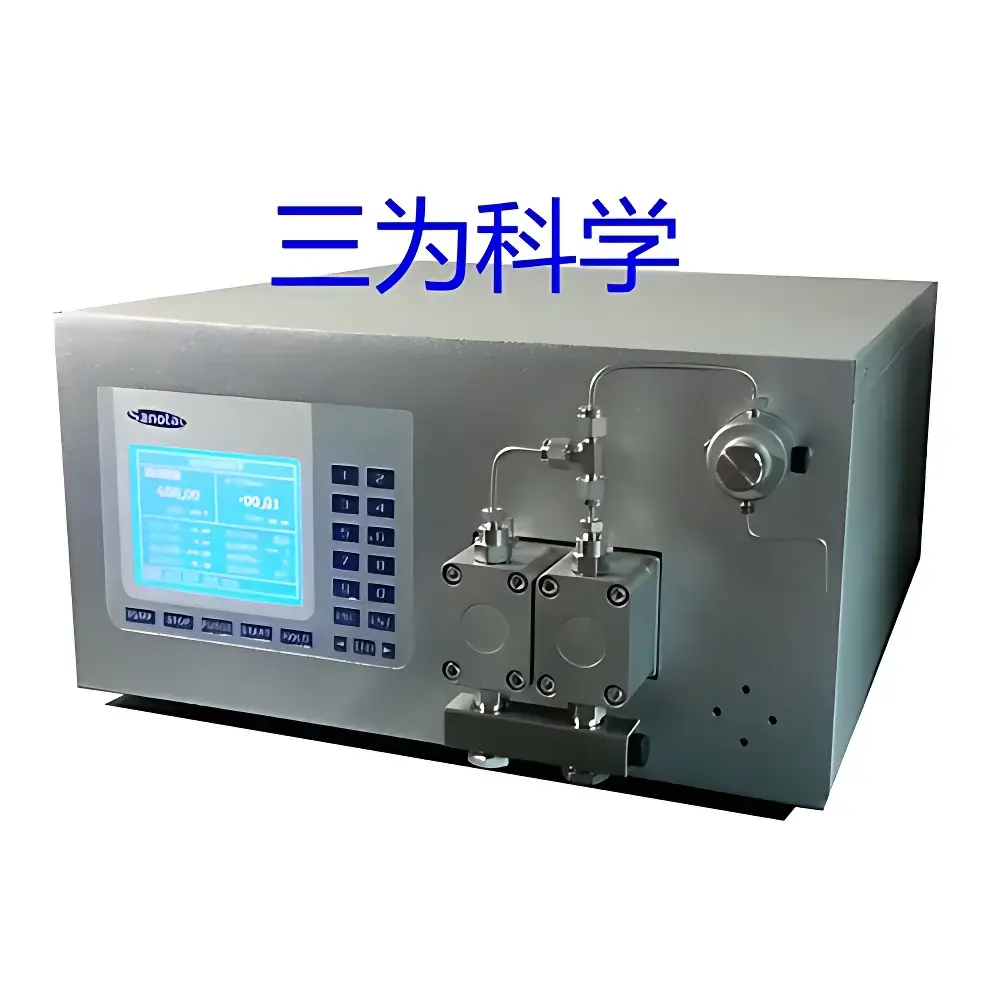
Sanotac GS0530 High-Pressure Constant-Flow Pump for Tubular Reactor Systems
| Brand | Sanotac |
|---|---|
| Origin | Shanghai, China |
| Manufacturer Type | Direct Manufacturer |
| Product Category | Domestic |
| Model | GS0530 |
| Flow Rate | 0.01–50.00 mL/min |
| Pressure Rating | ≤ 30 MPa |
| Flow Accuracy | ±0.5% |
| Flow Precision | ≤ 0.1% |
| Pressure Pulsation | ≤ 0.2 MPa |
| Wetted Materials | 316L Stainless Steel, Sapphire, PTFE, Ceramic |
| Connection | 1/16″ Standard Fitting |
| Display | 256×64 Dot Matrix OLED |
| Control | Local Keypad or Computer Reverse Control (Open Protocol) |
| Power Supply | 85–264 VAC, 50 Hz |
| Dimensions | 370 × 240 × 152 mm |
Overview
The Sanotac GS0530 High-Pressure Constant-Flow Pump is an engineered solution designed specifically for precise fluid delivery in continuous-flow chemical synthesis systems—particularly tubular reactors requiring stable, pulse-free, high-pressure liquid transport. Operating on a dual-piston parallel drive architecture with floating plunger technology, the pump delivers consistent volumetric flow across a wide dynamic range (0.01–50.00 mL/min) while maintaining pressure stability up to 30 MPa. Its core principle relies on positive displacement via synchronized reciprocating pistons, combined with real-time solvent compressibility compensation and multi-point flow calibration algorithms. This enables accurate metering of viscous reagents, catalyst solutions, supercritical fluids (e.g., CO₂), and reactive slurries—essential for kinetic studies, heterogeneous catalysis, and process intensification in lab-scale tubular reactor configurations such as coil-type, U-tube, multi-tube parallel, and packed-bed variants.
Key Features
- Dual-piston parallel pumping mechanism with floating plunger design minimizes seal wear and extends service life under sustained high-pressure operation.
- Microprocessor-controlled flow regulation incorporating cam-profile pulsation compensation and electronic flow ripple suppression ensures pressure pulsation ≤ 0.2 MPa—even at maximum output.
- Multi-point flow calibration across the full operational range (0.01–50 mL/min) guarantees flow accuracy of ±0.5% and repeatability ≤ 0.1% (RSD).
- Open communication protocol supports bidirectional computer control via RS232 or optional Ethernet interface; compatible with third-party chromatography data systems (CDS) and custom LabVIEW or Python-based automation frameworks.
- Front-panel interface features a self-illuminating 256×64 dot-matrix OLED display and 10 user-programmable methods for gradient elution profiles—including linear, step, and composite gradients—enabling flexible reaction parameter modulation.
- Chemically resistant fluid path constructed from 316L stainless steel, sapphire check valves, PTFE seals, and ceramic components ensures compatibility with aggressive solvents (e.g., concentrated acids, halogenated organics) and particulate-laden feeds.
Sample Compatibility & Compliance
The GS0530 accommodates a broad spectrum of process fluids relevant to continuous-flow chemistry: low-viscosity solvents (e.g., methanol, THF), high-boiling-point media (e.g., DMSO, glycerol), suspensions of solid catalysts (e.g., Pd/C, Ni nanoparticles), and supercritical CO₂ mixtures. Its wetted materials meet ASTM F2136 and ISO 10993-5 biocompatibility screening requirements for non-implantable devices. While not certified for GMP manufacturing environments, the pump’s traceable calibration records, audit-ready event logging (via optional software), and adherence to IEC 61000-6-3 EMC standards support GLP-compliant laboratory operations. It is routinely deployed in applications aligned with ASTM D6304 (water determination), ISO 11348 (toxicity testing), and USP method development protocols where controlled reagent addition is critical.
Software & Data Management
The pump supports standalone operation via its embedded keypad or integration into larger process control ecosystems. The open reverse-control protocol allows seamless incorporation into SCADA platforms or custom Python/Node-RED workflows. Optional Sanotac PumpControl Suite (v3.2+) provides time-stamped flow/pressure logging, method archiving, digital signature-enabled report generation, and 21 CFR Part 11-compliant user access controls—including role-based permissions, electronic signatures, and immutable audit trails. All configuration changes and operational events are timestamped and stored locally on internal flash memory (16 MB), with export options via USB or network transfer.
Applications
- Continuous-flow hydrogenation and oxidation reactions in coiled or multi-tube tubular reactors.
- Precise dosing of initiators and monomers in controlled radical polymerization (e.g., ATRP, RAFT).
- Supercritical fluid processing—including extraction, impregnation, and nanoparticle synthesis using scCO₂.
- Catalytic cracking and Fischer–Tropsch model studies requiring long-duration, stable feed delivery under elevated pressure.
- Electrochemical flow cell feeding with strict stoichiometric control for CO₂ reduction or water splitting experiments.
- High-pressure microreactor arrays for rapid catalyst screening and kinetic parameter estimation (e.g., Arrhenius plots, residence time distribution analysis).
FAQ
What is the maximum allowable backpressure for continuous operation?
The GS0530 is rated for continuous duty at pressures up to 30 MPa; however, sustained operation above 25 MPa requires active cooling of the pump head and verification of solvent thermal stability.
Can the pump handle abrasive slurries or particulates?
Yes—when equipped with optional ceramic plungers and sapphire valves, it tolerates particles ≤ 5 µm in diameter at concentrations up to 5 wt%, provided upstream filtration (≤ 1 µm) is implemented.
Is gradient programming limited to binary solvent systems?
No—the pump supports up to four independently programmable flow channels when integrated with Sanotac’s multi-solvent manifold modules, enabling ternary and quaternary gradient formation.
How is flow calibration verified and documented?
Calibration follows ISO 4064-2 procedures using gravimetric measurement against NIST-traceable analytical balances; certificates include uncertainty budgets and temperature-compensated correction factors.
Does the pump comply with explosion-proof requirements for hazardous area use?
The base model is rated for Class I, Division 2 environments per UL 1203; ATEX/IECEx certification requires factory-installed intrinsically safe barrier kits and is available upon request.



