
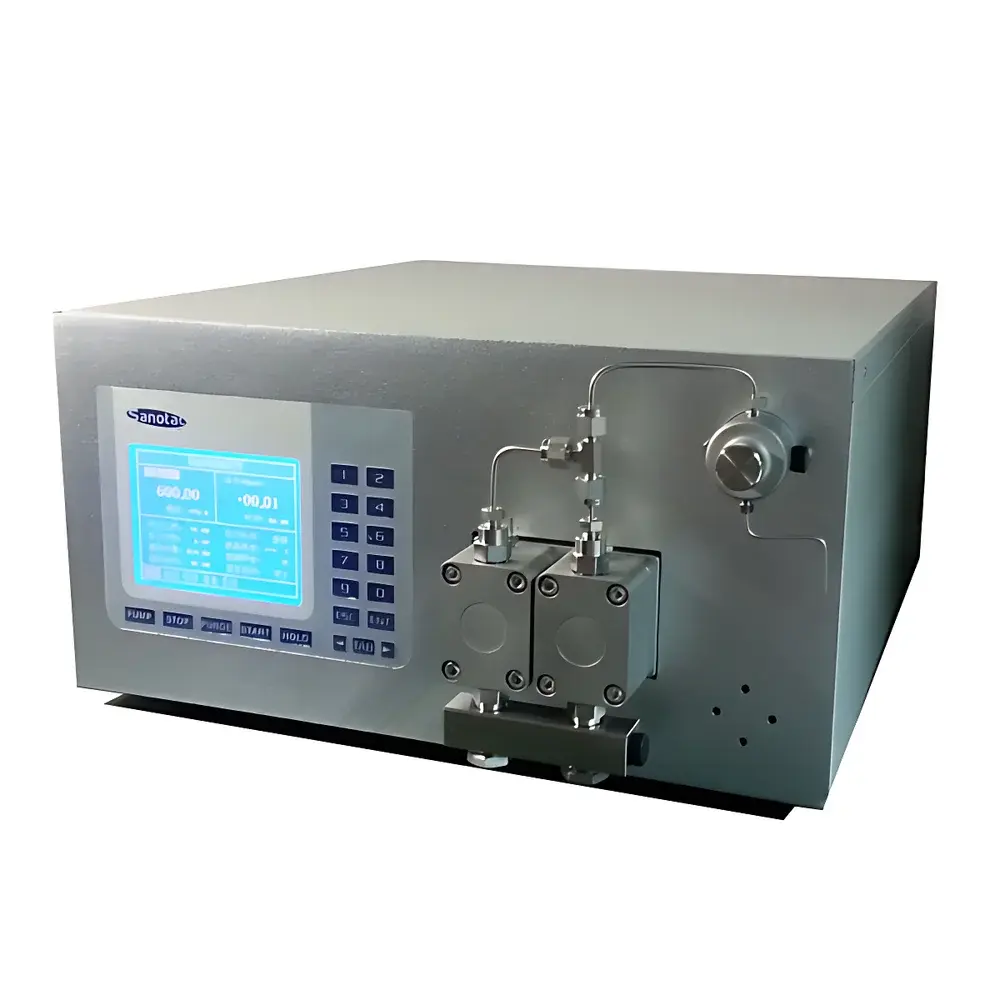
Sanotac TSP6010 High-Pressure Constant Flow Pump
| Brand | Sanotac |
|---|---|
| Origin | Shanghai, China |
| Manufacturer Type | OEM Manufacturer |
| Model | TSP6010 |
| Max. Pressure | 10 MPa |
| Pump Head Volume | 600 mL |
| Flow Rate Range | 0.001–600 mL/min (typical, dependent on fluid compressibility and system backpressure) |
| Flow Accuracy | ≤ ±0.3% RSD (at ≥1 mL/min, water, 25 °C) |
| Pressure Pulsation | < 0.5% (measured at 10 MPa, 1 mL/min, water) |
| Gradient Capability | Isocratic, Linear, Step, and Custom Multi-Segment Gradient Profiles |
| Control Interface | RS-232/RS-485, Analog 0–5 V / 4–20 mA, Optional USB/Ethernet Module |
| Programmable Methods | 10 Internal Methods with Flow & Gradient Scheduling |
| Valve Type | Imported Swiss Check Valves |
| Sealing Architecture | Floating Plunger Design with Dual-Cam Drive |
| Compliance | Designed to support GLP/GMP workflows |
Overview
The Sanotac TSP6010 High-Pressure Constant Flow Pump is an industrial-grade dual-plunger reciprocating pump engineered for precise, pulse-minimized solvent delivery in demanding analytical and process applications. Based on positive displacement principle with cam-driven parallel plunger architecture, the TSP6010 delivers stable volumetric flow across a wide dynamic range—from trace-level micro-injection (0.001 mL/min) to high-throughput process feeding (up to 600 mL/min)—while maintaining ≤ ±0.3% relative standard deviation in flow accuracy under calibrated conditions. Its 10 MPa maximum pressure rating and 600 mL pump head capacity make it suitable for high-backpressure liquid chromatography systems, continuous-flow catalytic reactors, supercritical fluid processing, and controlled reagent dosing in R&D-scale chemical synthesis. The pump operates on a closed-loop control strategy integrating real-time solvent compressibility compensation and multi-point flow calibration curves, ensuring reproducible delivery regardless of mobile phase composition or temperature drift.
Key Features
- Dual independent plunger heads driven by precision-machined dual-cam mechanism, enabling true parallel operation and enhanced mechanical longevity.
- Floating plunger assembly reduces radial load on high-pressure seals, extending seal service life by up to 3× compared to fixed-plunger configurations.
- Integrated electronic pulse suppression algorithm combined with optimized cam profile compensation achieves pressure pulsation < 0.5% at full load—critical for baseline stability in UV/VIS detection and mass spectrometry coupling.
- Microprocessor-based controller supports 10 user-defined methods with programmable flow ramps, gradient slope modulation, hold times, and pause/resume logic.
- Open communication protocol (ASCII-based RS-232/485) enables seamless integration with third-party chromatography data systems (CDS), LIMS, or custom SCADA platforms without proprietary driver dependencies.
- Swiss-sourced sapphire-faced check valves ensure long-term chemical compatibility with aggressive solvents (e.g., THF, DMF, concentrated acids/bases) and resistance to particulate-induced wear.
Sample Compatibility & Compliance
The TSP6010 is compatible with aqueous, organic, and mixed-phase solvents commonly used in HPLC, SFC, and preparative chromatography—including acetonitrile, methanol, ethanol, isopropanol, ethyl acetate, CO₂ (in supercritical mode), and aqueous buffers containing up to 0.5 M salt concentration. Wetted materials include 316L stainless steel, sapphire, PEEK, and chemically resistant elastomers (e.g., FFKM). While not certified as a medical device, the pump’s design adheres to key elements of ISO 9001 manufacturing controls and supports audit-ready documentation practices required under GLP (OECD 1998) and GMP (ICH Q7) frameworks. When paired with validated CDS software featuring electronic signatures, audit trails, and role-based access control, the system meets functional requirements for 21 CFR Part 11 compliance in regulated laboratories.
Software & Data Management
The TSP6010 operates autonomously via its embedded firmware interface or externally via ASCII command set over serial or analog I/O. No proprietary software installation is required for basic operation. For advanced workflow automation, Sanotac provides SDK documentation and example scripts (Python, LabVIEW, MATLAB) supporting TCP/IP and Modbus RTU extensions. All method parameters—including flow rate profiles, gradient tables, pressure limits, and valve switching events—are stored in non-volatile memory with timestamped version history. Real-time pressure and flow status can be logged at user-defined intervals (1 Hz to 1 min resolution) and exported in CSV format for post-run analysis or statistical process control (SPC) charting.
Applications
- HPLC and UHPLC system integration as primary or auxiliary pump in binary/quaternary gradient configurations.
- Continuous-flow catalysis: metered co-feeding of catalyst precursors, ligands, and substrates into micro/meso-reactors under elevated pressure and temperature.
- Supercritical fluid extraction (SFE) and impregnation systems requiring stable CO₂ or CO₂/co-solvent delivery at 10–30 MPa (when used with external pressure intensifiers).
- Electrochemical synthesis cells where precise stoichiometric reagent addition directly impacts Faradaic efficiency and product selectivity.
- Material science research: controlled polymerization initiator dosing, nanoparticle precursor injection in hot-injection synthesis, and battery electrolyte formulation validation.
- Industrial pilot-scale applications including foam extrusion, inkjet formulation dispensing, and membrane permeability testing under constant transmembrane pressure.
FAQ
What is the maximum allowable inlet pressure for the TSP6010?
The pump is designed for atmospheric or slightly pressurized (≤ 0.3 MPa) solvent reservoirs. Positive inlet pressure beyond this may compromise check valve integrity and void warranty.
Can the TSP6010 be used with viscous fluids such as glycerol or polymer solutions?
Yes—within operational limits. Viscosity > 20 cP requires reduced maximum flow rates and careful priming; pre-filtration through ≤ 0.45 µm filters is mandatory to prevent check valve clogging.
Is firmware upgrade supported in-field?
Yes. Firmware updates are delivered as HEX files and applied via RS-232 using Sanotac’s documented bootloader procedure—no hardware modification required.
Does the pump support automatic leak detection or pressure fault shutdown?
It features configurable over-pressure cutoff (user-settable threshold between 1–10 MPa) and stall detection via current monitoring, but lacks integrated fluid leak sensors.
How is flow calibration performed?
Calibration follows ASTM D3427-18 methodology: gravimetric measurement of dispensed mass over time using certified analytical balance (±0.1 mg), corrected for fluid density and temperature, with multi-point curve fitting stored in pump memory.



