
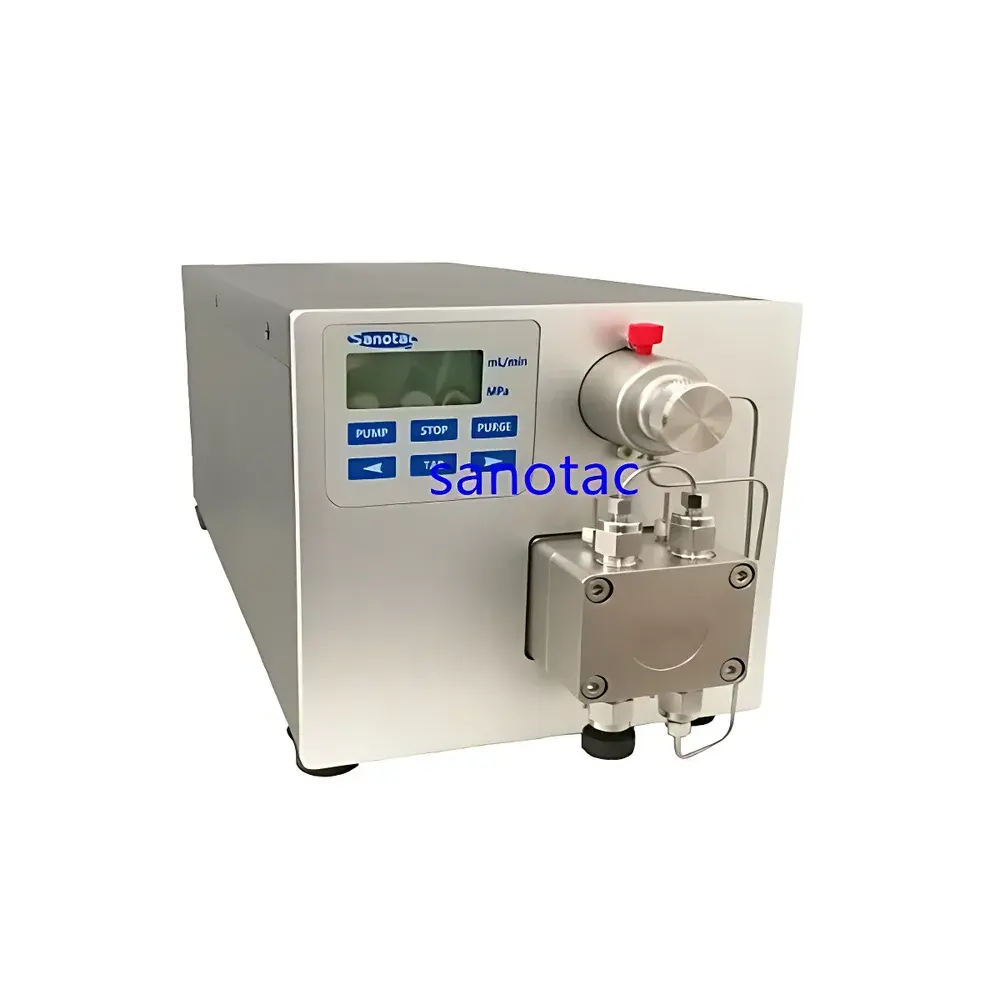
Sanotac WS0010 Analytical High-Pressure Syringe Pump
| Brand | Sanotac |
|---|---|
| Origin | Shanghai, China |
| Manufacturer Type | Direct Manufacturer |
| Product Origin | Domestic (China) |
| Model | WS0010 |
| Price Range | USD 1,400 – 2,800 |
| Flow Rate Range | 0.001–9.999 mL/min |
| Flow Increment | 0.001 mL/min |
| Flow Accuracy | ±0.1% |
| Flow Precision (RSD) | ≤0.1% |
| Maximum Pressure | 42 MPa |
| Pressure Pulsation | ≤0.1 MPa |
| Pump Head Volume | 10 mL |
| Pumping Mechanism | Dual-piston serial configuration with floating piston design |
| Wetted Materials | 316L stainless steel, sapphire, PTFE, ceramic |
| Tubing Connection | 1/16" standard fittings |
| Display | 256×64 dot matrix backlit LCD |
| Control Interface | Front-panel keypad + RS232/USB computer remote control (open communication protocol) |
| Power Supply | 85–264 VAC, 50 Hz |
| Dimensions | 370 × 240 × 152 mm |
Overview
The Sanotac WS0010 Analytical High-Pressure Syringe Pump is an engineered solution for precise, low-volume, high-pressure liquid delivery in analytical and preparative chromatographic systems. Designed around a dual-piston serial architecture with floating piston mechanics, the pump operates on positive displacement principles to deliver stable, pulse-minimized flow across a wide dynamic range—from nanoliter-per-minute microflow regimes up to 9.999 mL/min—while maintaining continuous pressure capability up to 42 MPa (6,090 psi). Its core application domain includes HPLC, UHPLC, SFC, and microfluidic interface systems where reproducible solvent delivery, gradient fidelity, and long-term seal integrity are critical under elevated backpressure conditions. The pump’s mechanical design incorporates cam-profile compensation and real-time electronic flow pulsation suppression, enabling consistent laminar delivery even at sub-mL/min flow rates typical of capillary and nano-LC workflows.
Key Features
- Dual-piston serial pumping mechanism with floating piston design—reduces radial load on seals and extends service life of high-pressure sealing components.
- Microprocessor-controlled operation with multi-point flow calibration curves, compensating for solvent compressibility across viscosity and pressure gradients.
- Low-pressure pulsation performance (≤0.1 MPa), achieved via synchronized cam profile optimization and active electronic flow stabilization.
- Open-protocol RS232/USB interface supporting bidirectional communication; compatible with third-party chromatography data systems (CDS) and custom LabVIEW or Python-based control environments.
- Front-panel programmability with ten user-defined methods—including flow rate ramps, multi-step gradients (isocratic, linear, step), dwell volume compensation, and hold functions.
- Chemically inert fluid path constructed from 316L stainless steel, sapphire check valves, PTFE seals, and ceramic components—ensuring compatibility with aggressive solvents (e.g., THF, DCM, TFA, high-pH buffers) and minimizing metal ion leaching.
Sample Compatibility & Compliance
The WS0010 is validated for use with aqueous, organic, and mixed mobile phases common in reversed-phase, HILIC, and ion-pairing chromatography. Its wetted materials meet USP Class VI biocompatibility requirements for non-implantable devices and conform to ISO 10993-5 cytotoxicity screening standards. While not certified as GMP-compliant out-of-the-box, the pump supports GLP/GMP-aligned operational practices when integrated into validated systems: audit-trail-capable CDS software can log all parameter changes, run sequences, and error events. Its open communication protocol enables integration with FDA 21 CFR Part 11–compliant platforms when paired with appropriate electronic signature and system validation documentation.
Software & Data Management
The pump operates autonomously via its embedded firmware but is fully controllable through external software using ASCII-based command sets documented in the publicly available communication protocol manual. No proprietary drivers are required—standard terminal emulators or Python serial libraries (e.g., PySerial) suffice for scripting. When used with commercial chromatography workstations (e.g., Chromeleon, Empower, OpenLab), it accepts standard command syntax for method loading, start/stop triggering, and real-time status polling (pressure, flow, valve position). All parameter modifications are timestamped internally and accessible via query commands—enabling traceable method execution history without requiring additional middleware.
Applications
- HPLC/UHPLC method development and routine analysis requiring sub-0.1% RSD flow stability at 0.1–2 mL/min.
- Supercritical fluid chromatography (SFC) with CO₂–co-solvent delivery under 30–40 MPa operating pressure.
- Micro- and nano-scale LC-MS coupling, especially for proteomics sample introduction where flow consistency directly impacts ionization efficiency.
- Automated solvent delivery in reaction monitoring systems (e.g., inline FTIR, UV-Vis flow cells) demanding precise reagent metering.
- Calibration of mass flow meters and pressure transducers in metrology laboratories.
- High-pressure material synthesis reactors requiring controlled co-injection of catalysts and monomers.
FAQ
Is the WS0010 suitable for use with corrosive solvents such as hydrochloric acid or sodium hydroxide solutions?
Yes—the fluidic path includes sapphire check valves and 316L stainless steel components rated for pH 1–13; however, prolonged exposure to >1 M NaOH or >0.1 M HCl is not recommended without prior compatibility testing.
Does the pump support gradient mixing at the high-pressure side?
No—the WS0010 is a single-channel high-pressure pump; gradient formation requires external low-pressure mixing modules or a second synchronized pump in a binary or quaternary configuration.
Can I perform preventive maintenance myself without voiding warranty?
Yes—seal replacement kits, piston cleaning protocols, and cam lubrication schedules are provided in the technical manual; no special tools beyond standard hex keys and torque screwdrivers are required.
What is the maximum allowable dwell volume when integrating with a 10 cm analytical column?
Dwell volume depends on tubing length and ID; with 0.12 mm ID PEEK tubing and 15 cm total path from pump outlet to column inlet, typical system dwell is ~120 µL—adjustable via gradient delay compensation in compatible CDS software.
Is firmware update supported remotely?
Firmware updates are performed locally via USB flash drive using signed binary files distributed through Sanotac’s authorized technical support portal; no over-the-air (OTA) capability is implemented for security and regulatory traceability reasons.
Related Products



