
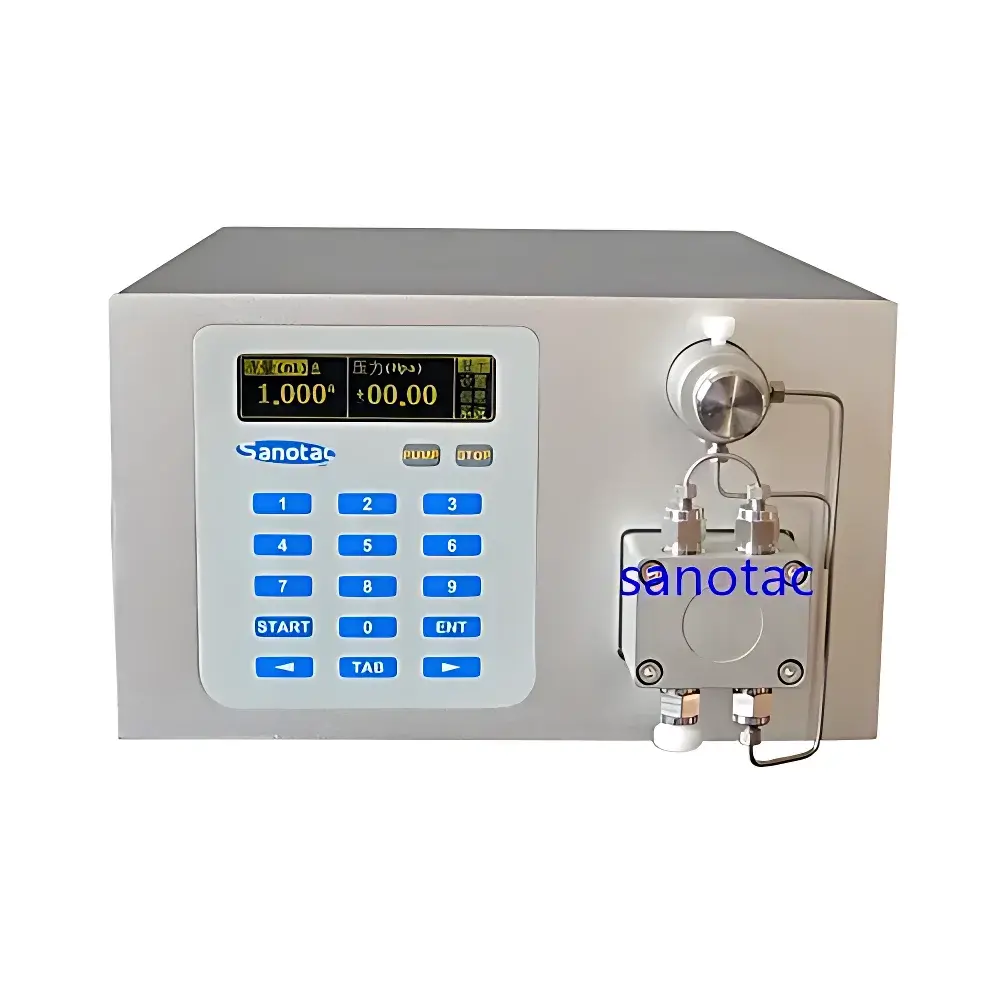
Sanotac Omnito CP1020 High-Precision Dual-Mode Constant-Pressure & Constant-Flow Infusion Pump
| Brand | Sanotac |
|---|---|
| Origin | Shanghai, China |
| Manufacturer Type | Direct Manufacturer |
| Country of Origin | China |
| Model | CP1020 |
| Pressure Range | 1–20 MPa |
| Pressure Accuracy | ±0.1 MPa |
| Flow Rate Range | 0.01–100.00 mL/min |
| Flow Increment | 0.01 mL/min |
| Flow Accuracy | ±0.5% |
| Flow Precision (RSD) | ≤0.1% |
| Pressure Pulsation | ≤0.2 MPa |
| Pump Head Material | 316L Stainless Steel (PEEK/Titanium optional) |
| Fluidic Path Materials | 316L SS, Ruby, PTFE, Ceramic |
| Tubing Connection | 1/16" Standard |
| Display | 256×64 Dot Matrix Backlit LCD |
| Control Interface | Front Panel + Open-Protocol PC Remote Control (RS232/USB) |
| Power Supply | 85–264 VAC, 50 Hz |
| Dimensions | 370 × 240 × 152 mm |
| Drive Mechanism | Cam-Driven Dual-Piston in Series with Floating Piston Design |
| Valves | Swiss-sourced Check Valves |
| Flow Compensation | Cam Profile Compensation + Electronic Pulse Suppression |
Overview
The Sanotac Omnito CP1020 is an engineered dual-mode infusion pump designed for precision fluid delivery in demanding laboratory and research environments. Unlike conventional syringe or single-piston peristaltic pumps, the CP1020 employs a cam-driven, dual-piston-in-series architecture with a floating piston mechanism—enabling true independent regulation of both pressure and flow rate within a single instrument. Its core operational principle relies on real-time closed-loop pressure feedback coupled with adaptive motor torque control, allowing dynamic adjustment of piston displacement to maintain setpoint pressure regardless of downstream resistance changes. This makes it uniquely suited for applications where hydraulic stability—not just volumetric consistency—is critical, such as organ perfusion, microfluidic pressure-driven mixing, and high-backpressure catalytic reaction systems.
Key Features
- Dual operational modes: selectable constant-pressure mode (1–20 MPa, ±0.1 MPa accuracy) and constant-flow mode (0.01–100.00 mL/min, ±0.5% accuracy, ≤0.1% RSD)
- Floating piston design minimizes seal wear and extends service life under continuous high-pressure operation
- Integrated cam profile compensation and electronic flow pulsation suppression reduce pressure ripple to ≤0.2 MPa (peak-to-peak)
- Modular fluid path constructed from chemically inert, high-strength materials: 316L stainless steel, ruby seat check valves, PTFE seals, and ceramic components
- Open communication protocol (RS232/USB) enables seamless integration into automated lab workflows and custom software platforms
- Backlit 256×64 dot-matrix LCD provides real-time display of pressure, flow rate, elapsed time, and system status without external monitoring hardware
- Compliant with IEC 61010-1 safety standards for laboratory equipment; CE-marked for use in EU-regulated research facilities
Sample Compatibility & Compliance
The CP1020 accommodates a broad range of solvents, biological buffers, viscous reagents, and abrasive suspensions through its configurable wetted-path options—including PEEK, titanium, and Hastelloy pump heads upon request. Its 1/16″ standard tubing interface ensures compatibility with common chromatographic, microfluidic, and perfusion manifolds. All fluid-contact materials meet USP Class VI biocompatibility requirements, supporting applications in ex vivo organ studies and preclinical pharmacokinetic modeling. The pump’s pressure and flow control algorithms are traceable to NIST-traceable calibration references, and its audit trail functionality (when used with validated host software) supports GLP and GMP-aligned experimental documentation per FDA 21 CFR Part 11 guidelines.
Software & Data Management
The CP1020 supports bidirectional serial communication via ASCII-based command protocol, enabling full remote control—including start/stop, mode switching, parameter setting, and real-time data streaming—through third-party applications written in Python, LabVIEW, MATLAB, or C#. Optional OEM firmware modules provide timestamped binary logging (CSV export), multi-segment gradient programming, and alarm-triggered event capture. When deployed in regulated environments, the pump can be integrated into validated LIMS or ELN systems using deterministic polling intervals and CRC-verified packet transmission—ensuring data integrity across extended unattended runs exceeding 72 hours.
Applications
- Ex vivo organ and tissue perfusion (e.g., isolated heart, liver, kidney models requiring stable hydrostatic pressure)
- Controlled reagent dosing in high-pressure chemical reactors and continuous-flow synthesis systems
- Microfluidic chip priming, pressure-balanced mixing, and laminar flow stabilization
- Gene delivery vector infusion with pressure-limited shear stress management
- Catalyst evaluation under realistic process conditions (e.g., fixed-bed reactor feed control)
- Calibration and challenge testing of pressure sensors, flow meters, and inline spectroscopic probes
FAQ
What distinguishes constant-pressure mode from constant-flow mode on the CP1020?
In constant-pressure mode, the pump continuously modulates piston stroke velocity to maintain user-defined backpressure—even during viscosity shifts or filter clogging. In constant-flow mode, it delivers precise volumetric rates irrespective of pressure fluctuations up to 20 MPa.
Can the CP1020 be integrated into a fully automated assay platform?
Yes—its open ASCII protocol, deterministic response timing, and support for TTL-triggered start/stop make it compatible with robotic liquid handlers and centralized control systems.
Is the pump suitable for corrosive or high-temperature fluids?
With optional titanium, PCTFE, or Hastelloy pump heads and high-temp PTFE seals, the CP1020 operates safely with aggressive solvents and fluids up to 80°C at rated pressure.
Does the device support regulatory-compliant data archiving?
When paired with validated host software that implements electronic signatures, audit trails, and secure data export, the CP1020 meets documentation requirements for ISO 17025, GLP, and FDA 21 CFR Part 11 compliance.
What maintenance intervals are recommended for sustained 20 MPa operation?
Under continuous high-pressure use, Sanotac recommends seal inspection every 500 operating hours and full piston assembly servicing every 2,000 hours—aligned with ISO 9001 preventive maintenance protocols.



