
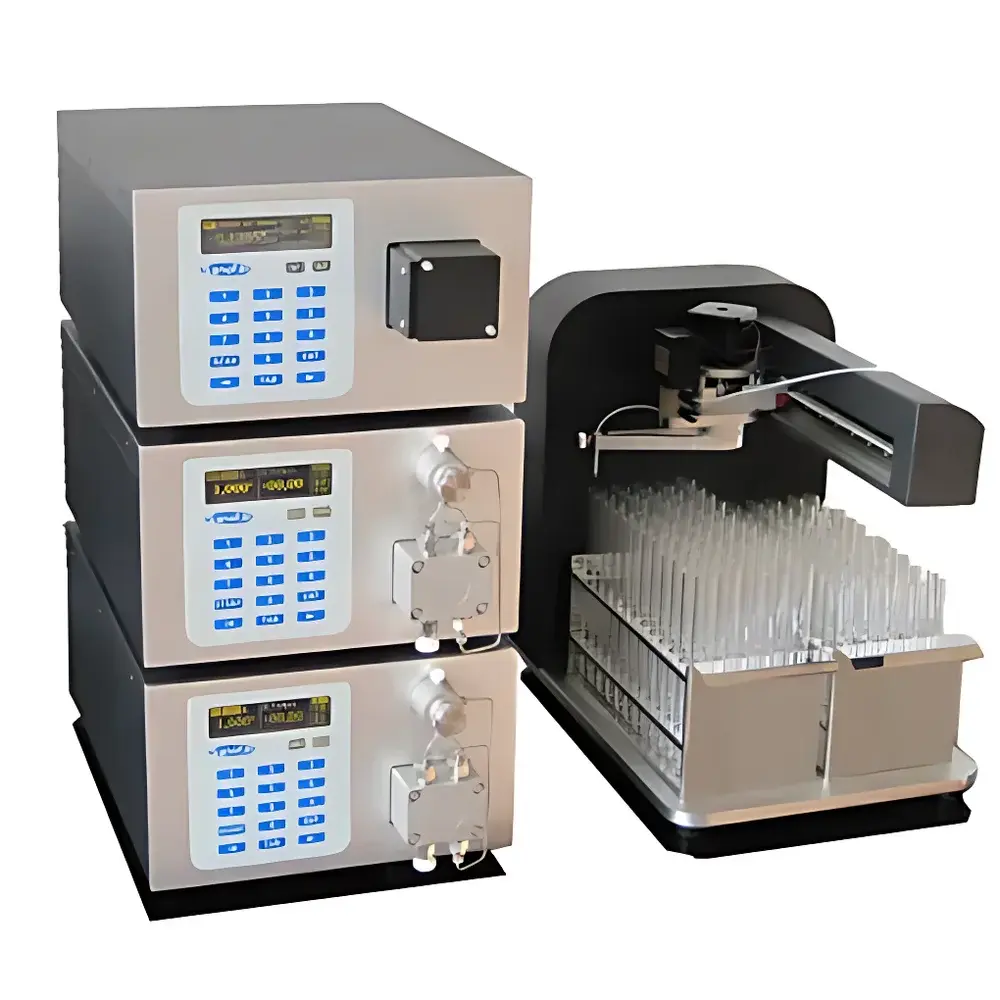
Sanotac UV2001 Dual-Wavelength Simultaneous Full-Range UV-Vis Detector
| Brand | Sanotac |
|---|---|
| Origin | Shanghai, China |
| Manufacturer Type | Manufacturer |
| Product Category | Domestic |
| Model | UV2001 |
| Quotation Range | USD 1,400–2,800 (FOB) |
| Compatible Instrument | HPLC Systems |
| Instrument Type | UV-Vis Absorbance Detector |
| Wavelength Range | 190–800 nm |
| Detection Mode | Simultaneous dual-wavelength detection across full range |
| Light Source | Deuterium Lamp + Tungsten-Halogen Lamp |
| Wavelength Accuracy | ±1 nm |
| Wavelength Repeatability | 0.2 nm |
| Flow Cell Pathlength | Adjustable from 1 to 5 mm |
| Flow Cell Inlet/Outlet | 1/16″ for analytical & semi-preparative |
| Baseline Noise | ±0.5 × 10⁻⁵ AU at 254 nm (TC = 1 s) |
| Baseline Drift | 1.5 × 10⁻⁴ AU/h at 254 nm |
| Linear Dynamic Range | ≥3 AU |
| Time Constants | 0.1 / 0.2 / 0.5 / 1.0 / 2.0 / 5.0 / 10.0 s |
| Digital Zero Adjustment | Full-scale auto-zero |
| Display | 320 × 240 pixel, 4.7-inch monochrome LCD with uniform backlighting |
| Control Interface | Front-panel keypad + RS-232/USB bidirectional communication with open protocol |
| Power Supply | 85–264 VAC, 50/60 Hz, 150 W |
Overview
The Sanotac UV2001 is a high-performance, dual-wavelength simultaneous ultraviolet-visible (UV-Vis) absorbance detector engineered for integration into analytical and semi-preparative high-performance liquid chromatography (HPLC) systems. It operates on the fundamental principle of Beer-Lambert absorption spectroscopy, measuring analyte concentration via attenuation of incident light at user-selectable wavelengths between 190 nm and 800 nm. Unlike single-wavelength detectors, the UV2001 employs a dual-optical-path architecture with synchronized deuterium and tungsten-halogen lamps, enabling real-time, independent monitoring at two distinct wavelengths without time multiplexing or mechanical wavelength switching. This design eliminates spectral acquisition latency and ensures temporal alignment of co-eluting peak signals—critical for ratio-based quantitation (e.g., purity assessment), solvent front identification, and multi-component resolution in complex matrices such as biopharmaceutical intermediates, natural product extracts, and synthetic reaction mixtures.
Key Features
- Dual-wavelength simultaneous detection with independent signal processing channels—no compromise in temporal resolution or photometric accuracy.
- Automated wavelength calibration routine compliant with ISO 17025 traceability requirements, supported by three scan modes: full-spectrum sweep (190–800 nm), fixed-point verification, and user-defined window scanning.
- Adjustable flow cell pathlength (1–5 mm) optimized for both low-volume analytical applications (e.g., 2–5 µL injection volumes) and higher-flow semi-preparative workflows (up to 10 mL/min), minimizing band broadening while maintaining optical density linearity.
- Open-protocol RS-232 and USB interfaces enable seamless integration with third-party chromatography data systems (CDS), including Empower, Chromeleon, and OpenLab CDS—fully supporting ASTM E2500-compliant instrument qualification protocols.
- Front-panel control with 4.7-inch high-contrast monochrome LCD (320 × 240 pixels) featuring consistent luminance across viewing angles and programmable backlight intensity—designed for extended operation in controlled laboratory environments.
- Low-noise analog electronics and thermally stabilized optical bench yield baseline noise of ±0.5 × 10⁻⁵ AU at 254 nm (1-second time constant) and drift <1.5 × 10⁻⁴ AU/h—meeting USP sensitivity thresholds for residual solvent and impurity profiling.
Sample Compatibility & Compliance
The UV2001 supports standard stainless-steel, PEEK, and fused-silica capillary interfaces (1/16″ for analytical, 1/8″ for preparative configurations), ensuring compatibility with all major HPLC and medium-pressure LC platforms. Its optical design accommodates aqueous, organic, and mixed mobile phases—including aggressive solvents like trifluoroacetic acid (TFA), acetonitrile, and THF—without compromising lamp lifetime or signal stability. The detector complies with IEC 61010-1 for electrical safety and meets electromagnetic compatibility (EMC) requirements per EN 61326-1. Firmware supports audit-trail-enabled operation aligned with FDA 21 CFR Part 11 Annex 11 principles when paired with validated CDS software, facilitating GLP/GMP-regulated environments.
Software & Data Management
The UV2001 communicates via an openly documented ASCII-based command set, enabling custom scripting in Python, LabVIEW, or MATLAB for automated method development and system validation. Raw absorbance data are output in time-stamped, comma-delimited format with metadata headers (wavelength, time constant, lamp status, zero reference). Internal memory stores up to 10 user-defined methods with retention of wavelength pairs, time constants, and zero-offset parameters. All firmware updates are delivered via signed binary packages with SHA-256 checksum verification—ensuring integrity during remote maintenance in distributed lab networks.
Applications
- Quantitative analysis of pharmaceutical actives and degradation products using dual-wavelength ratio tracking to correct for baseline shifts during gradient elution.
- Protein purification monitoring in FPLC and AKTA systems—simultaneous 280 nm (aromatic residues) and 214 nm (peptide bond) detection enables real-time assessment of column breakthrough and fraction purity.
- Nucleic acid quantification in oligonucleotide synthesis workflows, leveraging 260 nm/280 nm ratios to distinguish DNA/RNA from protein contamination.
- Impurity profiling in API manufacturing per ICH Q2(R2), where dual-wavelength detection supports specificity verification without secondary orthogonal techniques.
- Method transfer between analytical and semi-preparative scales—identical optical configuration ensures retention of relative response factors across flow rate and cell volume changes.
FAQ
Does the UV2001 support compliance with FDA 21 CFR Part 11?
Yes—when operated under a validated chromatography data system with electronic signature capability, the UV2001’s open communication protocol and timestamped data output meet core technical requirements for audit trail generation and data integrity.
Can the flow cell be replaced without tools?
Yes—the modular flow cell assembly features quick-release fittings compatible with standard 1/16″ and 1/8″ tubing; replacement requires no torque wrenches or alignment fixtures.
Is lamp replacement field-serviceable?
Yes—both deuterium and tungsten-halogen lamps are user-replaceable with factory-calibrated alignment jigs included; average lamp lifetimes exceed 2,000 hours under typical usage conditions.
What is the minimum detectable absorbance change?
At optimal settings (254 nm, 1 s time constant, 10 mm pathlength), the limit of detection (LOD) is ≤0.2 ng/µL for caffeine in methanol—verified per ICH Q2(R2) guidelines using signal-to-noise ratio (S/N = 3) methodology.
How does the dual-optical-path design improve measurement robustness?
Independent reference and sample beams eliminate common-mode drift from lamp intensity fluctuations or temperature-induced refractive index variations—resulting in enhanced long-term stability without periodic manual recalibration.






