
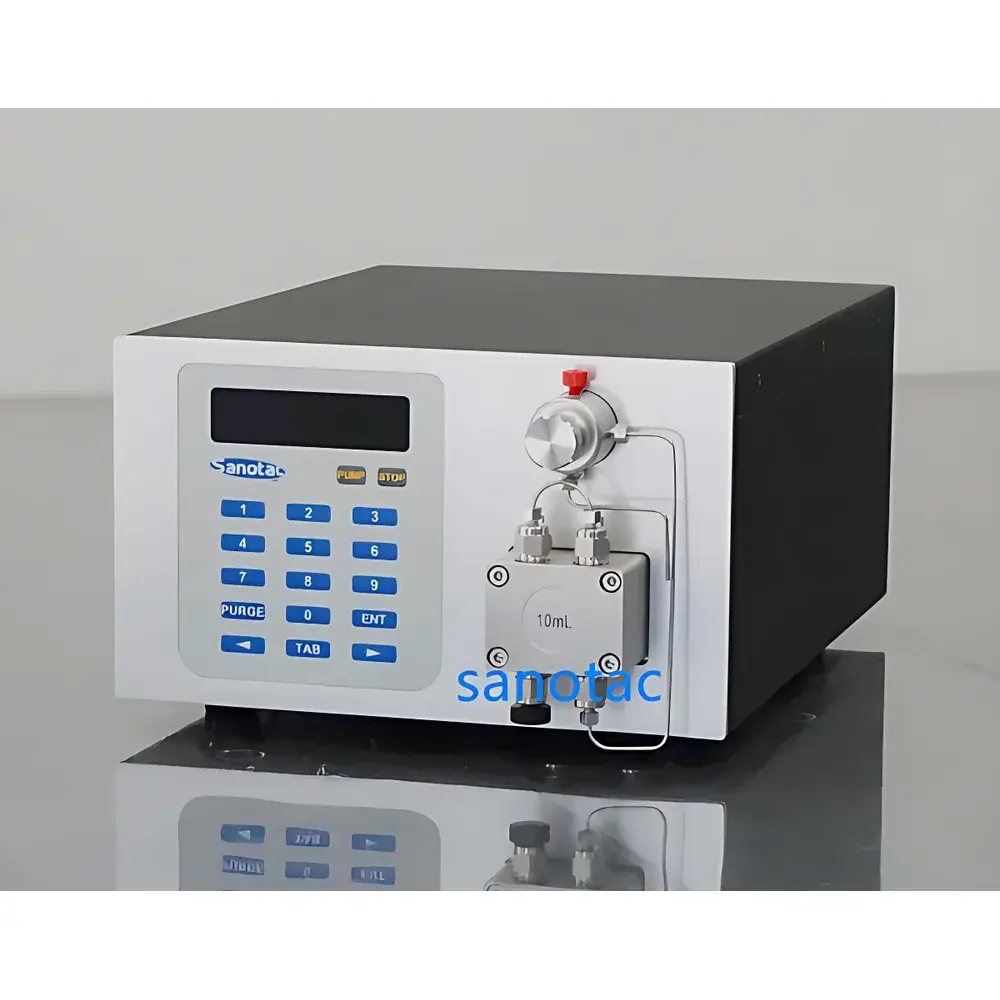
Sanotac MP1006C Stainless Steel Parallel-Plunger Constant Flow High-Pressure Pump
| Brand | Sanotac |
|---|---|
| Origin | Shanghai, China |
| Manufacturer Type | Direct Manufacturer |
| Model | MP1006C |
| Flow Rate | 0.1–100.0 mL/min |
| Pressure Range | ≤ 6 MPa |
| Flow Accuracy | ±1% |
| Flow Precision (RSD) | ≤1% |
| Pressure Pulsation | ≤ 0.2 MPa |
| Wetted Materials | 316L stainless steel, ruby, zirconia ceramic |
| Communication | RS-232 (standard), RS-485/RS-422 (optional), Sanotac proprietary protocol & Modbus RTU/ASCII |
| Power Supply | 85–264 VAC, 50 Hz |
| Power Consumption | 75 W |
| Weight | 12 kg |
Overview
The Sanotac MP1006C is a high-precision, parallel-plunger constant flow high-pressure pump engineered for demanding laboratory and pilot-scale applications requiring stable, pulse-minimized fluid delivery under elevated pressure. It operates on a dual-cylinder reciprocating principle: two independently driven plunger heads operate in phase opposition—while one draws in fluid, the other discharges—ensuring continuous, non-pulsating flow without reliance on accumulators or passive dampeners. This architecture delivers exceptional volumetric consistency essential for reactive chemistry workflows, particularly where precise stoichiometric control of thermally sensitive or hazardous reagents—such as di-tert-butyl peroxide (DTBP), a common initiator in melt-blown polypropylene production—is critical. The MP1006C is rated for continuous operation up to 6 MPa (870 psi) and supports flow rates from 0.1 to 100.0 mL/min with ±1% accuracy and ≤1% RSD, making it suitable for integration into automated synthesis platforms, microreactor systems, and analytical instrument fluidics.
Key Features
- Dual-Plunger Synchronization: Parallel-driven plunger heads with cam-profile compensation and real-time electronic pulse suppression reduce pressure ripple to ≤0.2 MPa—enabling stable flow in pressure-sensitive reaction environments.
- Comprehensive Pressure Management: Programmable upper/lower pressure limits with automatic shutdown; real-time pressure curve visualization for operational diagnostics and system integrity monitoring.
- Multi-Mode Flow Control: Switchable units between mL/min (volumetric) and g/min (mass-based, when paired with density input); solvent compressibility compensation and multi-point flow calibration ensure accuracy across viscosity and temperature gradients.
- Enhanced Maintenance Architecture: Integrated post-stroke plunger wash function prevents salt crystallization and particulate buildup on seals and plunger rods—extending service life in aqueous or buffer-containing media.
- Industrial-Grade Connectivity: Standard RS-232 interface; optional RS-485/RS-422 ports support daisy-chained configurations; native compatibility with Modbus RTU/ASCII and Sanotac’s custom ASCII protocol enables seamless integration into SCADA, LIMS, and PLC-controlled environments.
- Data Integrity & Traceability: Onboard logging captures synchronized pressure and flow curves; exportable to Excel (.xlsx) format with timestamped metadata—supporting GLP-compliant recordkeeping and FDA 21 CFR Part 11 audit requirements when deployed with validated software layers.
Sample Compatibility & Compliance
The MP1006C’s wetted path—constructed from 316L stainless steel, ruby check valves, and zirconia ceramic plungers—exhibits broad chemical resistance to organic peroxides (including DTBP), polar solvents, mild acids/bases, and halogenated compounds. Its design conforms to IEC 61000-6-2/6-4 for electromagnetic compatibility and meets CE safety directives (2014/30/EU, 2014/35/EU). While not intrinsically rated for Class I Div 1 hazardous locations, it is routinely deployed in ISO 14644-1 Class 7 cleanrooms and GMP-aligned process development labs handling controlled substances. For DTBP handling, users are advised to observe ASTM D7212–19 guidelines for peroxide stability during transfer and maintain line temperatures below 50 °C to mitigate thermal decomposition risk.
Software & Data Management
The pump supports both standalone operation via front-panel keypad and remote control through serial command sets. All configuration parameters—including pressure thresholds, flow profiles, communication settings, and calibration offsets—are stored in non-volatile memory and can be saved as named methods for rapid recall. Real-time data streams (pressure, flow, status flags) are time-synchronized and logged at user-defined intervals (100 ms–10 s resolution). Exported Excel files include column headers compliant with ASTM E2500-13 for raw data traceability. When integrated with third-party control software (e.g., LabVIEW, Python pySerial, or DeltaV), the MP1006C supports closed-loop feedback control—for instance, interfacing with an analytical balance in loss-in-weight mode to dynamically adjust flow based on real-time mass depletion rate.
Applications
- Precision delivery of initiators (e.g., DTBP, AIBN) and catalysts in polymerization reaction screening and kinetic studies.
- Fluid supply for microfluidic reactors and chip-based synthesis platforms requiring sub-mL/min stability.
- Mobile phase delivery in preparative HPLC and supercritical fluid chromatography (SFC) systems.
- Calibration fluid dispensing in metrology labs validating flow meters per ISO 4064-2.
- Continuous feeding of corrosive or viscous reagents in electrochemical cell testing and battery electrolyte formulation.
- On-line spiking systems for environmental water analysis (e.g., EPA Method 524.2) requiring reproducible nanoliter-level additions.
FAQ
What materials are compatible with DTBP delivery using the MP1006C?
The 316L stainless steel body, ruby valves, and zirconia ceramic plungers resist degradation from DTBP at ambient to moderately elevated temperatures (<50 °C). Avoid prolonged exposure to chlorinated solvents or strong oxidizers above 60 °C.
Can the MP1006C be integrated into a multi-pump gradient system?
Yes—it supports 1:32 master-slave expansion via RS-485, enabling synchronized gradient programming across up to 32 pumps with independent flow/pressure setpoints.
Is flow calibration traceable to NIST standards?
While the pump itself does not include certified calibration certificates, its multi-point flow correction algorithm accepts user-input reference values obtained from gravimetric or syringe-pump-traceable measurements—enabling lab-specific traceability per ISO/IEC 17025.
Does the pump support fail-safe shutdown on pressure deviation?
Yes—programmable upper and lower pressure limits trigger immediate motor stop and valve closure, with event logs timestamped to the millisecond.
What is the recommended maintenance interval for the plunger seals?
Under continuous operation with clean, non-abrasive fluids, seal replacement is typically required every 6–12 months; frequency increases with abrasive slurries or frequent DTBP cycling due to peroxide-induced elastomer aging.



