
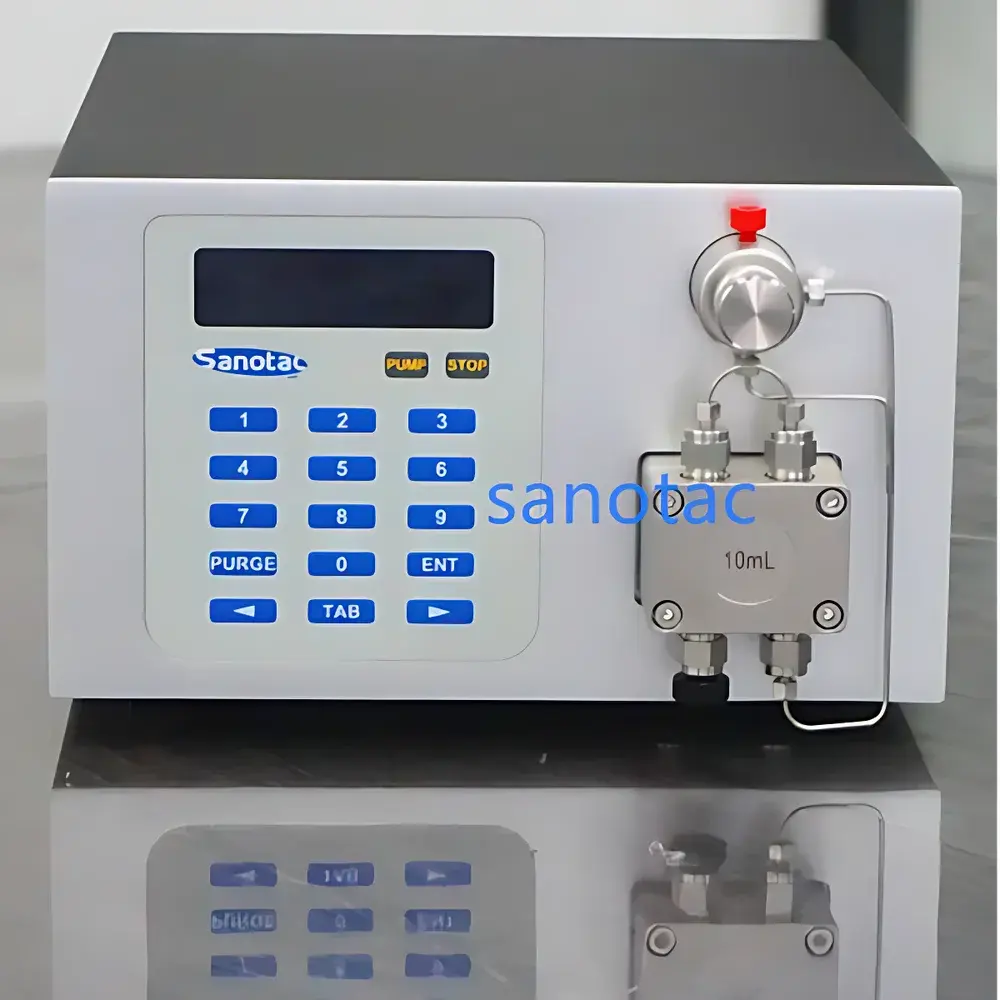
Sanotac SS1040 Stainless Steel Ultra-High-Pressure Liquid Chromatography Pump
| Brand | Sanotac |
|---|---|
| Model | SS1040 |
| Pump Type | Isocratic High-Pressure Solvent Delivery Pump |
| Max Operating Pressure | 40 MPa |
| Flow Rate Range | 0.01–100.00 mL/min |
| Flow Accuracy | ±0.5% |
| Flow Precision (RSD) | ≤0.1% |
| Pressure Pulsation | ≤0.1 MPa |
| Wetted Materials | 316L Stainless Steel, Sapphire, PTFE, Ceramic |
| Communication Interfaces | USB, RS232, RS485/422 (optional), Modbus RTU/ASCII |
| Power Supply | 85–264 VAC, 50 Hz |
| Power Consumption | 75 W |
| Dimensions | 370 × 240 × 152 mm |
| Weight | 8 kg |
Overview
The Sanotac SS1040 is an isocratic ultra-high-pressure liquid chromatography (UHPLC) pump engineered for precision fluid delivery in demanding analytical and process-critical applications. Designed around a dual-piston positive displacement architecture with active pulse suppression and real-time compression compensation, the SS1040 delivers stable, low-pulsation solvent flow across its full operational range — from trace-level micro-injection (0.01 mL/min) to high-throughput preparative-scale delivery (100.00 mL/min). Its 40 MPa maximum pressure rating enables compatibility with sub-2 µm particle-packed columns, capillary-scale separation systems, and non-standard chromatographic configurations requiring elevated backpressure stability. Unlike conventional HPLC pumps limited by mechanical hysteresis or thermal drift, the SS1040 integrates multi-point volumetric calibration, dynamic zero-point correction, and column-piston post-wash functionality — collectively ensuring long-term metrological integrity under continuous operation at elevated pressures.
Key Features
- Multi-point flow calibration across the entire 0.01–100.00 mL/min range, enabling traceable accuracy (±0.5%) and repeatability (RSD ≤0.1%) per ISO 5725 and ASTM D341
- Active pressure pulsation suppression via cam-profile optimization and real-time electronic flow feedback, limiting pressure ripple to ≤0.1 MPa even at 40 MPa and minimum flow rates
- Compression compensation algorithm dynamically adjusts piston stroke volume based on solvent compressibility, temperature, and system backpressure — critical for methanol/water and CO₂-based mobile phases
- Column-piston rear-wash mechanism reduces seal wear by removing particulate carryover and precipitated solutes, extending service intervals beyond 6,000 operating hours
- Modular communication architecture supporting native RS232/USB for lab integration and optional RS485/422, Modbus TCP, Profibus DP, and Profinet for industrial SCADA/DCS/PLC deployment
- Full analog and digital I/O: 0–5 V / 4–20 mA analog input for external pressure or temperature feedback; discrete TTL-level digital inputs for start/stop/pause commands
Sample Compatibility & Compliance
The SS1040 accommodates a broad spectrum of mobile phase chemistries — including aqueous buffers, organic solvents (acetonitrile, methanol, THF), supercritical CO₂, and corrosive reagents — through its fully wetted path constructed from 316L stainless steel, sapphire check valves, PTFE seals, and ceramic plungers. It meets mechanical safety requirements per EN 61010-1:2019 for laboratory equipment and complies with electromagnetic compatibility standards IEC 61326-1:2021. For regulated environments, firmware supports audit-trail-enabled operation when paired with validated control software compliant with FDA 21 CFR Part 11 and EU Annex 11 requirements — including electronic signatures, method versioning, and immutable event logging.
Software & Data Management
The optional Sanotac FlowControl Suite provides deterministic flow programming with up to eight user-defined profiles per method: constant, linear ramp, step-gradient, and custom time-segmented sequences. Real-time plotting of flow rate vs. pressure curves enables immediate detection of column clogging or seal degradation. All operational data — including timestamped flow, pressure, motor current, and temperature — are logged at 10 Hz resolution and exportable in CSV, Excel, or HDF5 formats for statistical process control (SPC) analysis. Calibration parameters are stored in encrypted EEPROM with tamper-evident checksums; factory defaults can be restored without firmware reset. Remote monitoring is supported via Ethernet-connected gateway with TLS 1.2-secured web interface and RESTful API endpoints.
Applications
The SS1040 serves as a primary fluidic actuator in UHPLC systems, preparative chromatography platforms, and hybrid analytical-process instrumentation. It is routinely deployed in catalytic evaluation reactors for precise co-feed of reactants and catalysts; in supercritical fluid chromatography (SFC) systems requiring CO₂ densification control; in microreactor arrays for residence-time-sensitive synthesis; and in layer-by-layer deposition systems where volumetric fidelity directly impacts film uniformity. Its robustness and programmability also support GLP-compliant method transfer between R&D and QC laboratories, as well as GMP-aligned continuous manufacturing workflows governed by ICH Q5 and Q8 guidelines.
FAQ
What is the maximum allowable backpressure for continuous operation?
The SS1040 is rated for continuous operation at ≤40 MPa (5,800 psi) with all standard wetted materials. Sustained operation above 35 MPa requires ambient temperature stabilization and use of low-compressibility solvents.
Can the pump be integrated into a PLC-controlled batch process?
Yes — via RS485 Modbus RTU or optional Profinet interface, the SS1040 supports full command-and-control integration, including real-time flow setpoint modulation, fault status polling, and emergency stop triggering.
Is flow calibration traceable to national standards?
Calibration procedures follow ISO/IEC 17025 principles; users may perform in-house verification using NIST-traceable gravimetric or timed-volume methods. Factory calibration certificates include uncertainty budgets per GUM (JCGM 100:2008).
Does the pump support gradient elution?
As a single-channel isocratic pump, the SS1040 does not natively mix solvents. However, it interfaces seamlessly with external low-dead-volume proportioning valves or binary mixing modules to enable high-pressure gradient formation.
What maintenance intervals are recommended for extended reliability?
With regular column-piston wash cycles and annual seal inspection, mean time between failures (MTBF) exceeds 15,000 hours. Full preventive maintenance — including valve replacement and compression compensation recalibration — is advised every 12 months or 5,000 operating hours, whichever occurs first.





