
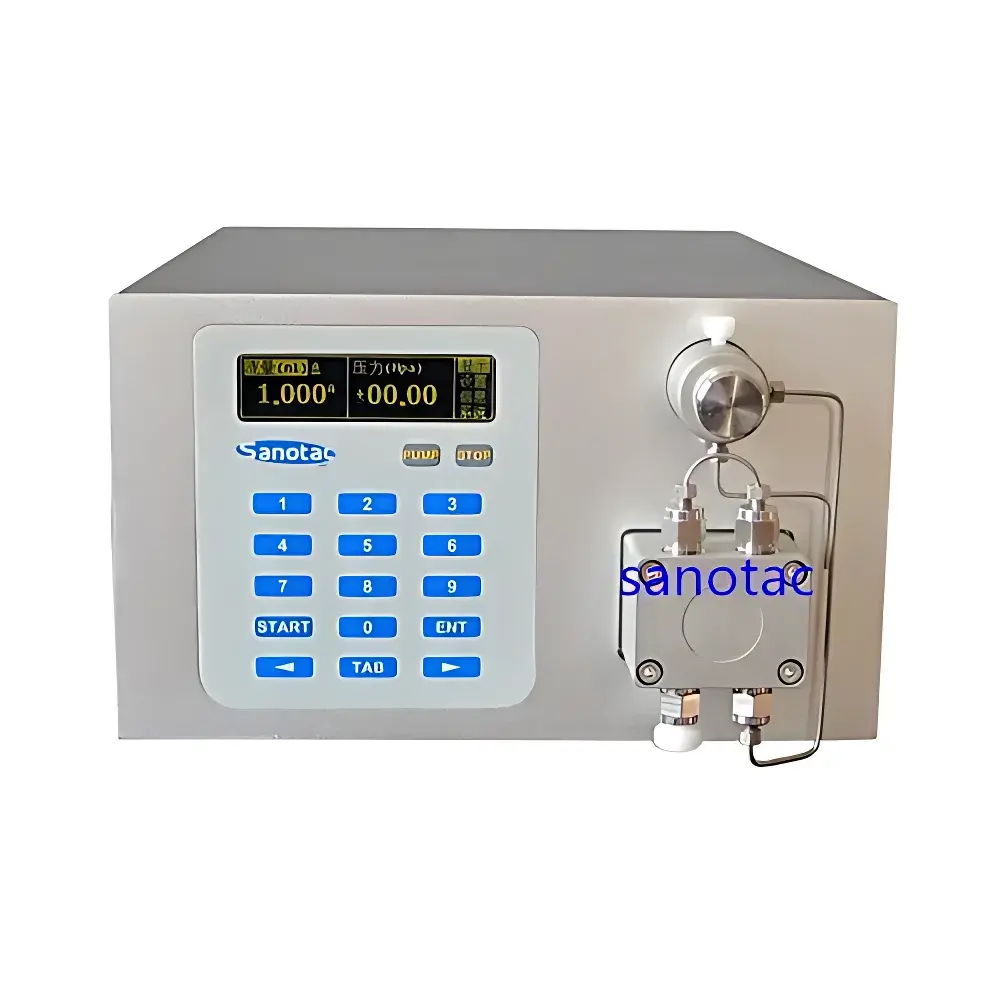
Sanotac FY0015 High-Pressure Constant Flow Pump
| Brand | Sanotac |
|---|---|
| Origin | Shanghai, China |
| Manufacturer Type | Manufacturer |
| Model | FY0015 |
| Flow Range | 0.001–9.999 mL/min |
| Increment | 0.001 mL/min |
| Flow Accuracy | ±0.1% |
| Flow Precision (RSD) | ≤0.1% |
| Maximum Pressure | 42 MPa |
| Pressure Pulsation | ≤0.1 MPa |
| Pump Head Volume | 10 mL |
| Fluidic Path Materials | 316L stainless steel, ruby, PTFE, ceramic |
| Tubing Connection | 1/16" standard |
| Display | 256×64 dot matrix LCD with backlight |
| Control Interface | Front-panel keypad + RS232/USB computer remote control (open protocol) |
| Power Supply | 85–264 VAC, 50 Hz |
| Dimensions | 370 × 240 × 152 mm |
Overview
The Sanotac FY0015 High-Pressure Constant Flow Pump is an engineered precision fluid delivery system designed for demanding chemical synthesis applications requiring stable, pulse-free solvent or reagent delivery under elevated pressure. Operating on a dual-piston serial configuration with floating piston design, the pump delivers highly reproducible flow across its full dynamic range—from ultra-low flow rates (0.001 mL/min) to 9.999 mL/min—while maintaining pressure stability up to 42 MPa (6090 psi). Its core architecture leverages microprocessor-based real-time flow compensation, solvent compressibility correction, and multi-point flow calibration to ensure metrological traceability in continuous-flow reactors, high-pressure hydrogenation setups, nitration trains, fluorination modules, and other exothermic or gas-involved reaction systems. Unlike peristaltic or diaphragm-based alternatives, the FY0015 employs positive displacement mechanics with sapphire-hardened check valves and ceramic-ruby sealing interfaces, minimizing wear and enabling long-term operation in aggressive chemical environments—including concentrated acids, halogenated solvents, and oxidizing media.
Key Features
- Dual-piston serial drive with floating piston mechanism reduces seal friction and extends service life of high-pressure seals by up to 3× compared to fixed-piston designs.
- Real-time solvent compressibility compensation algorithm dynamically adjusts piston stroke based on fluid density and system backpressure, ensuring volumetric accuracy across temperature and composition gradients.
- Multi-point flow calibration (10-point curve fitting) enables linearization over the entire flow range, delivering ≤0.1% RSD flow repeatability even at sub-mL/min rates.
- Low-pressure pulsation (<0.1 MPa) achieved via cam-profile optimization and active electronic pulse suppression—critical for maintaining laminar flow profiles in microreactors and packed-bed catalytic systems.
- Chemically inert fluid path constructed from 316L stainless steel, ruby balls, PTFE seals, and ceramic plungers—compatible with HNO₃, H₂SO₄, HF, Cl₂-saturated solvents, and peroxide-containing streams.
- Open-protocol RS232/USB interface supports integration with third-party chromatography data systems (CDS), LIMS, and PLC-controlled reaction platforms without proprietary middleware.
- Front-panel programmable memory stores up to 10 user-defined methods with gradient slope, dwell volume, and pressure limit parameters—enabling rapid method transfer between labs.
Sample Compatibility & Compliance
The FY0015 is routinely deployed in ISO/IEC 17025-accredited QC laboratories and GMP-compliant pilot-scale synthesis facilities where regulatory documentation of fluid delivery integrity is required. Its mechanical design conforms to EN 61000-6-2 (immunity) and EN 61000-6-4 (emission) standards. While not certified for ATEX Zone 1 use out-of-the-box, explosion-proof variants (e.g., FY0015-Ex) are available upon request for Class I, Division 1 hazardous locations. The pump meets material compatibility requirements outlined in ASTM D471 (elastomer resistance), ASTM F2097 (chemical resistance of polymeric components), and USP / for extractables profiling in pharmaceutical process equipment. All wetted parts are fully traceable to mill-certified 316L (ASTM A276) and ISO 6872-grade zirconia ceramics.
Software & Data Management
The FY0015 supports bidirectional communication via ASCII-based command set (documented in publicly available protocol manual), allowing direct integration with LabVIEW, Python (PySerial), MATLAB, or commercial CDS platforms such as Empower, Chromeleon, or OpenLab. Audit trail functionality—including timestamped parameter changes, flow/pressure logs, and error event records—is enabled when operated under validated workstation control. For standalone operation, the built-in LCD provides real-time display of current flow rate, setpoint, actual pressure, and operational status flags (e.g., “Valve Switch,” “Piston Stall,” “Leak Detected”). All configuration data is retained during power cycling via non-volatile EEPROM.
Applications
- Continuous-flow nitration and sulfonation reactors requiring precise stoichiometric reagent dosing under 20–40 MPa pressure.
- Catalytic hydrogenation systems using Pd/C or Ru-based catalysts in supercritical CO₂ or high-boiling solvents.
- Fluorination chemistry employing elemental fluorine or Selectfluor® solutions with corrosion-resistant fluid paths.
- High-pressure polymerization of acrylates, epoxides, or siloxanes in tubular or microstructured reactors.
- On-line derivatization modules coupled to LC-MS for real-time metabolic profiling in proteomics workflows.
- Automated parallel synthesis platforms where multi-channel synchronized pumping is required for library generation.
FAQ
What materials are used in the fluidic path, and how do they resist aggressive reagents?
The FY0015 uses 316L stainless steel housings, ruby ball check valves, PTFE-coated ceramic plungers, and fluoropolymer-sealed fittings—providing broad resistance to strong acids (including aqua regia at ambient T), halogens, peroxides, and organometallics.
Can this pump be integrated into a GxP-regulated environment?
Yes—when paired with validated software control (e.g., Empower 3 with 21 CFR Part 11 add-on), it supports electronic signatures, audit trails, and change control documentation required for FDA submissions.
Is gradient programming supported in constant-pressure mode?
No—the FY0015 operates exclusively in constant-flow mode; gradient formation is achieved by blending multiple FY0015 units or interfacing with a dedicated low-pressure mixing module.
What maintenance intervals are recommended for high-pressure operation (>30 MPa)?
Plunger seals and check valves should be inspected every 500 hours of operation at >35 MPa; typical service life exceeds 2000 hours under 25 MPa continuous duty with proper filtration (≤0.2 µm inlet filter).
Does the pump support remote start/stop via digital I/O signals?
Yes—optional TTL-level trigger input/output ports are available for external synchronization with reactor heating cycles, UV detectors, or safety interlocks.



