
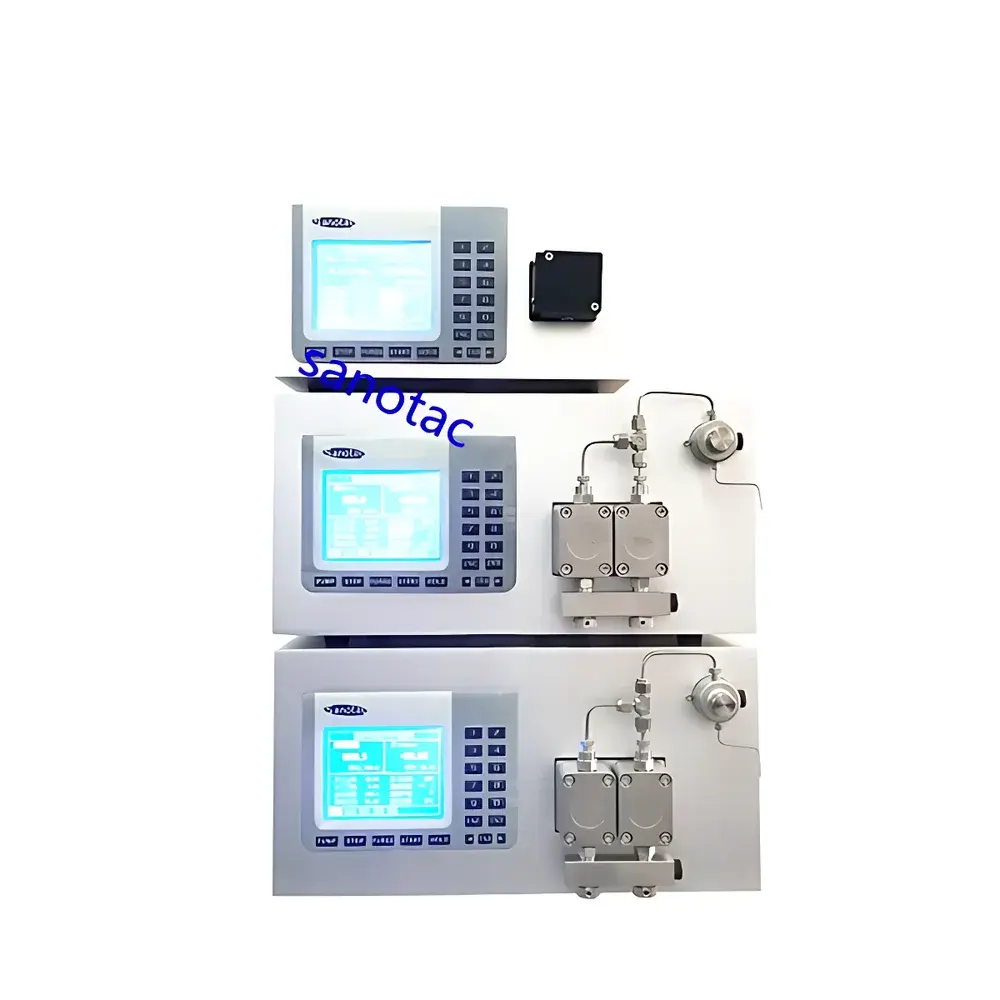
Sanotac Purifier300 Preparative Liquid Chromatography System
| Brand | Sanotac |
|---|---|
| Origin | Shanghai, China |
| Manufacturer Type | Original Equipment Manufacturer (OEM) & Direct Producer |
| Product Category | Domestic |
| Model | Purifier300 |
| Application Level | Laboratory-Scale |
| Instrument Type | Medium-to-Low Pressure Preparative LC System |
| Flow Rate Range | 0.01–300.00 mL/min |
| Flow Accuracy | ±1% |
| Flow Precision (RSD) | ≤0.5% |
| Maximum Operating Pressure | 10 MPa |
| Wavelength Range | 190–700 nm (D₂ + W lamp) |
| Wavelength Accuracy | ±1 nm |
| Wavelength Repeatability | ±0.2 nm |
| Baseline Noise | ±0.75×10⁻⁵ AU @ 254 nm, TC = 1 s |
| Data Acquisition Rate | 10 Hz |
Overview
The Sanotac Purifier300 Preparative Liquid Chromatography System is an engineered solution for laboratory-scale isolation and purification of organic molecules, natural product isolates, synthetic intermediates, antibiotics, and bioactive compounds. Designed around classical high-performance liquid chromatography (HPLC) principles—employing gradient-elution, isocratic separation, and UV-Vis detection—the system operates within the medium-to-low pressure regime (≤10 MPa), balancing robustness, scalability, and operational safety for routine preparative workflows. Its architecture adheres to fundamental chromatographic theory: retention time reproducibility depends on precise mobile-phase delivery, column temperature stability, and detector linearity; the Purifier300 addresses each via dual-piston reciprocating pumps with real-time pressure feedback, programmable gradient profiles, and a dual-lamp UV-Vis detector with dynamic wavelength switching. Unlike analytical HPLC systems optimized for detection sensitivity, the Purifier300 prioritizes flow fidelity across wide volumetric ranges (0.01–300.00 mL/min), mechanical durability under extended load cycles, and modular adaptability to semi-preparative columns (ID 10–30 mm). It is not intended for GMP manufacturing but meets technical requirements for method development, fraction collection, and compound library enrichment in academic, pharmaceutical R&D, and natural products laboratories.
Key Features
- Microprocessor-controlled dual-piston pump system with active cavity pressure compensation—minimizing solvent compressibility effects and refill-induced pulsation across the full flow range.
- Cam-profile flow pulsation suppression technology reduces baseline noise to ≤±0.75×10⁻⁵ AU (254 nm, 1 s time constant), enabling reliable detection of trace impurities alongside major components.
- Multi-point volumetric calibration curves ensure flow accuracy of ±1% and repeatability (RSD) ≤0.5% from 0.01 to 300.00 mL/min—critical for method transfer between analytical and preparative scales.
- Floating plunger seal design extends high-pressure seal service life and maintains consistent piston alignment under prolonged operation at up to 10 MPa.
- Ten user-defined methods support independent programming of flow rate, gradient slope, hold time, and detection parameters—including dual-wavelength monitoring, wavelength stepping, and stop-flow spectral scanning.
- Dual-lamp (deuterium + tungsten) UV-Vis detector with automatic lamp switching, adjustable flow cell pathlength (1–5 mm), and digital zero-baseline correction ensures long-term photometric stability and broad spectral coverage (190–700 nm).
Sample Compatibility & Compliance
The Purifier300 accommodates standard semi-preparative reversed-phase (C18, C8, phenyl-hexyl), normal-phase (silica, cyano), and ion-exchange columns with internal diameters of 10–30 mm and lengths up to 250 mm. It supports common solvents including water, acetonitrile, methanol, isopropanol, ethyl acetate, and hexane—compatible with both volatile and non-volatile mobile phases. While not certified for 21 CFR Part 11 compliance out-of-the-box, its software architecture permits audit-trail configuration, electronic signature integration, and data export in ASCII/CSV formats suitable for GLP-aligned documentation. The system meets ISO 9001 manufacturing standards at the Shanghai production facility and conforms to IEC 61010-1 for electrical safety in laboratory equipment. Column hardware interfaces comply with standard 1/4″-28 UNF fittings and Rheodyne-compatible valve actuation protocols.
Software & Data Management
The included chromatography workstation provides intuitive method building, real-time chromatogram visualization, peak integration (tangent skim, valley-to-valley, Gaussian deconvolution), and fraction-triggered collection logic. All acquisition parameters—including flow rate, gradient table, wavelength program, and detector time constants—are stored as structured XML metadata. Raw data files retain full detector signal resolution (10 Hz sampling) and are timestamped with instrument serial number and firmware revision. Export options include AIA (.cdf), .csv, and .txt formats compatible with third-party analysis tools (e.g., Chromeleon, OpenChrom, MATLAB). Software logs all method changes, run start/stop events, and error codes—supporting retrospective review per GLP principles. Remote monitoring via Ethernet interface allows integration into centralized lab informatics platforms.
Applications
- Isolation of bioactive alkaloids, flavonoids, terpenoids, and saponins from plant extracts—particularly in traditional Chinese medicine (TCM) research where multi-component fractionation is required prior to structural elucidation.
- Purification of synthetic small molecules (MW < 1,000 Da) following solid-phase or solution-phase organic synthesis—enabling rapid removal of unreacted starting materials, catalysts, and regioisomeric byproducts.
- Preparative separation of peptide fragments and modified nucleosides under mild aqueous conditions using low-pressure C18 or HILIC columns.
- Method scouting and scale-up studies: analytical-to-preparative transfer using retention time normalization and linear velocity matching (e.g., 1 mL/min on 4.6 mm ID → 25 mL/min on 21 mm ID).
- Support for orthogonal purification strategies—e.g., coupling with flash chromatography or crystallization steps—to achieve >99.5% purity for NMR characterization or biological assay.
FAQ
What column dimensions are supported?
The Purifier300 is configured for semi-preparative columns with internal diameters of 10–30 mm and lengths up to 250 mm. Standard fittings accommodate 1/4″-28 UNF threaded connections.
Can the system operate under GMP conditions?
It is designed for laboratory R&D—not cGMP manufacturing—but supports configurable audit trails, electronic signatures, and raw data integrity when integrated with validated LIMS or ELN environments.
Is the UV detector compliant with pharmacopeial wavelength accuracy requirements?
Yes: ±1 nm accuracy and ±0.2 nm repeatability meet USP , EP 2.2.25, and JP 6.03 specifications for UV-Vis detector qualification.
How is solvent compressibility compensated during high-flow operation?
Via real-time pressure feedback to the pump microcontroller, which dynamically adjusts piston stroke volume and refill timing—ensuring consistent volumetric delivery regardless of mobile-phase composition.
What maintenance intervals are recommended for the dual-piston pump?
Seals and check valves should be inspected every 500 hours of operation; the floating plunger design extends mean time between failures to ≥1,200 hours under typical usage (≤5 MPa, 100 mL/min average).
Related Products



