
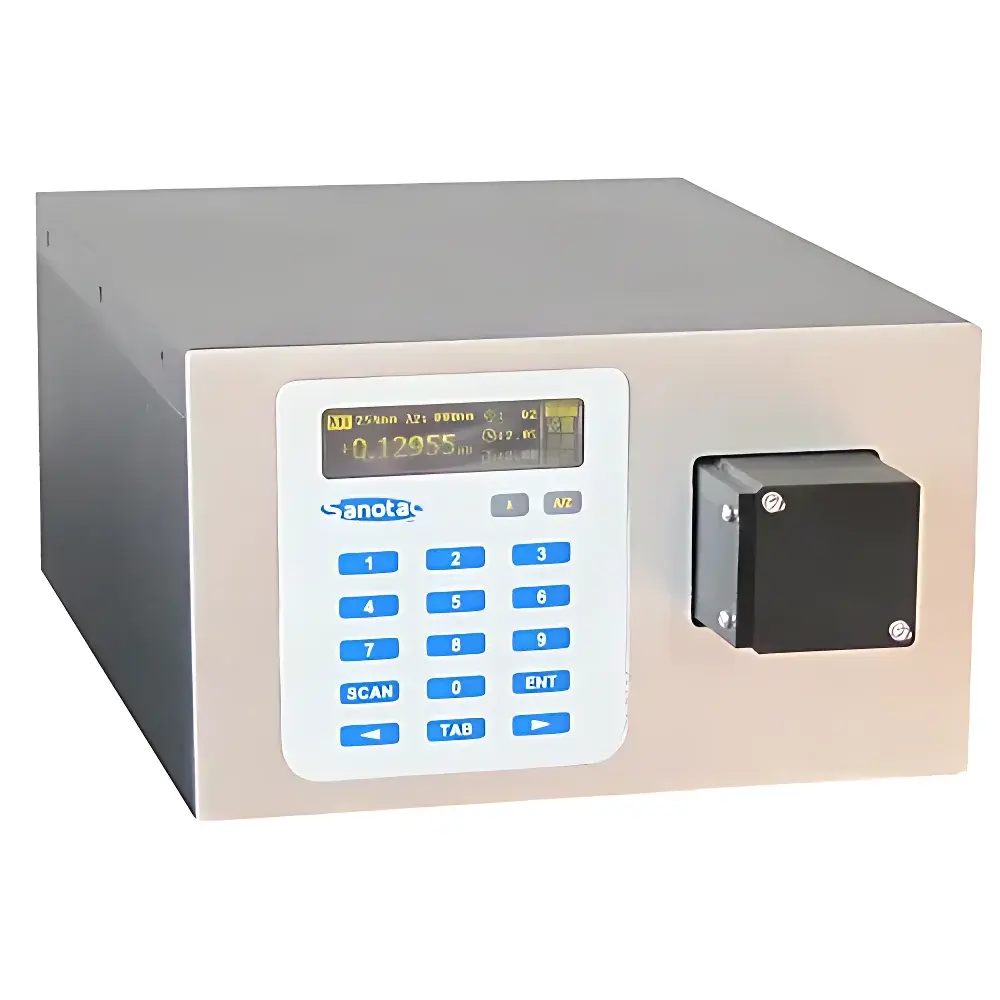
Sanotac B1001 Dual-Wavelength Online UV-Vis Nucleic Acid & Protein Detector
| Brand | Sanotac |
|---|---|
| Model | B1001 |
| Origin | Shanghai, China |
| Manufacturer Type | Direct Manufacturer |
| Product Category | Protein Quantification Analyzer |
| Detection Principle | Magnetic Immuno-Chromatographic Assay (MIC) coupled with Dual-Wavelength UV-Vis Absorption Spectrophotometry |
| Wavelength Range | 190–700 nm (simultaneous dual-wavelength detection) |
| Wavelength Repeatability | ±0.2 nm |
| Wavelength Accuracy | ±1 nm |
| Detection Limit | 5×10⁻⁹ g/mL |
| Recovery Rate | 99% |
| Optical Path Length | Adjustable (1–5 mm) |
| Baseline Noise | ±0.5×10⁻⁵ AU (254 nm, TC = 1 s) |
| Baseline Drift | 1.5×10⁻⁴ AU (254 nm, 1 h) |
| Absorbance Range | 0–3 AU |
| Time Constants | 0.1 / 0.2 / 0.5 / 1.0 / 2.0 / 5.0 / 10.0 s |
| Light Source | Integrated Deuterium Lamp + Tungsten-Halogen Lamp (auto-switching) |
| Flow Cell Interfaces | 1/16″ for analytical/semi-preparative, 1/8″ for preparative applications |
| Data Interface | USB + RS-232 |
| Software Compliance | FDA 21 CFR Part 11, CFDA GxP, GLP/GMP-ready audit trail and electronic signature support |
Overview
The Sanotac B1001 Dual-Wavelength Online UV-Vis Nucleic Acid & Protein Detector is a precision optical detection module engineered for real-time quantification and qualitative monitoring of biomolecules during liquid chromatography-based purification workflows. It operates on the fundamental principle of ultraviolet–visible absorption spectrophotometry, leveraging Beer–Lambert law-based photometric measurement to determine concentration of analytes—including proteins, nucleic acids, peptides, and enzymes—that exhibit characteristic absorbance in the 190–700 nm spectral range. Unlike endpoint assay systems, the B1001 integrates directly into mid-pressure chromatographic systems (e.g., gel filtration, ion exchange, affinity, and hydrophobic interaction chromatography), enabling continuous, non-destructive, in-line detection without sample diversion or dilution. Its dual-wavelength capability allows simultaneous monitoring at two user-selectable wavelengths—commonly 280 nm (for aromatic amino acids in proteins) and 260 nm (for nucleic acid backbone)—supporting ratio-based analysis (e.g., A260/A280) critical for purity assessment. The instrument employs a dual-beam optical architecture with auto-switching deuterium and tungsten-halogen lamps, ensuring stable baseline performance across both deep-UV and visible regions.
Key Features
- Dual-wavelength real-time detection (190–700 nm) with ±0.2 nm repeatability and ±1 nm accuracy, validated per ISO 17025 traceable calibration protocols
- Adjustable flow cell pathlength (1–5 mm), optimized for analytical, semi-preparative, and preparative-scale separations without external splitting
- Integrated digital zeroing and full-scale auto-calibration; no manual mechanical adjustment required
- Three wavelength scanning modes (fixed, gradient, and sweep), plus ten customizable user-defined methods stored locally and via project-based database management
- Open communication protocol (RS-232/USB) compliant with ASTM E1382 and ISO/IEC 17025 data exchange standards, enabling third-party HPLC/UHPLC system integration
- Self-luminous 256×64 dot-matrix LCD display with uniform brightness across viewing angles and adjustable backlight for laboratory ambient lighting conditions
- Robust mechanical design rated for continuous operation under 85–264 VAC input and ≤150 W power consumption
Sample Compatibility & Compliance
The B1001 supports aqueous and organic-aqueous mobile phases commonly used in protein purification (e.g., phosphate buffers, imidazole gradients, NaCl elution, and acetonitrile/water mixtures). It is compatible with standard chromatographic hardware—including glass and stainless-steel columns (ID 4.6–25 mm), SPE cartridges, and fraction collectors—from all major vendors. Regulatory compliance is embedded at the system level: software enforces role-based access control (RBAC), time-stamped electronic signatures, immutable audit trails, and data integrity safeguards aligned with FDA 21 CFR Part 11, CFDA GxP guidelines, and EU Annex 11 requirements. All method parameters, raw chromatograms, peak integration settings, and calibration logs are stored within a relational database schema, supporting retrospective review and regulatory inspection readiness.
Software & Data Management
Control and data acquisition are managed through a Windows-native workstation application (compatible with Windows 7/8/10/11), offering synchronized control of peristaltic pumps, conductivity detectors, fraction collectors, and the B1001 detector itself. The software implements project-level data organization—each project contains associated instrument methods, calibration files, chromatograms, integration reports, and exportable CSV/PDF outputs. Raw absorbance data is recorded at ≥10 Hz sampling rate, with configurable time constants (0.1–10.0 s) to balance signal-to-noise ratio and dynamic response. Peak detection algorithms apply first-derivative thresholding and valley-to-valley integration, with optional manual correction. All user actions—including parameter changes, calibration events, and report generation—are logged with operator ID, timestamp, and contextual metadata, fulfilling ALCOA+ (Attributable, Legible, Contemporaneous, Original, Accurate, Complete, Consistent, Enduring, Available) data governance criteria.
Applications
The B1001 serves as a core detection module in academic and industrial bioprocessing labs performing recombinant protein purification, monoclonal antibody isolation, plasmid DNA recovery, viral vector characterization, and food-grade enzyme activity profiling. It is routinely deployed in GMP-compliant downstream processing for vaccine development, biosimilar manufacturing, and nutraceutical quality control. In food science laboratories, it enables rapid verification of protein enrichment in dairy, soy, and cereal matrices, as well as detection of nucleic acid contaminants in fermented products. Its high sensitivity (LOD: 5×10⁻⁹ g/mL) and linear dynamic range (0–3 AU) make it suitable for both low-abundance target quantification and high-concentration process stream monitoring.
FAQ
What chromatographic techniques is the B1001 compatible with?
It supports gel filtration (SEC), ion exchange (IEX), hydrophobic interaction (HIC), affinity (e.g., His-tag, Protein A), and reversed-phase (RP) chromatography when paired with appropriate column chemistries and mobile phases.
Does the B1001 require external calibration standards for routine use?
No—built-in wavelength verification using holmium oxide and didymium filters enables automated self-validation; quantitative calibration is performed using certified reference materials traceable to NIST SRM 936a.
Can the B1001 be integrated into an existing non-Sanotac chromatography system?
Yes—its open ASCII-based command protocol and dual serial/USB interfaces allow seamless integration with third-party pumps, fraction collectors, and data systems.
Is the software validated for regulated environments?
Yes—the workstation includes IQ/OQ documentation templates, change control logs, and 21 CFR Part 11-compliant electronic signature implementation with multi-factor authentication options.
What maintenance is required for long-term stability?
Annual lamp replacement (deuterium and tungsten), quarterly flow cell cleaning with 20% isopropanol, and biannual optical alignment verification using factory-certified alignment tools.
Related Products





