
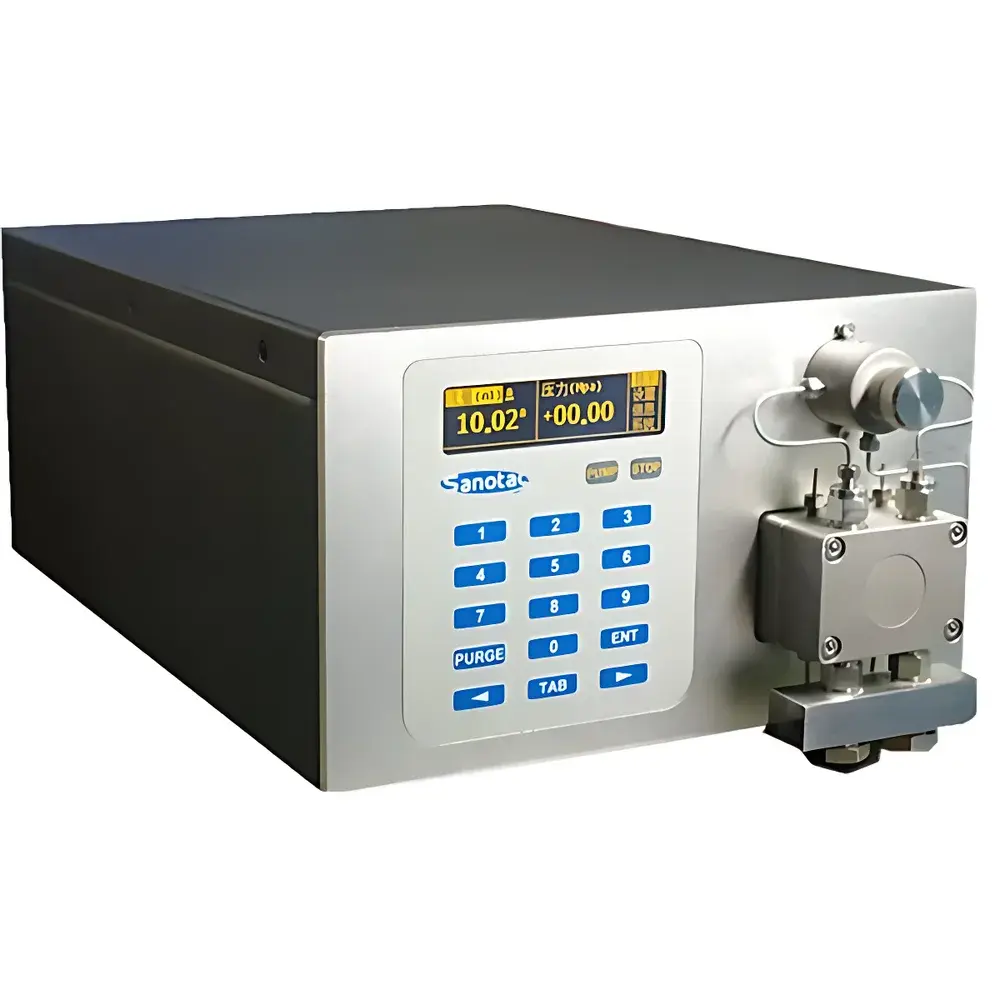
Sanotac SPT0530 Titanium Alloy High-Pressure Constant Flow Pump
| Brand | Sanotac |
|---|---|
| Origin | Shanghai, China |
| Manufacturer Type | Direct Manufacturer |
| Model | SPT0530 |
| Flow Rate | 50 mL/min |
| Maximum Pressure | 30 MPa |
| Construction Material | Grade 2 Titanium (Ti-6Al-4V compatible) |
| Flow Accuracy | ±0.3% RSD (at ≥1 mL/min) |
| Pressure Pulsation | <0.5% RMS |
| Gradient Capability | Isocratic, Linear, Step, and Custom Multi-Segment Profiles |
| Control Interface | RS-232/RS-485, Open Protocol for Third-Party HPLC Software Integration |
| Compliance | Designed to meet ISO 9001 manufacturing standards |
Overview
The Sanotac SPT0530 Titanium Alloy High-Pressure Constant Flow Pump is an engineered solution for precise, corrosion-resistant fluid delivery in demanding analytical and process-critical environments. Based on positive displacement reciprocating piston technology with dual parallel pump heads, it delivers stable volumetric flow under sustained high backpressure—up to 30 MPa (4350 psi)—without mechanical drift or seal fatigue. Its core architecture follows the Couette-flow principle in pump head hydraulics, where synchronized cam-driven pistons, coupled with real-time solvent compressibility compensation algorithms, ensure consistent delivery across wide viscosity and temperature gradients. Unlike stainless-steel or PEEK-based alternatives, the SPT0530 employs ASTM B348 Grade 2 titanium for all wetted surfaces—including pump heads, check valves, inlet/outlet manifolds, and fluidic pathways—providing exceptional resistance to halide-induced pitting, strong acids (e.g., HCl, HNO₃), oxidizing media, and supercritical CO₂ environments. This makes it particularly suitable for applications where long-term chemical integrity, minimal metal leaching, and regulatory traceability are mandatory.
Key Features
- Titanium-wetted path construction (ASTM B348 Gr.2) ensures immunity to chloride stress corrosion cracking and compatibility with aggressive solvents used in petrochemical catalysis and battery electrolyte research.
- Dual parallel piston architecture with microprocessor-controlled cam profile optimization minimizes flow pulsation (<0.5% RMS) and enables high reproducibility (±0.3% RSD) across the full operating range (0.01–50 mL/min).
- Integrated solvent compressibility compensation adjusts stroke volume dynamically based on fluid density and system pressure—critical for accurate delivery of low-compressibility solvents (e.g., acetonitrile/water mixtures) at >20 MPa.
- Multi-segment gradient generation supports isocratic hold, linear ramp, step transitions, and user-defined non-linear profiles—enabling method development for complex separations in preparative HPLC and SFC.
- Floating plunger design reduces radial loading on high-pressure seals, extending service life of Ti-compatible fluoropolymer sealing elements beyond 12,000 hours of continuous operation.
- Open communication protocol (RS-232/RS-485) allows native integration with third-party chromatography data systems (CDS), including Thermo Chromeleon, Waters Empower, and Agilent OpenLab—supporting FDA 21 CFR Part 11–compliant audit trails when paired with validated software layers.
Sample Compatibility & Compliance
The SPT0530 maintains operational stability with a broad spectrum of chemically aggressive samples and mobile phases: concentrated mineral acids (up to 6 M HCl), alkaline solutions (pH 13 NaOH), hydrogen peroxide (>30%), supercritical fluids (scCO₂, scCHF₃), organometallic catalysts, and battery-grade LiPF₆ electrolytes. Its titanium fluid path meets ASTM F136 biocompatibility requirements for extractables testing and complies with ISO 13485 material traceability protocols. While not certified as intrinsically safe, it conforms to IEC 61010-1 for laboratory equipment safety and supports GxP-aligned validation documentation packages—including IQ/OQ/PQ templates, calibration certificates (NIST-traceable flow verification), and materials of construction declarations (EN 10204 3.1).
Software & Data Management
The embedded firmware supports local programming of up to 10 independent methods, each configurable with flow rate ramps, gradient segments, pressure limits, and auto-shutdown triggers. All parameter changes are timestamped and stored in non-volatile memory with cyclic overwrite protection. When connected to external CDS platforms via serial interface, the pump transmits real-time telemetry—including actual flow rate, instantaneous pressure, motor load, and error codes—with millisecond-level resolution. Raw data streams can be logged in CSV or XML format for post-acquisition analysis in MATLAB or Python-based QC pipelines. Audit trail functionality (enabled via host software) records operator ID, parameter modification history, and system event logs—meeting ALCOA+ principles for data integrity in regulated laboratories.
Applications
- Preparative and analytical liquid chromatography (HPLC, UHPLC, SFC) requiring inert fluidic paths for trace-metal-sensitive analyses (e.g., ICP-MS sample introduction).
- In-situ catalyst injection and reactant metering in continuous-flow microreactors and autoclave-based hydrothermal synthesis.
- Electrolyte dosing and pressure-controlled electrolyte circulation in lithium-ion and solid-state battery R&D test cells.
- Supercritical fluid extraction (SFE) and impregnation systems operating above 10 MPa with CO₂ or ethanol-modified scCO₂.
- High-pressure corrosion testing rigs simulating downhole oilfield conditions (H₂S/CO₂/brine mixtures at >150°C).
- Pharmaceutical crystallization studies involving acidic or basic antisolvent addition under controlled stoichiometric precision.
FAQ
What materials are in contact with the fluid path?
All wetted components—including pump heads, inlet/outlet check valves, manifold blocks, and tubing adapters—are fabricated from ASTM B348 Grade 2 titanium. Non-wetted structural parts use 316L stainless steel or aerospace-grade aluminum alloys.
Is the pump compatible with FDA-regulated pharmaceutical manufacturing?
Yes—when integrated into a validated chromatographic system with compliant CDS software, the SPT0530 supports 21 CFR Part 11 requirements for electronic records and signatures, provided audit trail logging and user access controls are implemented at the workstation level.
Can the pump operate continuously at maximum pressure (30 MPa)?
Yes—rated for continuous duty at 30 MPa with appropriate thermal management; ambient temperature must remain between 10–35°C, and fluid viscosity should not exceed 20 cP to maintain specified flow accuracy.
Does the pump support pulse-free flow for mass spectrometry coupling?
Yes—low-pressure pulsation (<0.5% RMS) and optional active flow smoothing firmware modules enable direct interfacing with ESI and APCI sources without additional dampeners.
How is calibration performed and documented?
Factory calibration uses NIST-traceable gravimetric flow standards across five points (0.1, 1, 10, 25, and 50 mL/min) at 20 MPa; users receive a certificate with uncertainty values (k=2) and may perform field verification using calibrated flow meters compliant with ISO 4064-2 Class B.



