
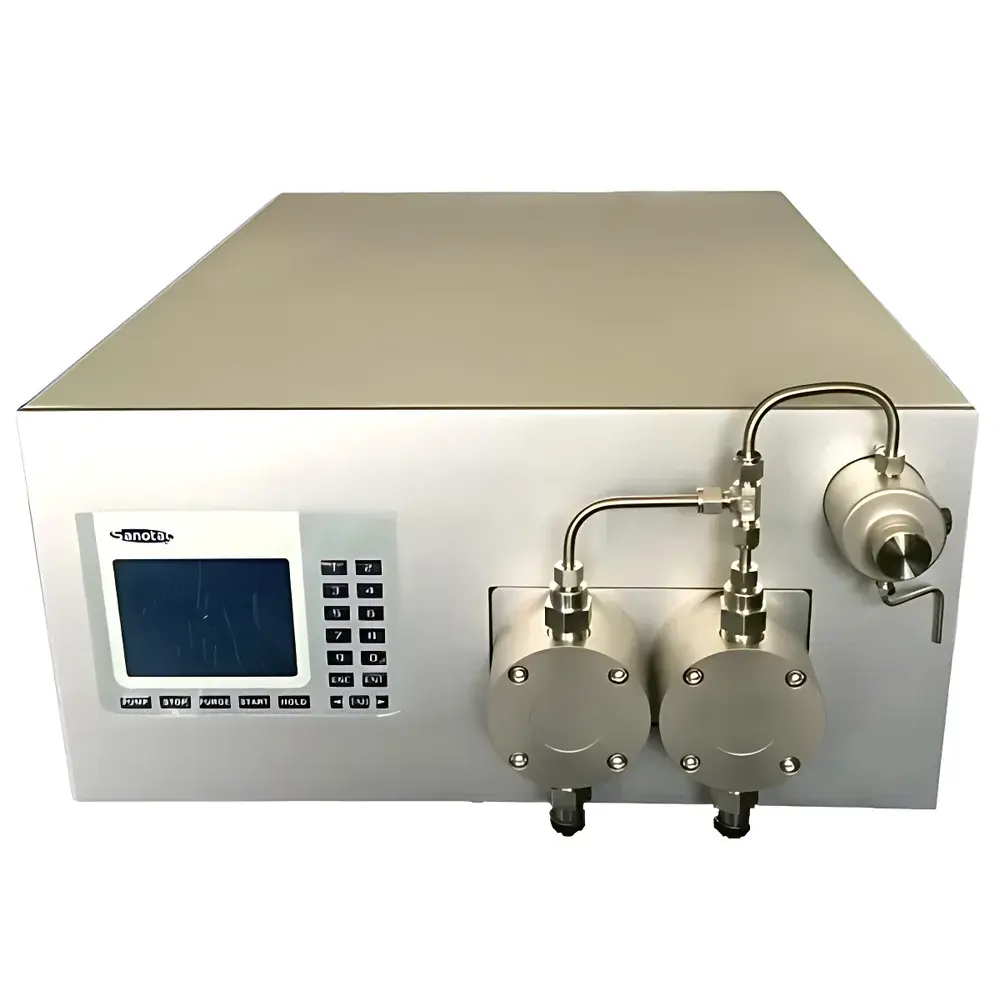
Sanotac KLP1010 High-Flow High-Pressure Dual-Piston Solvent Delivery Pump
| Brand | Sanotac |
|---|---|
| Origin | Shanghai, China |
| Manufacturer Type | Direct Manufacturer |
| Product Category | Domestic |
| Model | KLP1010 |
| Flow Range | 10–10,000 mL/min |
| Pressure Range | 2–42 MPa |
| Pump Head Options | Stainless Steel / Titanium / PTFE / PCTFE / Hastelloy / PEEK |
| Pricing Range | USD 2,800–7,000 (FOB) |
Overview
The Sanotac KLP1010 is a high-flow, high-pressure dual-piston solvent delivery pump engineered for precision fluid metering in demanding laboratory and pilot-scale process environments. Based on positive displacement piston actuation with dual-synchronized cam-driven heads, the KLP1010 operates on Couette-type volumetric displacement principles—ensuring consistent volumetric output independent of fluid viscosity or backpressure within its rated operating envelope. Its design targets applications requiring stable, pulse-dampened flow across wide dynamic ranges—from analytical-scale HPLC feed to industrial catalytic reactor dosing, supercritical fluid delivery, and continuous-flow synthesis systems. Unlike single-piston or peristaltic alternatives, the KLP1010’s parallel dual-head architecture enables true continuous flow without dead-volume interruption, critical for gradient elution integrity and long-duration unattended operation.
Key Features
- Dual-synchronized piston heads with microprocessor-controlled cam profile compensation, minimizing pressure ripple to < ±0.2% RSD over full flow range
- Multi-point flow calibration algorithm supporting linear, stepwise, and custom non-linear gradient profiles—including hybrid gradients combining isocratic hold, linear ramp, and discrete step transitions
- Floating piston seal design with low-friction ceramic-coated rods and self-aligning PTFE composite seals, extending service life under sustained 42 MPa operation
- Integrated electronic pulse suppression circuitry synchronized with cam position feedback, reducing hydraulic pulsation amplitude by >90% versus conventional dual-piston pumps
- Modular wetted-path construction: interchangeable pump heads available in stainless steel (316L), titanium (Grade 2), PTFE-lined, PCTFE, Hastelloy C-276, and PEEK—each certified for compatibility with aggressive solvents, acids, bases, and supercritical CO₂
- Front-panel interface with 5.7″ TFT LCD, supporting 10 user-defined methods with programmable flow rate, gradient slope, hold time, and pressure limit thresholds
Sample Compatibility & Compliance
The KLP1010 accommodates Newtonian and mildly shear-thinning fluids with viscosities up to 500 cP at 25°C and particulate loadings ≤5 µm (with optional inlet filtration). It complies with IEC 61000-6-2 (EMC immunity) and IEC 61010-1 (safety for laboratory equipment). Wetted materials meet USP Class VI biocompatibility requirements where applicable (e.g., PEEK, PTFE variants). For regulated environments, the pump supports audit-trail-capable operation when integrated with validated chromatography data systems compliant with FDA 21 CFR Part 11—requiring external software configuration for electronic signature, event logging, and user role-based access control. No internal battery-backed memory; all method parameters persist via EEPROM with write-cycle endurance ≥1 million cycles.
Software & Data Management
The KLP1010 implements an open ASCII-based RS-232/RS-485 communication protocol (also available via optional USB-C or Ethernet TCP/IP module), enabling native integration with third-party chromatography data systems (CDS), SCADA platforms, or custom LabVIEW/Python control scripts. Command syntax follows ANSI X3.4 conventions, supporting real-time flow setpoint updates, pressure readback, status polling (e.g., “READY”, “PAUSED”, “OVERPRESSURE”), and firmware version interrogation. All communications are ASCII-encoded with CR/LF termination; no proprietary drivers required. Data export supports CSV-formatted logs (timestamp, setpoint flow, actual flow, pressure, temperature) at user-configurable intervals (100 ms–60 s). Local storage is limited to method recall—no onboard data archiving.
Applications
- HPLC and preparative LC systems requiring flow rates beyond 500 mL/min at pressures up to 42 MPa
- Catalytic reaction engineering: precise co-feeding of catalyst precursors, oxidants, and substrates into fixed-bed or slurry reactors
- Supercritical fluid processing (SFC, scCO₂ extraction): stable delivery of modifier solvents under dense-phase conditions
- Continuous hydrothermal synthesis and nanoparticle precipitation reactors
- Electrochemical flow cells and fuel cell membrane testing rigs
- High-throughput formulation screening in pharmaceutical and battery electrolyte development
FAQ
What is the minimum programmable flow rate and its accuracy specification?
The KLP1010 achieves a minimum stable flow of 10 mL/min with ±0.5% RSD repeatability (n=6, water at 25°C, 10 MPa backpressure), verified per ISO 5725-2:2019 guidelines.
Can the pump operate continuously at maximum pressure (42 MPa)?
Yes—continuous operation at 42 MPa is supported for all wetted-path configurations rated for that pressure class, provided ambient temperature remains between 10–40°C and cooling airflow meets manufacturer-specified minimum velocity (≥0.5 m/s across heat sink fins).
Is gradient mixing performed internally or externally?
The KLP1010 is a high-pressure binary or quaternary pump: gradient formation occurs upstream of the pump head via proportioning valves; the pump itself delivers pre-mixed solvent streams at high pressure without internal mixing chambers.
Does the pump support automatic solvent degassing?
No—degassing is not integrated. Users must employ external inline vacuum degassers or sparging systems prior to pump inlet, especially for low-surface-tension solvents prone to cavitation at high flow rates.
What maintenance intervals are recommended for seal replacement?
Under typical use (20 MPa, 200 mL/min, aqueous/organic solvents), floating piston seals require inspection every 1,500 operational hours and replacement every 3,000 hours; titanium and Hastelloy variants extend this interval by ~40% in corrosive media.



