
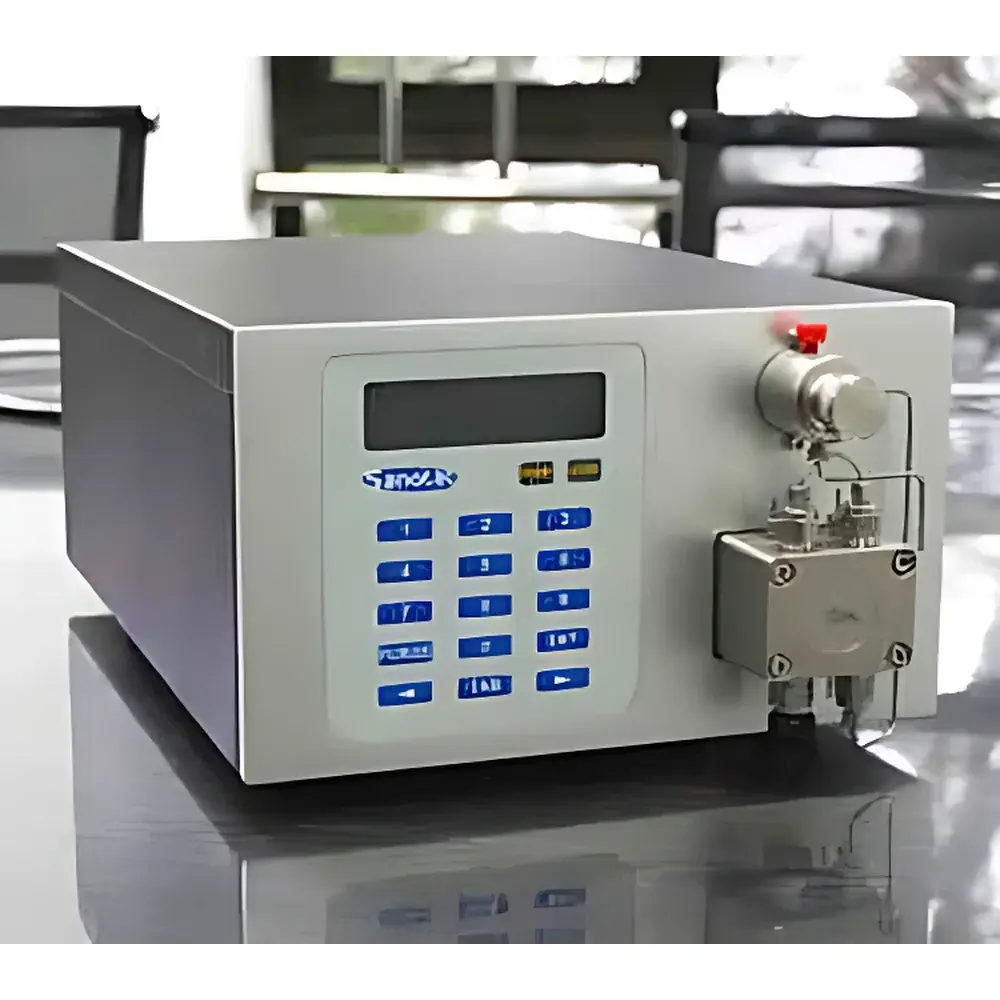
Sanotac N100 High-Pressure Infusion Pump for Lipid Nanoparticle (LNP) Formulation in DNA/mRNA Therapeutic Development
| Brand | Sanotac |
|---|---|
| Origin | Shanghai, China |
| Manufacturer Type | Direct Manufacturer |
| Product Category | Domestic |
| Model | N100 |
| Flow Rate | 0.01–100.00 mL/min (adjustable in 0.01 mL/min increments) |
| Pressure Range | 0–20 MPa (0–2900 psi) |
| Flow Accuracy | ±0.5% |
| Flow Precision (RSD) | ≤0.1% |
| Pressure Pulsation | ≤0.2 MPa |
| Pump Head Material | 316L Stainless Steel, Sapphire, PTFE, Ceramic |
| Fluidic Connection | 1/16" Standard Tubing Port |
| Display | 256×64-dot backlit LCD |
| Communication Interfaces | RS232 & USB (standard), RS485/RS422/Ethernet (optional) |
| Protocols | Modbus RTU/TCP, Profibus-DP, Profinet |
| Power Supply | 85–264 VAC, 50 Hz |
| Dimensions | 370 × 240 × 152 mm |
Overview
The Sanotac N100 High-Pressure Infusion Pump is an engineered constant-flow precision delivery system designed specifically for critical unit operations in nucleic acid therapeutic development—particularly lipid nanoparticle (LNP) formulation for mRNA and DNA drug delivery. Operating on a dual-piston parallel architecture with floating plunger design, the N100 delivers stable, pulse-minimized flow under sustained high pressure (up to 20 MPa / 2900 psi), enabling controlled microfluidic mixing of aqueous mRNA solutions and organic-phase lipid streams. This hydrodynamic focusing process—conducted within dedicated LNP microfluidic mixers—is essential for reproducible formation of uniform, sub-100 nm LNPs with narrow polydispersity index (PDI < 0.15). Unlike general-purpose peristaltic or syringe pumps, the N100’s robust 316L stainless steel fluid path, sapphire check valves, and ceramic seals ensure chemical compatibility with ethanol, chloroform, and other solvents commonly used in lipid dissolution, while maintaining long-term dimensional stability under continuous high-pressure operation.
Key Features
- Dual-piston parallel pumping mechanism with real-time cam-profile compensation and electronic flow pulsation suppression, achieving pressure pulsation ≤ 0.2 MPa and flow repeatability ≤ 0.1% RSD.
- Programmable pressure limits (upper/lower thresholds) with automatic shutdown and alarm logging—critical for protecting downstream microfluidic chips and ensuring process safety during GMP-compliant LNP synthesis.
- Two operational modes: constant-flow mode for steady-state formulation and gradient-flow mode for staged solvent exchange or multi-component lipid blending protocols.
- User-accessible flow calibration zone allowing field adjustment of volumetric (mL/min) or gravimetric (g/min) delivery rates to accommodate viscosity shifts across lipid formulations (e.g., DSPC:DOPE:Chol:mPEG-2000 mixtures).
- Real-time dual-curve visualization: synchronized pressure and flow rate trend plots displayed on the integrated 256×64 backlit LCD, supporting immediate process diagnostics without external software.
- Industrial-grade communication suite—including native Modbus RTU/TCP, Profibus-DP, and Profinet support—enabling seamless integration into validated control environments (e.g., Siemens S7 PLCs, Wonderware SCADA, LabVIEW-based QC workstations).
Sample Compatibility & Compliance
The N100 is compatible with standard 1/16″ PTFE, PEEK, or stainless-steel capillary tubing used in pharmaceutical microfluidics. Its wetted materials—316L stainless steel, sapphire, PTFE, and alumina ceramics—are resistant to common LNP formulation solvents (ethanol, isopropanol, ethyl acetate) and aqueous buffers (Tris-HCl, citrate, PBS). The pump meets mechanical safety requirements per ISO 13850 and electromagnetic compatibility standards per IEC 61326-1. While not certified as Class III medical device hardware, its architecture supports alignment with FDA 21 CFR Part 11 when deployed within validated computerized systems (e.g., with audit-trail-enabled HMI/SCADA layers). It has been successfully qualified in multiple GLP-compliant preclinical LNP process development campaigns and supports documentation packages required for regulatory submissions (e.g., IQ/OQ protocols, traceable calibration records).
Software & Data Management
The N100 operates as a deterministic peripheral in automated formulation workflows. Its embedded firmware provides timestamped event logging (pressure alarms, flow deviations, power cycles) accessible via RS232 or USB virtual COM port. When integrated with third-party control platforms—such as Siemens TIA Portal, Ignition SCADA, or custom Python-based orchestration tools—the pump exposes full parameter read/write access (setpoint, actual flow, current pressure, status flags) with millisecond-level command response. Optional Ethernet interface enables remote monitoring via HTTP API endpoints or MQTT telemetry ingestion into centralized data lakes. All communication channels support configurable baud rates, parity, and timeout settings to match legacy DCS infrastructure. Calibration coefficients are stored in non-volatile memory with write-protection logic to prevent unauthorized modification—a requirement for audit-ready environments.
Applications
- Microfluidic LNP synthesis for mRNA vaccine candidates (e.g., encapsulation of IVT mRNA encoding SARS-CoV-2 spike protein).
- Scalable process development from lab-scale (1–10 mg dose batches) to pilot-scale (100–500 mg) using identical pump dynamics and control logic.
- Co-infusion of ionizable lipids, helper lipids, cholesterol, and PEG-lipids with precise stoichiometric ratios to modulate LNP size, encapsulation efficiency (>90%), and endosomal escape kinetics.
- In-process monitoring of formulation consistency via real-time pressure/flow correlation analysis—deviations often indicate lipid precipitation, mixer clogging, or solvent phase separation.
- Integration into continuous manufacturing lines compliant with ICH Q5A(R2), Q5D, and emerging FDA guidance on continuous processing of advanced therapeutics.
FAQ
What is the maximum allowable backpressure for continuous operation?
The N100 is rated for continuous operation up to 20 MPa (2900 psi); short-term overpressure events up to 22 MPa are tolerated for ≤5 seconds without performance degradation.
Can the pump handle viscous lipid solutions (e.g., >30 cP at 25°C)?
Yes—its dual-piston design and torque-optimized stepper motor maintain rated accuracy across viscosities up to 50 cP when operated below 50 mL/min; higher viscosities require flow rate derating per manufacturer’s viscosity correction chart.
Is flow calibration traceable to NIST standards?
Calibration is performed using gravimetric methods traceable to national metrology institutes; certificate of calibration includes uncertainty budget and reference standard IDs per ISO/IEC 17025 guidelines.
Does the pump support 21 CFR Part 11-compliant electronic records?
The standalone pump does not include audit-trail or e-signature functionality; however, it fully supports integration with Part 11–compliant host systems that manage user authentication, change control, and electronic signature workflows.
What maintenance intervals are recommended for GMP environments?
Plunger seals and check valves require replacement every 500 operational hours or after 100 L total fluid volume processed—whichever occurs first—using Sanotac-certified spare kits with lot-controlled material certifications.
Related Products



