
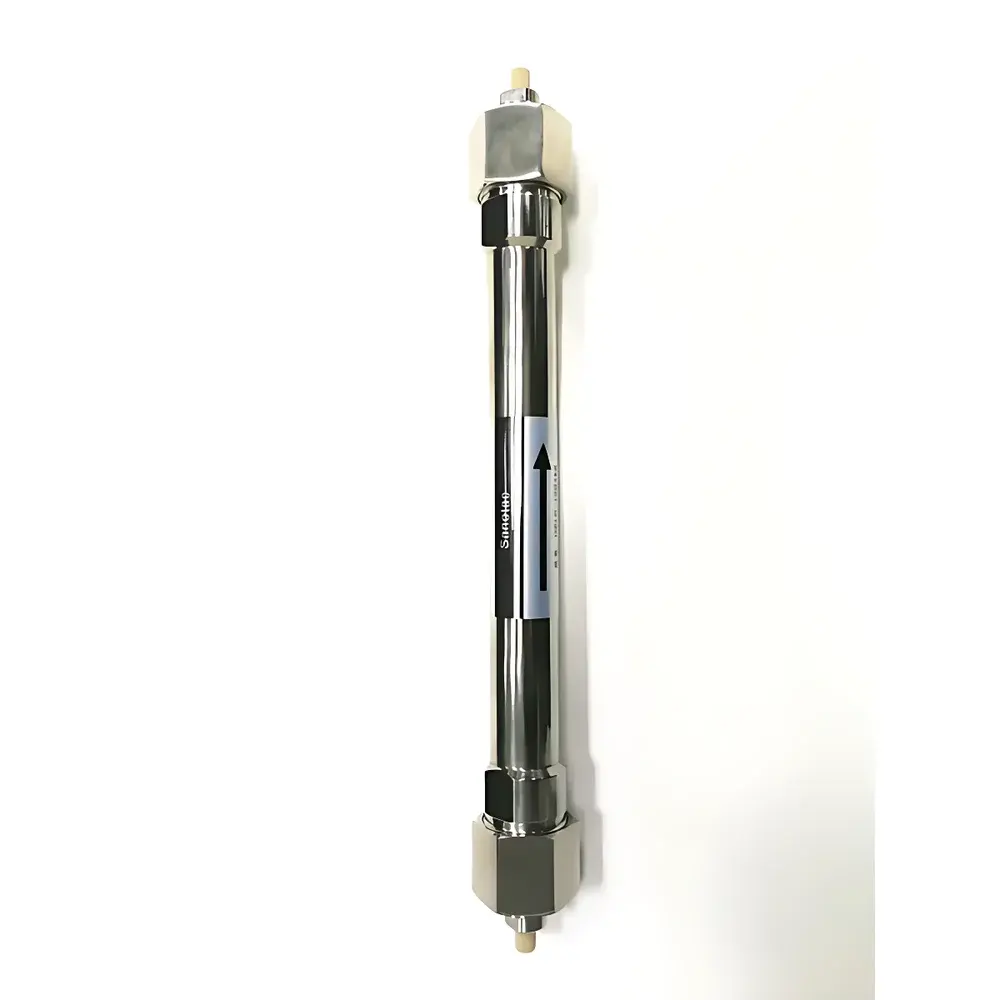
Sanotac S10C3025 Semi-Preparative/Preparative HPLC Column, C18 Reversed-Phase Chromatography Column
| Brand | Sanotac |
|---|---|
| Origin | Shanghai, China |
| Manufacturer Type | Direct Manufacturer |
| Product Category | Domestic |
| Model | S10C3025 |
| Application Level | Laboratory Grade |
| Instrument Type | High-Pressure Preparative Liquid Chromatography System |
| Flow Rate Range | 0.01–100.00 mL/min |
| Flow Accuracy | ±1% |
| Flow Precision (RSD) | ≤0.5% |
| Maximum Pressure Rating | 10 MPa |
| Wavelength Range | ±1 nm |
| Wavelength Reproducibility | 0.2 nm |
| Baseline Noise | ±0.5 × 10⁻⁵ AU (254 nm, TC = 1 s) |
| Data Acquisition Frequency | 10 Hz |
Overview
The Sanotac S10C3025 is a high-performance semi-preparative to preparative-scale reversed-phase HPLC column engineered for robust fractionation and purification of organic small molecules, natural product isolates, synthetic intermediates, and early-stage pharmaceutical compounds. Designed for integration into high-pressure preparative liquid chromatography systems, this column employs fully endcapped, spherical C18-bonded silica particles with 10 µm particle size and 120 Å pore diameter—optimized for high dynamic binding capacity, low backpressure generation, and consistent mass transfer kinetics under gradient elution conditions. Its stainless-steel housing complies with ISO 7206-1 mechanical integrity standards and supports sustained operation at up to 10 MPa (1450 psi), enabling scalable method transfer from analytical to preparative workflows without re-optimization of mobile phase composition or gradient profiles.
Key Features
- High-purity, metal-reduced silica base material ensures minimal acidic silanol activity and reduced tailing for basic analytes.
- Uniform 10 µm particle morphology and narrow particle size distribution (PSD < 1.1) deliver superior peak symmetry and resolution at preparative flow rates.
- Chemically stable C18 ligand with ≥95% surface coverage provides broad pH tolerance (pH 2–8) and resistance to hydrolytic degradation during extended use.
- Column dimensions: 30 mm I.D. × 250 mm length; packed bed volume ≈ 177 mL; recommended flow range: 15–30 mL/min for optimal efficiency and recovery yield.
- Factory-tested for pressure integrity, flow uniformity, and retention time reproducibility (RSD < 0.3% over 5 consecutive injections).
- Compatible with common HPLC solvents including acetonitrile, methanol, water, and buffered aqueous phases (e.g., ammonium acetate/formate, phosphate).
Sample Compatibility & Compliance
The S10C3025 column demonstrates validated compatibility with diverse compound classes—including alkaloids, flavonoids, peptides, heterocycles, and lipophilic drug candidates—without irreversible adsorption or column fouling under standard regeneration protocols. It meets ASTM D7720-19 guidelines for column performance verification in preparative separations and supports GLP-compliant documentation when deployed with FDA 21 CFR Part 11–enabled chromatography data systems (CDS). Batch-to-batch consistency is ensured through ISO 9001-certified manufacturing processes, with full traceability of raw materials, slurry preparation parameters, and packing pressure logs included in the Certificate of Analysis (CoA).
Software & Data Management
While the column itself is hardware-only, its performance metrics are fully integrable with industry-standard CDS platforms such as Waters Empower, Thermo Chromeleon, Agilent OpenLab CDS, and Shimadzu LabSolutions. Retention time stability, peak area reproducibility, and resolution values can be tracked across batches using automated QC reporting modules. When paired with Sanotac’s optional preparative system controllers (e.g., PuriFlash®-compatible interfaces), real-time UV absorbance data (254 nm, ±1 nm bandwidth) is acquired at 10 Hz sampling frequency, supporting precise fraction triggering based on integrated peak thresholds and baseline correction algorithms compliant with USP chromatographic system suitability criteria.
Applications
- Purification of synthetic APIs prior to crystallization and salt formation studies.
- Isolation of bioactive constituents from plant extracts and fermentation broths.
- Desalting and buffer exchange of peptide fragments post-solid-phase synthesis.
- Removal of residual catalysts (e.g., Pd, Ru) and protecting group byproducts in multistep organic synthesis.
- Scale-up support for method development from 4.6 mm analytical columns to 30 mm preparative format using linear velocity-based scaling principles.
- Stability-indicating purification of degradants for forced degradation studies per ICH Q1A(R2).
FAQ
What is the recommended equilibration protocol before first use?
Condition with 10 column volumes of 100% organic solvent (acetonitrile or methanol), followed by 15 CV of starting mobile phase at 50% of target flow rate. Monitor pressure and UV baseline stability before sample injection.
Can this column be used with TFA-containing mobile phases?
Yes, but prolonged exposure (>50 injections) may accelerate ligand hydrolysis; recommend post-run flushing with 20 CV of 100% water followed by 10 CV of isopropanol to remove residual TFA.
Is column regeneration possible after performance decline?
Regeneration is feasible via sequential flushing: 20 CV methanol → 20 CV dichloromethane → 20 CV methanol → 20 CV water → 20 CV starting mobile phase. Performance recovery should be verified using a standardized test mixture (e.g., USP Prednisone Mixture B).
Does Sanotac provide column lifetime validation data?
Yes—each batch undergoes accelerated lifetime testing (≥2000 injections under stress conditions); typical service life exceeds 1500 injections when operated within specified pH and pressure limits and maintained with proper cleaning protocols.
How does the S10C3025 compare to analytical C18 columns in terms of selectivity?
Selectivity is preserved across scales due to identical bonding chemistry and silica matrix; however, slight differences in k′ and α may arise from extra-column dispersion effects inherent to preparative tubing and detector cell geometry—not column intrinsic properties.




