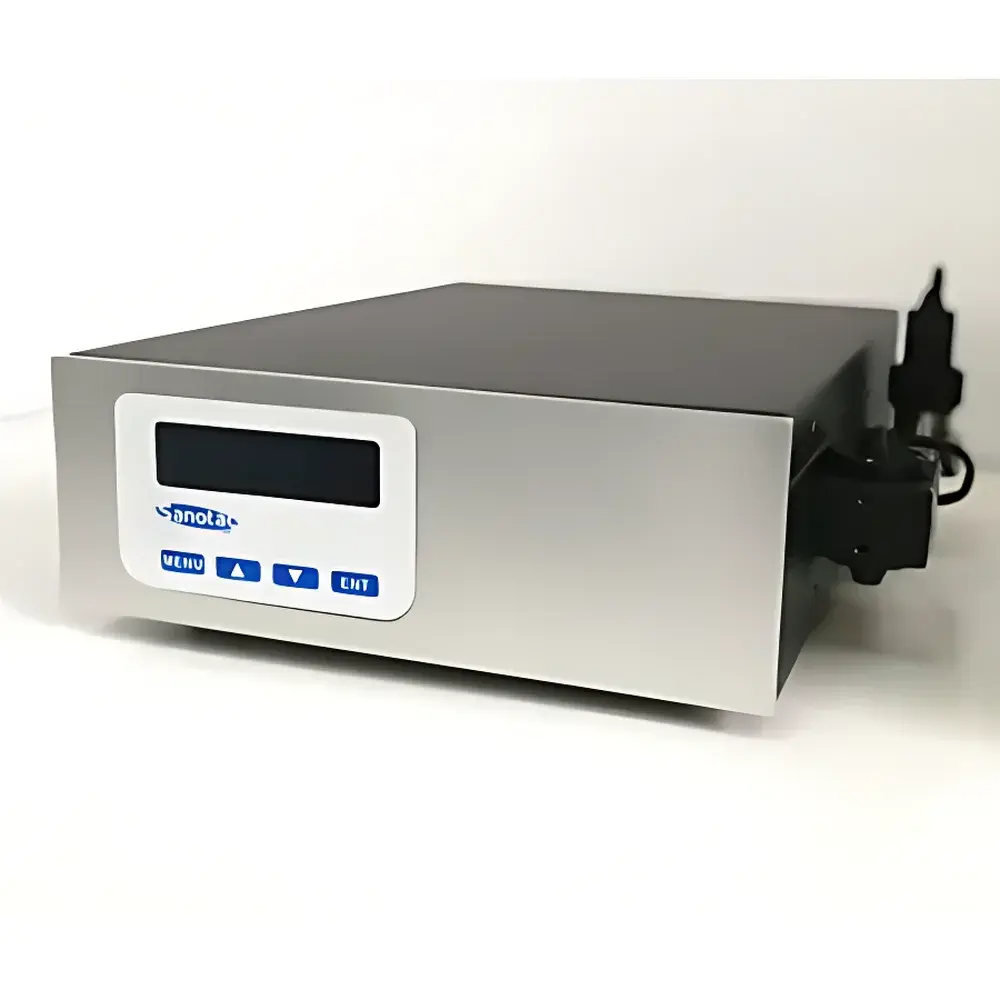
Sanotac C3000 Dedicated Conductivity Detector for Protein Purification Systems
| Brand | Sanotac |
|---|---|
| Origin | Shanghai, China |
| Manufacturer Type | OEM Manufacturer |
| Product Category | Domestic |
| Model | C3000 |
| Detection Principle | Conductivity Measurement |
| Detector Type | Conductivity Detector |
| Detection Range | 1 µS/cm – 500 mS/cm |
| Flow Rate Capacity | 0–3000 mL/min |
| Tubing Connection | 1/4" (6.35 mm) OD |
| Temperature Measurement Range | 0–99 °C |
| Temperature Accuracy | ±1 °C |
| Conductivity Accuracy | ±2% FS |
| Display | 256×64 dot-matrix backlit LCD |
| Control Interface | Front-panel keypad + PC-based remote control via USB/Ethernet |
| Software Compliance | FDA 21 CFR Part 11 (audit trail, electronic signature, role-based user access, data integrity safeguards) |
| Power Supply | 85–264 VAC, 50 Hz |
| Dimensions | 370 × 240 × 95 mm |
| Weight | ~4.2 kg |
Overview
The Sanotac C3000 Dedicated Conductivity Detector is an engineered component designed exclusively for integration into medium- to high-flow protein purification systems—particularly those used in preparative chromatography workflows involving ion exchange (IEX), hydrophobic interaction (HIC), and desalting steps. Operating on the principle of two-electrode AC conductivity measurement, the C3000 delivers real-time, temperature-compensated electrical conductivity data across a broad dynamic range (1 µS/cm to 500 mS/cm), enabling precise monitoring of buffer composition, gradient elution profiles, and column equilibration status. Its robust fluidic architecture supports continuous operation at flow rates up to 3000 mL/min through standardized 1/4″ (6.35 mm) tubing connections—making it compatible with industrial-scale FPLC and AKTA-style platforms. Unlike generic benchtop conductivity meters, the C3000 features built-in temperature sensing (0–99 °C, ±1 °C accuracy) and automatic temperature coefficient selection (α = 0.019–0.025 /°C), ensuring traceable, reproducible measurements under varying thermal conditions common in multi-hour purification runs.
Key Features
- High-flow compatibility: Engineered for seamless integration with preparative chromatography systems operating at 500–3000 mL/min, eliminating flow restriction or pressure drop concerns.
- Temperature-compensated conductivity detection: Integrated Pt1000 RTD sensor enables real-time compensation using selectable linear temperature coefficients per IUPAC and ASTM D1125 standards.
- Low-noise analog signal path: Optimized electrode design and shielded signal conditioning yield baseline stability < ±0.5 µS/cm over 24 h (at constant temperature and flow).
- Dual-mode operation: Supports standalone use via front-panel controls or full remote supervision via PC-based software with bi-directional communication (USB 2.0 or Ethernet).
- FDA 21 CFR Part 11-compliant software stack: Includes electronic signatures, immutable audit trails, role-based user authentication (admin/operator/observer), and data export in CSV/PDF formats with embedded metadata.
- Modular mechanical interface: Standard 1/4″ Swagelok-compatible ports simplify installation and maintenance without requiring custom adapters or seal replacements.
Sample Compatibility & Compliance
The C3000 is validated for use with aqueous biological buffers—including Tris-HCl, phosphate, sodium acetate, ammonium sulfate, and guanidine hydrochloride solutions—across pH 3–12 and conductivity ranges typical of protein purification protocols. It complies with ISO 17025 requirements for measurement traceability when calibrated against NIST-traceable KCl standards (e.g., 1413 µS/cm, 12.88 mS/cm). All firmware and software components undergo periodic validation per GMP Annex 11 and GLP guidelines. The detector’s housing meets IP20 environmental rating, and its wetted parts (316L stainless steel electrodes, PEEK flow cell body) are certified non-pyrogenic and extractables-tested per USP .
Software & Data Management
The included Windows-based control software provides synchronized acquisition of conductivity, temperature, and system timing data alongside pump and fraction collector events. Raw data files are stored in encrypted binary format with SHA-256 checksums; exported reports include timestamped calibration logs, operator IDs, and instrument configuration snapshots. Audit trails record every parameter change, method load, calibration event, or user login—retained for ≥36 months by default. Software updates are digitally signed and version-controlled, with rollback capability for regulatory continuity.
Applications
- Monitoring conductivity gradients during stepwise or linear elution in IEX chromatography of monoclonal antibodies (mAbs) and Fc-fusion proteins.
- Verifying buffer exchange efficiency in desalting and diafiltration steps prior to SEC or viral clearance filtration.
- Real-time tracking of conductivity shifts during capture-elution cycles in affinity purification of His-tagged recombinant proteins.
- Supporting process analytical technology (PAT) initiatives in compliance with ICH Q5, Q8, and Q9 frameworks for biologics manufacturing.
- Enabling automated decision logic in closed-loop purification systems—e.g., triggering fraction collection upon detection of conductivity thresholds indicative of target elution peaks.
FAQ
Is the C3000 compatible with third-party chromatography systems beyond Sanotac’s BIOLOT series?
Yes—the C3000 communicates via standard RS-232/USB virtual COM port or TCP/IP protocol, supporting integration with GE Cytiva AKTA, Bio-Rad NGC, and other vendors’ controllers through OEM SDK or Modbus TCP mapping.
Does the detector require periodic recalibration during extended purification runs?
No routine recalibration is needed within a single run; however, daily verification using a certified reference solution (e.g., 1413 µS/cm KCl) is recommended per SOP-driven quality systems.
Can conductivity data be synchronized with UV absorbance and pH signals in one timeline?
Yes—when used with Sanotac’s BIOLOT100 platform or compatible multi-channel DAQ systems, all sensor streams are time-aligned with microsecond precision and exported as unified datasets.
What materials contact the sample stream, and are they compliant with USP Class VI testing?
Wetted surfaces consist of electropolished 316L stainless steel electrodes and medical-grade PEEK flow cell—both independently tested and certified USP Class VI and ISO 10993-5 cytotoxicity compliant.