
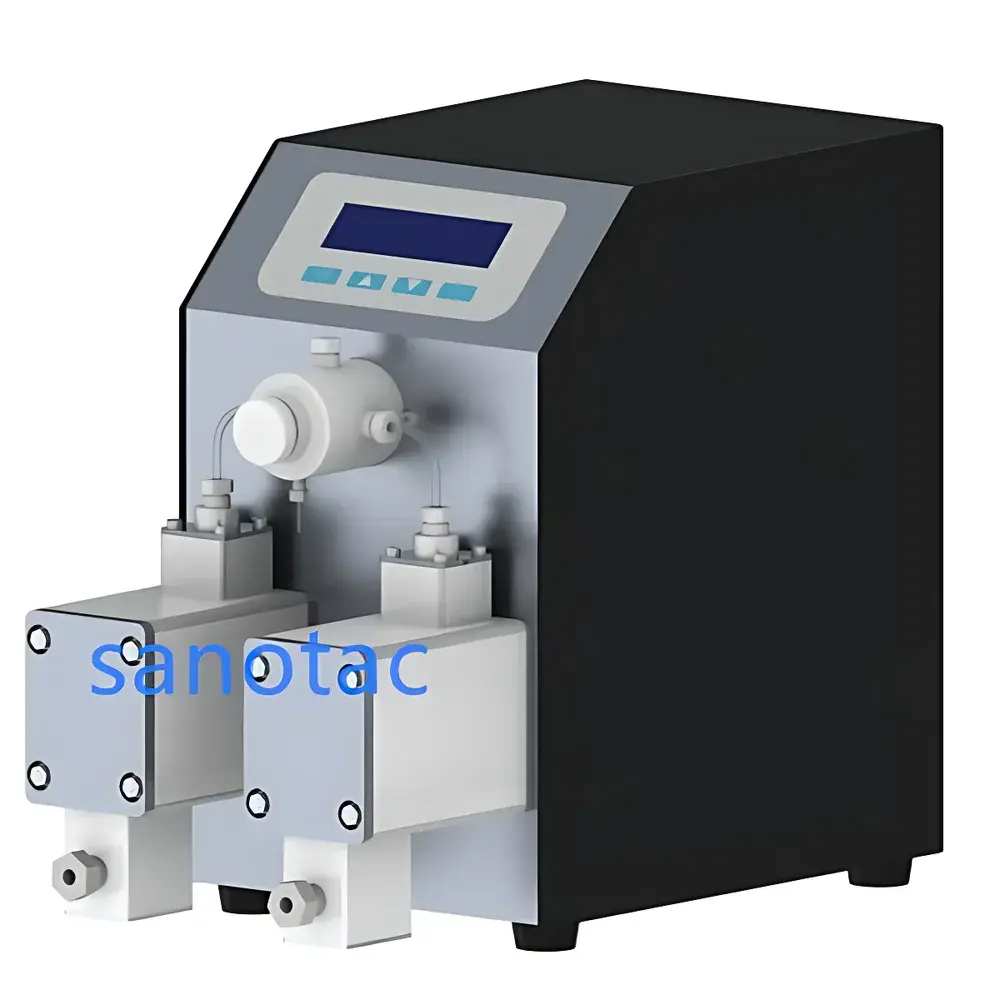
Sanotac BM10 Diaphragm-Type Precision Metering Pump with Fully Fluorinated Flow Path
| Brand | Sanotac |
|---|---|
| Model | BM10 |
| Flow Range | 1.0–10.0 mL/min |
| Accuracy | ±1% |
| Max Pressure | ≤0.5 MPa |
| Wetted Materials | PTFE, PFA, Specialty Ceramic |
| Inlet Port | φ6 mm × φ4 mm |
| Outlet Port | φ3.175 mm × φ1.58 mm |
| Viscosity Range | 0–300 cP |
| Increment Resolution | 0.1 mL/min |
| Communication | USB, RS232, RS485 (Modbus) |
| Power Supply | 85–264 VAC, 50 Hz |
| Power Consumption | 20 W |
| Weight | 8 kg |
| Dimensions | 362 × 169 × 278 mm |
Overview
The Sanotac BM10 is a diaphragm-type precision metering pump engineered for ultra-high chemical compatibility and leak-free operation in critical fluid handling applications. Unlike conventional plunger or peristaltic pumps, the BM10 employs a hermetically sealed fluoropolymer diaphragm actuation system—eliminating dynamic seals, shaft penetrations, and metal-wetted components. Its measurement principle relies on precise linear displacement of a flexible PFA/PTFE diaphragm driven by a high-resolution lead screw mechanism, ensuring repeatable volumetric delivery without pulsation-induced flow deviation. This architecture inherently satisfies stringent requirements for semiconductor front-end process tools, battery electrolyte formulation lines, and GMP-compliant pharmaceutical synthesis—where trace metal contamination, particle generation, and vapor-phase ingress must be rigorously controlled. The fully fluorinated flow path (including PFA tubing, PTFE valve seats, and ceramic check valves) enables stable, long-term transport of aggressive reagents such as anhydrous hydrogen fluoride (HF), phosphorus trichloride (PCl₃), oleum, fuming nitric acid, and organolithium compounds—substances that rapidly degrade elastomers, stainless steel, and standard polymer components.
Key Features
- Fully metal-free wetted path constructed exclusively from PTFE, PFA, and chemically inert specialty ceramics—certified for continuous exposure to HF, PCl₃, Br₂, Cl₂, chlorosulfonic acid, and >98% H₂SO₄
- Zero dynamic seals or sliding interfaces—no O-rings, no packing glands, no rotating shafts—thereby eliminating seal degradation, fugitive emissions, and particulate shedding
- Hermetic diaphragm isolation prevents ambient air or moisture ingress, mitigating crystallization of hygroscopic electrolytes (e.g., LiPF₆ solutions) and oxidation-sensitive reagents (e.g., n-BuLi)
- Lead-screw-driven linear actuation delivers true continuous flow with <0.1 mL/min resolution and ±1% volumetric accuracy across the full 1.0–10.0 mL/min range
- Robust pressure capability up to 0.5 MPa (72.5 psi) supports back-pressure regulation in closed-loop synthesis reactors and inline dilution manifolds
- Multi-protocol digital interface (USB, RS232, RS485) with Modbus RTU support enables seamless integration into PLC-controlled process skids and SCADA systems compliant with ISA-88/ISA-95 standards
Sample Compatibility & Compliance
The BM10 is validated for use with Class 3A and Class 4A corrosive liquids per ASTM D1654 classification, including but not limited to: hydrofluoric acid (49% and anhydrous), liquid hydrogen fluoride, phosphorus trichloride, bromine, chlorine, sulfuryl chloride, oleum (fuming sulfuric acid), fuming nitric acid (≥90%), concentrated phosphoric acid (85%), and pyrophoric organometallics. Its construction materials meet USP Class VI biocompatibility requirements and are compatible with ISO 14644-1 Class 5 (ISO Class 5) cleanroom environments when installed with appropriate filtration and venting. The pump’s design supports audit readiness for FDA 21 CFR Part 11 electronic record integrity, with optional firmware logging of run parameters, start/stop timestamps, and error codes—traceable to GLP/GMP documentation workflows.
Software & Data Management
Sanotac provides a dedicated PC-based configuration utility supporting real-time flow rate adjustment, duty cycle programming, and alarm threshold setting (e.g., pressure fault, motor stall, communication timeout). All operational data—including cumulative volume dispensed, instantaneous flow rate, motor current draw, and thermal status—are timestamped and exportable in CSV format. When deployed in networked configurations via RS485 daisy-chaining, the BM10 supports synchronized multi-pump sequencing for ratio-controlled reagent addition (e.g., cathode slurry formulation). Firmware updates preserve calibration coefficients and user-defined profiles, ensuring continuity during routine maintenance cycles.
Applications
- Semiconductor manufacturing: Precise delivery of photoresist developers, HF-based etchants, and high-purity electronic-grade solvents in track and wet bench systems
- Lithium-ion battery production: Metering of LiPF₆ electrolyte blends, binder slurries, and NMP-based cathode coatings under nitrogen glovebox conditions
- Fine chemical synthesis: Controlled addition of pyrophoric reagents (e.g., t-BuLi, Grignard reagents) and moisture-sensitive catalysts in continuous flow reactors
- Pharmaceutical R&D: Solvent and reagent dosing in automated parallel synthesis platforms requiring USP compliant fluid paths
- Environmental testing labs: Calibration-standard delivery for EPA Method 300.0 and ISO 10304-1 ion chromatography sample introduction
FAQ
What materials constitute the complete wetted path?
The entire fluid-contacting surface consists of molded PTFE valve bodies, PFA diaphragms and tubing, and alumina ceramic ball-and-seat check valves—no metals, elastomers, or adhesives are present.
Can the BM10 handle two-phase (gas-liquid) mixtures?
Yes—the positive displacement diaphragm design tolerates entrained microbubbles and low-level vapor without cavitation or loss of prime, provided gas fraction remains below 5% v/v.
Is the pump suitable for use in explosion-hazardous areas?
The BM10 is not intrinsically safe certified; however, it may be installed in Zone 2/Class I Division 2 environments when housed in a purged enclosure meeting NEC 500 or IEC 60079-13 requirements.
How is flow calibration verified and maintained?
Factory calibration uses gravimetric NIST-traceable standards; users may perform field verification using calibrated mass flow meters or timed volumetric collection—no disassembly required.
Does the pump support remote start/stop via digital input?
Yes—opto-isolated digital I/O terminals accept 3–24 VDC signals for external interlock control, emergency stop, and batch-triggered dispensing sequences.



