
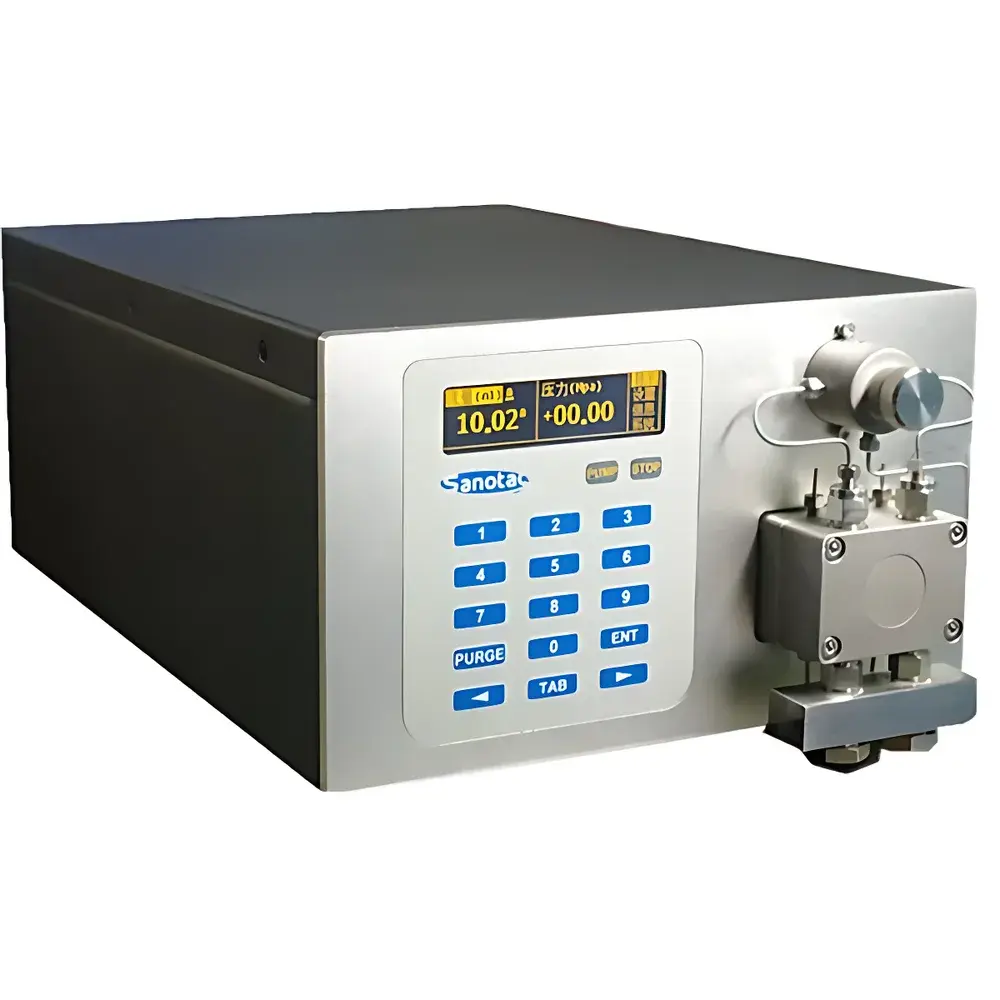
Sanotac SP1020 Preparative High-Pressure Solvent Delivery Pump (100 mL Head, 20 MPa)
| Brand | Sanotac |
|---|---|
| Origin | Shanghai, China |
| Manufacturer Type | Direct Manufacturer |
| Model | SP-1020 |
| Flow Rate | 0.01–100.00 mL/min (0.01 mL/min increment) |
| Maximum Pressure | 20 MPa |
| Flow Accuracy | ±0.5% |
| Flow Precision (RSD) | ≤0.1% |
| Pressure Pulsation | ≤0.2 MPa |
| Display | 256×64-dot backlit LCD with uniform luminance |
| Control Interface | Front-panel keypad + RS232/USB computer remote control (open protocol) |
| Power Supply | 85–264 VAC, 150 W |
Overview
The Sanotac SP1020 Preparative High-Pressure Solvent Delivery Pump is an engineered solution for precise, high-stability liquid delivery in preparative chromatography, process-scale purification, and continuous-flow synthesis applications. Built upon a dual-piston parallel architecture with floating piston design, the pump delivers robust performance across a wide dynamic range—from trace-level analytical prep to milliliter-per-minute fraction collection. Its microprocessor-controlled fluidic system incorporates real-time chamber pressure feedback to dynamically compensate for solvent compressibility and refill lag, ensuring consistent volumetric displacement under varying backpressures up to 20 MPa (2900 psi). This architecture enables stable flow generation even with low-compressibility solvents (e.g., acetonitrile, methanol) and high-viscosity mobile phases (e.g., DMSO/water mixtures), making it suitable for flash chromatography, SMB (simulated moving bed), and multi-column recycling systems.
Key Features
- Dual parallel plunger design with active floating piston mechanism—minimizes seal wear and extends service life of 316L stainless steel pump heads beyond 10,000 hours of continuous operation.
- Real-time pressure feedback loop integrated into the drive control algorithm—compensates for solvent compressibility and refilling dynamics without external sensors or manual tuning.
- Flow pulsation suppression via cam-profile compensation—reduces baseline noise in UV/ELSD detection by maintaining pressure stability within ±0.2 MPa across full flow range.
- Multi-point flow calibration curve support—enables user-defined correction tables at 10 discrete flow points (0.1, 1, 5, 10, 25, 50, 75, 90, 95, 100 mL/min), ensuring accuracy better than ±0.5% across the entire 0.01–100.00 mL/min range (0.01 mL/min resolution).
- Open communication protocol (RS232 and USB virtual COM port)—fully compatible with third-party chromatography data systems (CDS), LIMS, and custom Python/Matlab automation scripts; supports ASCII command set per IEEE 488.2 conventions.
- High-contrast 256×64 dot-matrix self-luminous LCD display—viewable from all angles with adjustable backlight intensity; displays real-time pressure, flow rate, program status, and error codes.
Sample Compatibility & Compliance
The SP1020 accommodates a broad spectrum of solvents—including aqueous buffers, organic modifiers (THF, chloroform, DMF), and corrosive reagents—when used with optional chemically resistant pump head configurations (e.g., Hastelloy C-276 wetted parts). All fluidic pathways comply with USP Class VI biocompatibility standards for non-leachable extractables. The pump meets IEC 61010-1 safety requirements for laboratory equipment and conforms to electromagnetic compatibility (EMC) standards EN 61326-1 and EN 55011. While not certified for GMP production environments, its audit-ready operation logs (via computer control), programmable gradient sequences, and deterministic flow behavior support GLP-aligned method development and validation workflows per ISO/IEC 17025 and ASTM E2656 (Standard Guide for Validation of Liquid Chromatography Systems).
Software & Data Management
The SP1020 supports both standalone operation and full integration into automated lab networks. Its open ASCII-based command protocol allows bidirectional communication: initiation of preloaded methods, real-time parameter adjustment (flow, pressure limit, gradient slope), and retrieval of operational logs including cumulative runtime, total delivered volume, and pressure excursion history. When paired with Sanotac’s optional ChromaControl Suite (v3.2+), users gain access to audit-trail-enabled method storage, electronic signature support, and export of CSV-formatted run reports compliant with FDA 21 CFR Part 11 requirements for electronic records. Raw telemetry data (pressure vs. time, flow vs. time) can be streamed at 10 Hz for post-acquisition pulse analysis using external DAQ systems.
Applications
- Preparative HPLC and MPLC (medium-pressure liquid chromatography) for natural product isolation and pharmaceutical intermediate purification.
- Continuous-flow reactor feed systems requiring stable, pulse-free delivery at elevated pressures (e.g., photochemical or catalytic hydrogenation reactors).
- Automated column regeneration and system flushing protocols in multi-column chromatographic processes.
- Method scouting and robustness testing where precise gradient reproducibility across multiple flow rates is critical.
- Integration into custom-built purification platforms where OEM-level control and deterministic timing are required.
FAQ
What is the maximum recommended operating pressure for the standard 316L pump head?
The SP1020 is rated for continuous operation up to 20 MPa (2900 psi) with the standard 316L stainless steel pump head.
Can the pump be operated without a computer connection?
Yes—the front-panel keypad and LCD interface support full manual operation, including flow setting, pressure limit configuration, and execution of stored user programs.
Is gradient programming supported natively?
Yes—up to 10 independent user programs may be stored internally, each supporting step or linear gradient profiles defined by flow rate and time segments.
Does the pump include built-in leak detection or over-pressure shutdown?
The SP1020 features hardware-enforced pressure cutoff: if sensed pressure exceeds the user-set limit (adjustable from 1–20 MPa), the drive motors halt within <50 ms and trigger an audible alarm and display warning.
What maintenance intervals are recommended for the pump seals and check valves?
Under typical use with HPLC-grade solvents, primary seal replacement is recommended every 6,000–8,000 hours; check valves should be inspected quarterly and replaced annually or after 2,000 hours of high-pressure operation (>15 MPa).
Related Products



