
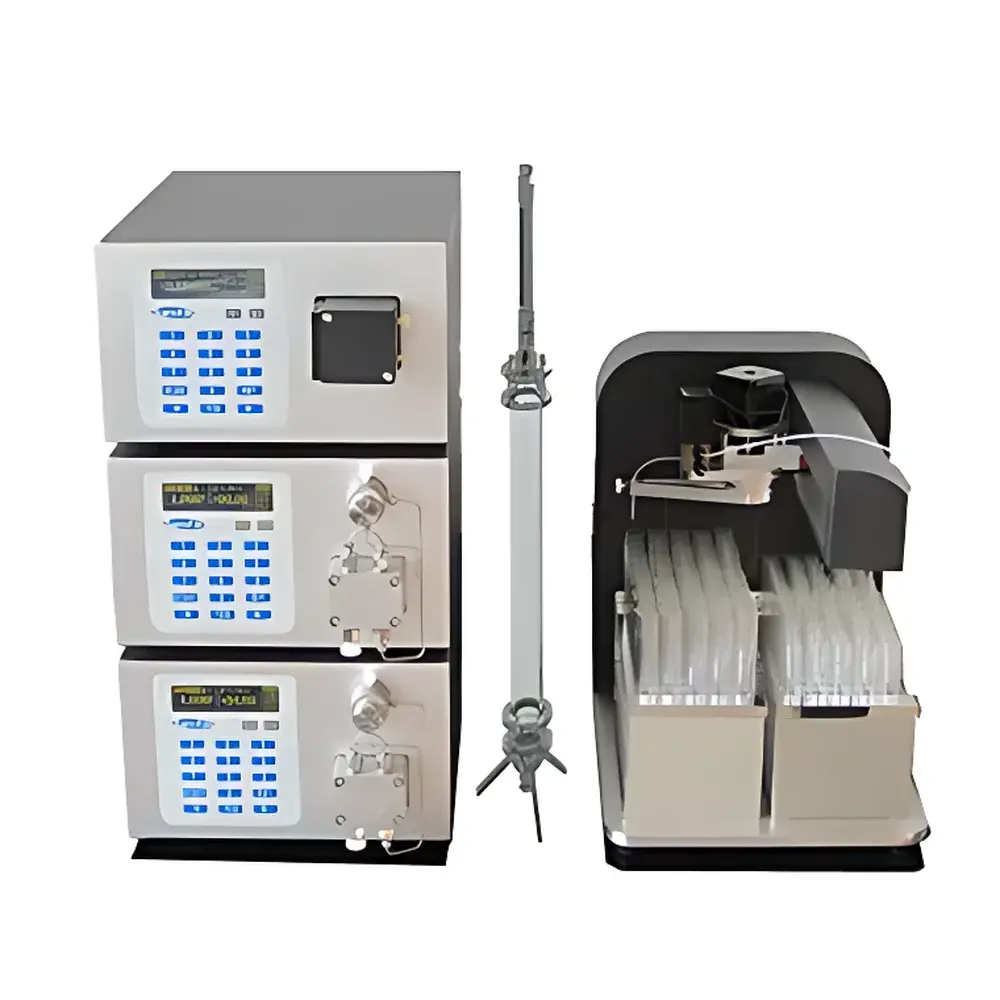
Sanotac S26310 Medium-Pressure Glass Chromatography Column
| Brand | Sanotac |
|---|---|
| Model | S26310 |
| Origin | Shanghai, China |
| Manufacturer Type | OEM/ODM Manufacturer |
| Application Level | Laboratory Grade |
| Instrument Type | Medium-Pressure Preparative Liquid Chromatography Column |
| Internal Diameter | 26 mm |
| Length | 310 mm |
| Maximum Operating Pressure | 40 bar (4 MPa) |
| Flow Rate Range | 0.01–100.00 mL/min |
| Flow Accuracy | ±1% |
| Flow Precision (RSD) | ≤0.5% |
| Wavelength Accuracy | ±1 nm |
| Wavelength Repeatability | 0.2 nm |
| Baseline Noise | ±0.5×10⁻⁵ AU (254 nm, TC = 1 s) |
| Data Acquisition Frequency | 10 Hz |
| Column Material | Borosilicate Glass with Reinforced Stainless Steel Jacket |
| Sample Introduction Design | Flared Inlet Head (No Traditional Frit-Based Packing) |
| Compatible Packing Materials | 30–50 µm C18, Silica, Amino, Cyano, and Other Standard Prep LC Phases |
Overview
The Sanotac S26310 Medium-Pressure Glass Chromatography Column is an engineered solution for scalable, transparent, and reproducible preparative chromatography in natural product isolation, pharmaceutical impurity enrichment, and synthetic compound purification. Designed around a robust borosilicate glass tube encased in a pressure-rated stainless steel clamping jacket, the column operates reliably up to 40 bar (4 MPa), bridging the performance gap between low-pressure flash systems and high-pressure preparative HPLC. Its core principle leverages laminar flow dynamics within a rigid, optically transparent conduit—enabling real-time visual monitoring of band migration, solvent front progression, and colored analyte elution without compromising mechanical integrity. Unlike conventional stainless-steel or PEEK columns, the glass body permits direct observation of column packing homogeneity, gradient mixing behavior, and potential channeling or air trapping—critical for method development and troubleshooting in complex matrices such as herbal extracts, fermentation broths, or pigment-rich botanical fractions.
Key Features
- Flared Inlet Head Design: Replaces traditional frit-based sample introduction with a precision-machined conical inlet that promotes radial sample dispersion across the entire cross-sectional area—enhancing loading capacity by ≥5× compared to standard HPLC prep columns of equivalent dimensions.
- Stainless Steel Clamped Jacket System: Eliminates reliance on multi-port valves and quantitative loops; instead integrates a gas-tight, pressure-balanced interface that accommodates high-concentration samples (>100 mg/mL) without clogging or backpressure spikes at the injection point.
- Optically Transparent Borosilicate Construction: Complies with ISO 3585 specifications for hydrolytic resistance and thermal shock tolerance; enables in-situ assessment of bed stability, fraction color intensity, and elution profile consistency—particularly valuable for anthocyanins, curcuminoids, chlorophyll derivatives, and other chromophoric targets.
- Modular Packing Compatibility: Validated for dry- or slurry-packing with 30–50 µm spherical silica, C18, NH₂, CN, and Diol phases; supports both reversed-phase and normal-phase separations across a pH range of 2–8 (with appropriate mobile phase selection).
- User-Serviceable Architecture: Tool-free disassembly allows full column cleaning, repacking, and gasket replacement in under 15 minutes—reducing long-term cost of ownership and supporting GLP-aligned maintenance logs.
- Scalable Geometry Options: Part of a standardized series (S10–S100 ID, 100–920 mm length) with pressure ratings de-rated systematically by inner diameter (e.g., 70 mm ID rated to 15 bar; 100 mm ID to 10 bar), ensuring safe operation across analytical to pilot-scale throughput requirements.
Sample Compatibility & Compliance
The S26310 column demonstrates broad compatibility with small-molecule APIs, plant secondary metabolites (alkaloids, flavonoids, terpenes), peptides (<5 kDa), and polar glycosides. It has been validated per ASTM D4294–22 for silica-based slurry packing integrity and meets ISO 17025-relevant criteria for column-to-column reproducibility (n = 6, RSD < 2.1% in retention time for caffeine/methylnaphthalene test mix). While not certified for GMP manufacturing environments, its design supports 21 CFR Part 11–compliant data capture when paired with Sanotac’s optional PrepChrom software suite—providing electronic audit trails for pressure, flow, UV trace, and fraction collection events. All glass components are manufactured to Class A volumetric tolerance per ISO 648 and undergo batch-certified hydrostatic pressure testing at 1.5× maximum rated pressure prior to shipment.
Software & Data Management
When integrated into Sanotac’s PrepChrom Control Platform (v4.2+), the S26310 column supports synchronized acquisition of UV absorbance (dual-wavelength, 190–400 nm), system pressure (0–60 bar full scale), and fractional collector triggers. Raw chromatograms are stored in vendor-neutral .cdf format compliant with Open Chromatography Data Format (CdfCore v2.1) standards. Audit trail functionality includes timestamped operator login, method version control, parameter change logging, and digital signature support for QC release documentation. Optional CSV export enables direct import into Empower, Chromeleon, or custom Python-based chemometric workflows (e.g., PCA, MCR-ALS) for peak deconvolution and purity assessment.
Applications
- Isolation of bioactive constituents from Salvia miltiorrhiza, Ginkgo biloba, and Camellia sinensis extracts under gradient RP conditions (MeCN/H₂O + 0.1% formic acid)
- Rapid enrichment of genotoxic impurities (e.g., alkyl halides, hydrazines) from API batches at 10–100 mg scale, achieving >90% recovery in ≤60 min
- Method scouting for chiral resolution using amylose- or cellulose-derived CSPs packed in 26 mm ID × 310 mm geometry
- Process validation support for DOE-driven optimization of loading mass, flow rate, and gradient slope in DOE-based DoE studies
- Educational use in university teaching labs for hands-on demonstration of van Deemter kinetics, band broadening mechanisms, and resolution–efficiency trade-offs
FAQ
Can the S26310 column be used with aggressive solvents such as THF or chloroform?
Yes—borosilicate glass exhibits excellent chemical resistance to all common LC solvents including THF, CHCl₃, DMF, and DMSO. However, prolonged exposure to concentrated HF or hot concentrated alkalis (>1 M NaOH at >60 °C) is not recommended.
What is the maximum recommended linear velocity for optimal resolution?
At 26 mm ID and 310 mm length, the optimal linear velocity range is 1.5–3.0 cm/min for 30–50 µm particles, corresponding to 5–20 mL/min at typical system backpressures below 30 bar.
Is column conditioning required before first use?
Yes—equilibrate with 10 column volumes of starting mobile phase at 5 mL/min, followed by a 30-min stabilization period under constant pressure and flow prior to sample injection.
Does Sanotac provide packing services or column qualification reports?
OEM customers may request factory-packed columns with Certificate of Analysis (CoA) documenting void volume, backpressure profile, and test chromatogram using USP L1 reference standard mixture.
How does the flared inlet improve loading capacity compared to standard fritted columns?
By eliminating radial flow restriction at the column head, the flared geometry reduces localized overloading and promotes uniform radial distribution—resulting in higher dynamic binding capacity and reduced band distortion during large-volume injections.
Related Products





