
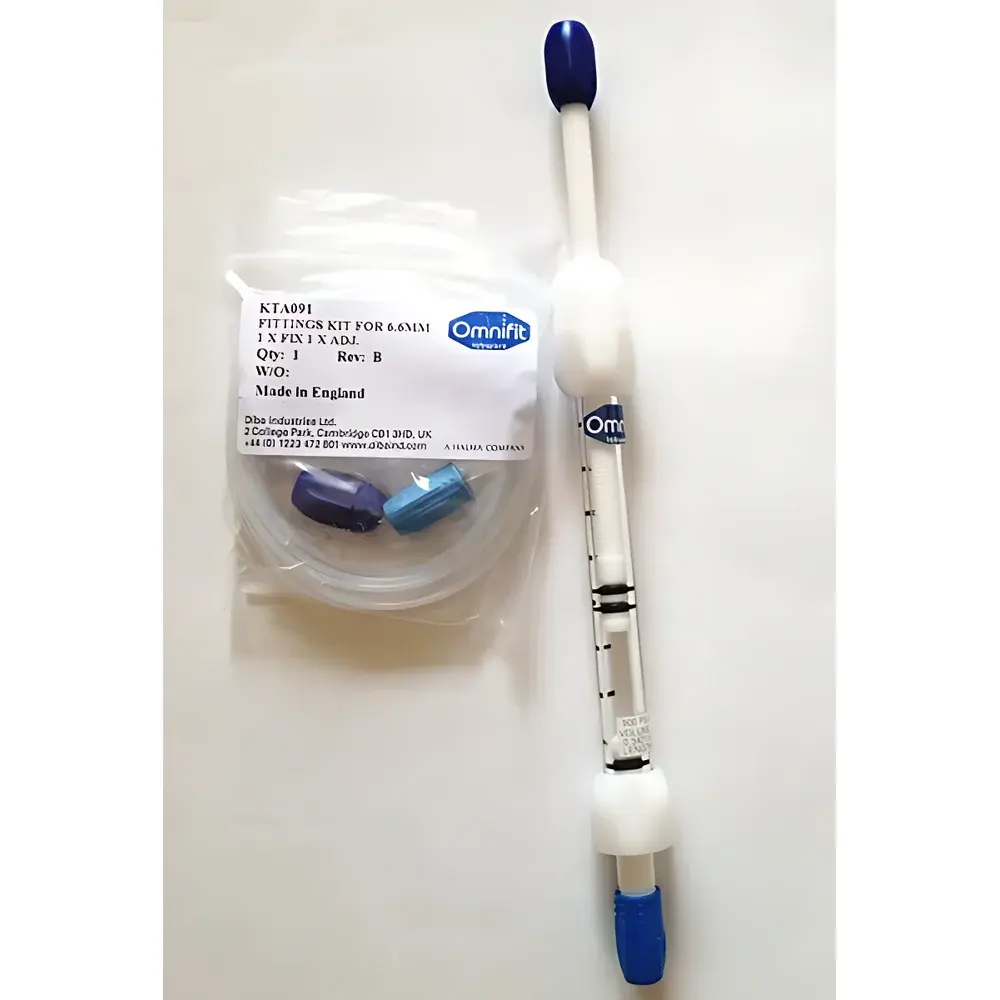
Omnifit 006BCC-03-02-FF Medium-Pressure Axial Compression Glass Microchromatography Column
| Origin | UK |
|---|---|
| Manufacturer Type | Authorized Distributor |
| Origin Category | Imported |
| Model | 006BCC-03-02-FF |
| Application Level | Laboratory Grade |
| Instrument Type | Medium-to-Low Pressure Preparative Liquid Chromatography |
| Max Operating Pressure | 1200 psi (80 bar) |
| Column Material | Borosilicate Glass |
| End Frit Material | PCTFE |
| Bed Support Plate | PCTFE & Stainless Steel |
| O-Ring Material | FKM/FPM |
| Tubing Fittings | Glass-Filled Polypropylene (PP) |
| Included Tubing | Two PTFE tubes (2 m and 0.5 m, OD 1/16", one end with 1/4-28 UNF PP fitting) |
| Column Dimensions | 3 mm ID × 25 mm length |
| Frit Options Available | 2–50 µm (PTFE, PE, SS) |
Overview
The Omnifit 006BCC-03-02-FF is a precision-engineered, medium-pressure axial compression glass microchromatography column designed for reproducible, scalable preparative liquid chromatography (prep LC) in laboratory-scale purification workflows. Constructed entirely from high-purity borosilicate glass (Duran®-grade), the column features an integrated axial compression mechanism that ensures uniform bed packing density and eliminates channeling—critical for maintaining resolution and recovery during repeated loading cycles. Unlike conventional screw-cap or hand-tightened columns, this design applies controlled, linear force directly along the column axis, enabling consistent bed integrity across pressure ranges up to 1200 psi (80 bar). Its compatibility with aqueous buffers and common organic solvents—including acetonitrile, methanol, ethanol, THF, and ethyl acetate—makes it suitable for reversed-phase, ion-exchange, and size-exclusion applications in pharmaceutical process development, natural product isolation, and synthetic chemistry support. The column operates optimally within a temperature range of 4–20 °C and maintains structural and chemical stability across pH 1–14, supporting both acidic and basic mobile phases under validated conditions.
Key Features
- Borosilicate glass body with optical clarity for real-time bed inspection and visual monitoring of sample breakthrough or precipitation.
- Integrated axial compression assembly with calibrated torque-limiting mechanism—ensures repeatable packing pressure without over-compression or frit deformation.
- Chemically resistant end fittings and sealing components: PCTFE frits (5–50 µm options), stainless steel–reinforced PCTFE bed support plate, and FKM/FPM O-rings rated for broad solvent compatibility.
- Modular connection system using glass-filled polypropylene (PP) 1/4-28 UNF threaded fittings, minimizing metal contamination risk and ensuring leak-free operation at ≤1200 psi.
- Pre-assembled with two PTFE capillary lines (1/16″ OD): one 2 m length and one 0.5 m length, each terminated with PP 1/4-28 UNF male connectors—ready for immediate integration into standard prep LC manifolds.
- Standardized 3 mm internal diameter and 25 mm bed length—ideal for method scouting, fraction collection optimization, and small-batch purification (typically 0.1–10 mg analytical to semi-prep scale).
Sample Compatibility & Compliance
The 006BCC-03-02-FF column is validated for use with water, buffered saline solutions, and polar organic solvents commonly employed in low-to-medium pressure chromatographic separations. It is explicitly incompatible with strong oxidizers, concentrated mineral acids (>5% HCl, >10% HNO₃), caustic alkalis (>10% NaOH), ketones (e.g., acetone, MEK), chlorinated hydrocarbons (e.g., chloroform, DCM), aliphatic esters (e.g., ethyl acetate above 30% v/v), and phenol solutions exceeding 10% concentration. These limitations are defined per ISO 8536-4 (glass containers for pharmaceutical use) and aligned with USP requirements for borosilicate glass performance. All wetted materials comply with USP Class VI biocompatibility standards and are non-leaching under typical LC operating conditions. The column’s mechanical design supports GLP-compliant documentation of packing procedures, including torque values, compression cycles, and pressure hold tests—facilitating audit readiness in regulated environments.
Software & Data Management
While the 006BCC-03-02-FF is a hardware-only component (no embedded electronics or firmware), its dimensional consistency and pressure rating ensure full interoperability with industry-standard prep LC control platforms—including those compliant with FDA 21 CFR Part 11. When deployed with chromatography data systems (CDS) such as Waters Empower, Thermo Chromeleon, or Agilent OpenLab CDS, column-specific metadata (ID, dimensions, frit pore size, packing history) can be logged manually or via barcode-scanned accessory kits (e.g., 006BFE-xx frit modules). Audit trails for column usage, regeneration cycles, and pressure decay logs may be maintained externally in accordance with GMP Annex 11 and ICH Q5C guidelines for column lifecycle management.
Applications
- Early-stage purification of peptides, oligonucleotides, and small-molecule APIs during synthetic route validation.
- Desalting and buffer exchange of protein samples prior to MS analysis or crystallization trials.
- Method development for gradient elution in reversed-phase and HILIC modes using sub-2 mL injection volumes.
- Scalable capture-step replacement for affinity resins in monoclonal antibody intermediate polishing.
- Quality control testing of excipient purity and degradation product profiling in generic drug formulations.
FAQ
What is the maximum recommended operating pressure for continuous use?
The column is rated for sustained operation at ≤1000 psi (69 bar); 1200 psi (80 bar) represents the short-term burst pressure limit and should not exceed 5 minutes per run.
Can this column be repacked with different stationary phases?
Yes—the axial compression design allows for complete disassembly, cleaning, and re-slurry packing with silica, polymer-based, or hybrid resins (e.g., C18, SAX, Toyopearl). Recommended slurry solvent: isopropanol/water (70:30) for silica; DMF for polystyrene-divinylbenzene resins.
Are replacement frits traceable to certified pore size distributions?
All PTFE and stainless steel frits (006BFE series) are supplied with manufacturer-certified pore size verification reports per ISO 4003, including mean flow pore size and standard deviation.
Is the column compatible with automated fraction collectors?
Yes—its standardized 1/4-28 UNF inlet/outlet threads interface directly with most commercial fraction collector manifolds equipped with PEEK or PP tubing adapters.
How often should O-rings be replaced under routine lab use?
FKM/FPM O-rings (006OR-03-V) should be inspected after every 20 runs or 6 months—whichever occurs first—and replaced if swelling, cracking, or compression set exceeds 15% of original cross-section height.
Related Products






