
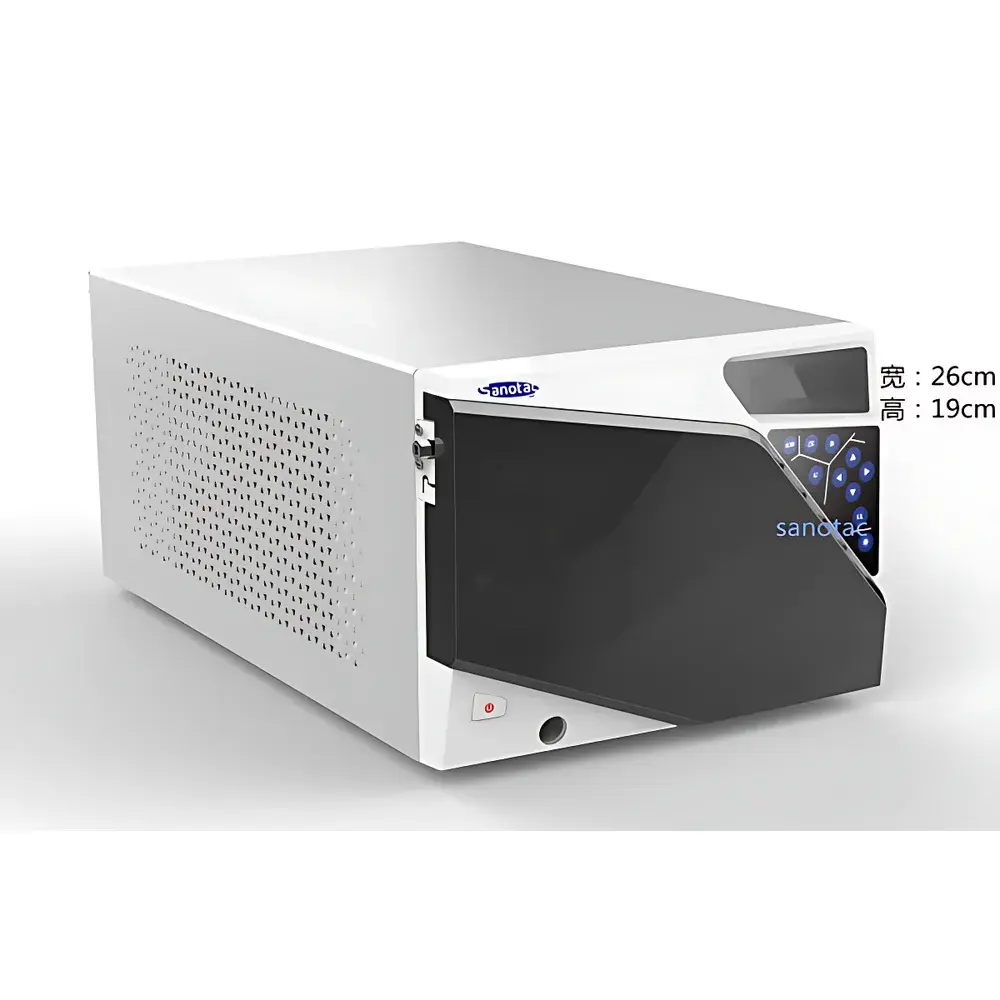
Sanotac Omnitor ELSD-2000 Evaporative Light Scattering Detector
| Brand | Sanotac |
|---|---|
| Origin | Shanghai, China |
| Manufacturer Type | Original Equipment Manufacturer (OEM) |
| Model | ELSD-2000 |
| Instrument Type | Evaporative Light Scattering Detector (ELSD) |
| Wavelength | 650 nm |
| Detection Mode | Low-Temperature Evaporation |
| Light Source | Semiconductor Laser Diode |
| Baseline Noise | ≤ 0.04 mV |
| Baseline Drift | ≤ 0.4 mV / 30 min |
| Minimum Detectable Mass | < 1 ng |
| Quantitative Range | 0.1 µg – 30 µg |
| Quantitative RSD | ≤ 2% |
| Evaporator Temp Range | Ambient to 130 °C (1 °C increments) |
| Nebulizer Temp Range | Ambient to 56 °C (1 °C increments) |
| Temperature Accuracy | ±1 °C |
| Carrier Gas | Clean Air or Nitrogen |
| Gas Pressure Range | 2–5 bar |
| Gas Pressure Resolution | 0.01 bar |
| Gas Flow Rate | 1–4 L/min |
| Flow Control Accuracy | ≤1% or 0.02 L/min |
| Mobile Phase Flow Compatibility | 0.01–3 mL/min |
| Analog Output | −1200 to +1200 mV |
| Gain Adjustment | 0.3–30 (continuous) |
| Data Acquisition Rate | 100 Hz (digital), 20 Hz (analog) |
| Interface | RS-232, RS-485, USB/LAN (TCP/HTTP), Programmable External Event I/O |
| Dimensions (W×H×D) | 26 × 19 × 46 cm |
| Weight | 10 kg |
Overview
The Sanotac Omnitor ELSD-2000 is a high-performance evaporative light scattering detector engineered for universal, non-destructive detection of non-volatile and semi-volatile analytes in liquid chromatography systems. Unlike UV-Vis or fluorescence detectors, the ELSD-2000 operates on a mass-sensitive principle: the mobile phase is nebulized into fine droplets, thermally evaporated to remove volatile solvents, and the remaining non-volatile analyte particles are illuminated by a 650 nm semiconductor laser. Scattered light is collected by a photomultiplier tube (PMT), generating a signal proportional to analyte mass—regardless of chromophore presence, molecular absorption, or refractive index change. This physical detection mechanism ensures consistent response across diverse compound classes, including carbohydrates, lipids, polymers, saponins, glycosides, and other UV-transparent or weakly absorbing substances commonly encountered in natural product analysis, pharmaceutical QC, and synthetic polymer characterization.
Key Features
- Low-temperature evaporation architecture: Optimized nebulizer and evaporator temperature control (ambient to 56 °C and ambient to 130 °C, respectively) minimizes thermal degradation of labile compounds while maintaining robust aerosol generation and solvent removal efficiency.
- High-sensitivity optical path: Precision-aligned 650 nm laser diode and low-noise PMT deliver baseline noise ≤ 0.04 mV and drift ≤ 0.4 mV/30 min—enabling reliable quantification down to sub-nanogram levels per injection.
- Intelligent system self-diagnostics: Built-in 16-point automated health check monitors gas pressure, heater status, laser activation, valve sequencing, and communication integrity—reducing downtime and supporting preventive maintenance protocols.
- Modular flow compatibility: Supports capillary, analytical, and preparative LC flow rates (0.01–3 mL/min), with integrated gas flow control accuracy ≤1% or 0.02 L/min for reproducible droplet size distribution.
- Multi-interface connectivity: Native support for RS-232, RS-485, USB, and TCP/IP (HTTP) enables seamless integration with third-party HPLC systems—including Agilent, Waters, Shimadzu, and Thermo platforms—via Clarity® DLL or vendor-neutral ASCII protocols.
- Energy-conscious design: Standby mode reduces power consumption by >70% during idle periods without compromising thermal stability or calibration integrity.
Sample Compatibility & Compliance
The ELSD-2000 is inherently compatible with reversed-phase, normal-phase, HILIC, and supercritical fluid chromatography (SFC) methods using volatile or semi-volatile mobile phases (e.g., acetonitrile, methanol, ethanol, THF, CO2). It complies with key regulatory expectations for analytical instrument qualification: its temperature control accuracy (±1 °C), gas pressure resolution (0.01 bar), and analog output linearity support IQ/OQ documentation per ASTM E2500 and ISO/IEC 17025 frameworks. While not intrinsically 21 CFR Part 11 compliant, the detector’s digital event logging, parameter versioning, and audit-ready method storage (10 method groups × 25 parameters each) facilitate alignment with GLP and GMP data integrity requirements when deployed with validated chromatography data systems (CDS).
Software & Data Management
Sanotac’s proprietary multi-platform acquisition software provides real-time signal visualization, peak integration, calibration curve generation (linear/log-log), and export to CSV, TXT, or CDF formats. The software supports dynamic method linking—allowing automatic switching between ELSD and UV detector signals during gradient runs—and embeds Clarity® SDK for custom CDS integration. All instrument parameters—including temperature ramps, gain settings, gas flow profiles, and external event triggers—are stored with timestamped metadata. Raw data files retain full 100 Hz sampling fidelity, enabling retrospective reprocessing without loss of temporal resolution.
Applications
- Quantitative analysis of herbal extracts and traditional Chinese medicine (TCM) formulations where UV-absorbing markers are absent or co-elute with matrix interferences.
- Characterization of lipid classes (triglycerides, phospholipids, free fatty acids) in food, clinical, and biopharmaceutical matrices.
- Residual solvent and excipient profiling in generic drug development under ICH Q2(R2) guidelines.
- Monitoring polymer molecular weight distributions via SEC/GPC when refractive index detectors suffer from solvent mismatch or column bleed artifacts.
- Method development for carbohydrate separation in HPAEC-PAD alternatives—particularly for neutral oligosaccharides lacking electrochemical activity.
FAQ
Does the ELSD-2000 require post-column derivatization or chemical modification of analytes?
No. ELSD is a label-free, universal detection technique that responds directly to particle mass after solvent evaporation—no derivatization, ionization, or chromophore introduction is necessary.
Can the detector be used with non-volatile mobile phase additives such as phosphate buffers?
No. Non-volatile salts will accumulate in the nebulizer and evaporator, causing clogging and signal drift. Volatile buffers (e.g., ammonium acetate, ammonium formate, triethylamine) are required.
How does ELSD response relate to analyte concentration?
The signal follows a power-law relationship (S = k·mn, where n ≈ 0.6–0.8). Accurate quantification therefore requires empirical calibration curves—not single-point normalization.
Is the 650 nm laser safe for routine laboratory operation?
Yes. The Class 1 laser enclosure meets IEC 60825-1:2014 requirements; no external safety interlocks or operator training beyond standard lab PPE are mandated.
What maintenance intervals are recommended for optimal performance?
Nebulizer capillary cleaning every 200 injections; evaporator chamber wipe-down weekly; PMT gain verification quarterly; full system leak test and gas filter replacement every 6 months.





