
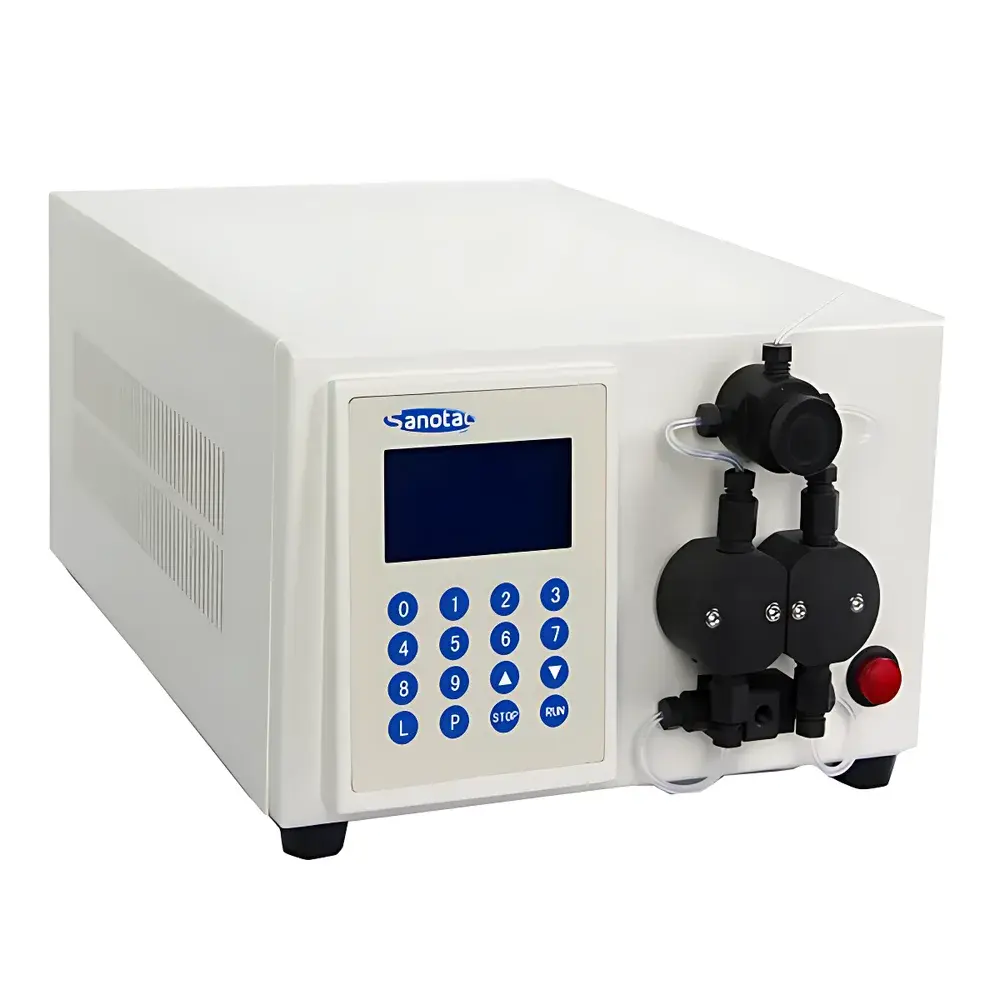
Sanotac MPF0502 PTFE Constant Flow Pump
| Brand | Sanotac |
|---|---|
| Origin | Shanghai, China |
| Manufacturer Type | Manufacturer |
| Model | MPF0502 |
| Flow Rate | 0.1–50.0 mL/min (adjustable in 0.1 mL/min increments) |
| Maximum Pressure | 2 MPa |
| Flow Accuracy | ±1% |
| Flow Precision (RSD) | ≤1% |
| Pressure Pulsation | ≤0.2 MPa |
| Wetted Materials | Sapphire, PTFE, Zirconia Ceramic |
| Display | Backlit LCD |
| Control | Front-panel manual control or PC remote control via RS232/USB |
| Power Supply | 220 V ±10%, 50/60 Hz, 150 W |
| Tubing Connection | Standard φ3 mm fittings |
Overview
The Sanotac MPF0502 PTFE Constant Flow Pump is a precision-engineered positive displacement pump designed for continuous, stable delivery of aggressive and sensitive fluids in analytical, preparative, and process-critical laboratory environments. Built around a chemically inert fluid path composed entirely of sapphire, polytetrafluoroethylene (PTFE), and zirconia ceramic, it operates on a reciprocating plunger principle—ensuring consistent volumetric displacement per stroke and minimal flow deviation across extended operation. Its core function is to maintain a user-defined flow rate with high reproducibility under variable backpressure conditions up to 2 MPa, making it suitable for applications where chemical compatibility, thermal stability, and long-term baseline integrity are non-negotiable.
Key Features
- Chemically inert wetted path: All fluid-contact components—including plunger seal, pump head, check valves, and tubing interface—are constructed from PTFE, sapphire, and zirconia ceramic, delivering exceptional resistance to concentrated mineral acids (e.g., HF, aqua regia), strong alkalis (except molten alkali metals and >300 °C NaOH), oxidizers (e.g., HNO₃, KMnO₄), reductants, and organic solvents (e.g., THF, DCM, DMF, acetone).
- Wide operational temperature range: Stable performance from –190 °C to +260 °C enables use in cryogenic solvent delivery, high-temperature reaction quenching, and steam-assisted extractions without material degradation or dimensional drift.
- Precision flow control: Digital stepper motor drive ensures linear, pulse-dampened output with flow accuracy of ±1% and repeatability (RSD) ≤1% across the full 0.1–50.0 mL/min range, adjustable in 0.1 mL/min increments.
- Low-pressure pulsation design: Optimized valve timing and dual-piston synchronization reduce pressure ripple to ≤0.2 MPa, minimizing baseline noise in downstream detection systems such as UV-Vis, conductivity, or mass spectrometry.
- Flexible operation modes: Local control via high-contrast, backlit LCD interface with intuitive menu navigation; optional computer-based control via RS232 or USB using standard SCPI commands for integration into automated workflows or LIMS environments.
- Robust mechanical architecture: Sealed housing, IP20-rated enclosure, and vibration-damped mounting base ensure reliable operation in shared lab spaces and industrial pilot plants.
Sample Compatibility & Compliance
The MPF0502 is validated for handling corrosive, viscous, particulate-laden, and low-surface-tension fluids commonly encountered in fine chemical synthesis, pharmaceutical process development, and environmental sample preparation. Its materials comply with USP Class VI biocompatibility standards for PTFE and ISO 10993-5 cytotoxicity testing for wetted surfaces. While not intrinsically certified for GMP or FDA 21 CFR Part 11 compliance, its audit-ready data logging (when paired with compatible software), deterministic flow behavior, and traceable calibration protocols support qualification under GLP and GMP frameworks—particularly when deployed in method transfer, cleaning validation, or extractables/leachables studies. It meets CE marking requirements for electromagnetic compatibility (EN 61326-1) and safety (EN 61010-1).
Software & Data Management
The pump supports bidirectional communication via ASCII-based SCPI protocol over RS232 or USB virtual COM port. Third-party software platforms—including LabVIEW, MATLAB, Python (pySerial), and chromatography data systems (CDS)—can initiate flow start/stop, adjust setpoints, query real-time status (e.g., current flow, pressure estimate, error codes), and log timestamps. Optional Sanotac PumpControl Suite (v3.x) provides graphical configuration, method storage, event-triggered logging, and CSV export for audit trail generation. All parameter changes are timestamped and retained in non-volatile memory, satisfying basic ALCOA+ principles for raw data integrity in regulated environments.
Applications
- Acid digestion and leaching in geochemical and metallurgical analysis
- Mobile phase delivery in HPLC and IC systems requiring high-pH or fluoride-containing eluents
- Reagent metering in continuous-flow reactors for API synthesis
- Calibration solution delivery in ion-selective electrode (ISE) and potentiometric titration systems
- Extraction solvent delivery in ASE (accelerated solvent extraction) and SFE (supercritical fluid extraction) interfaces
- Cell culture media perfusion in bioreactor feed loops exposed to sterilizing agents (e.g., hydrogen peroxide vapor)
- Standard addition and internal standard spiking in ICP-MS sample introduction lines
FAQ
What is the maximum allowable backpressure for the MPF0502 with PTFE pump head?
The rated maximum pressure is 2 MPa (290 psi) at ambient temperature. Performance above 1.5 MPa requires verification of system integrity, including tubing burst rating and fitting torque.
Can the pump handle slurries or suspensions?
It is not recommended for abrasive or >5 µm particulate-laden fluids without upstream filtration (e.g., 0.45 µm inline filter), as sapphire and zirconia components resist wear but are not immune to erosion by hard solids.
Is flow calibration traceable to national standards?
Yes—Sanotac provides factory calibration certificates traceable to NIM (National Institute of Metrology, China) using gravimetric reference methods per ISO 4064-2. On-site recalibration kits and procedures are available upon request.
Does the pump support gradient programming?
No—the MPF0502 is a single-channel constant-flow device. Gradient profiles require external switching valves or integration with multi-pump systems.
What maintenance intervals are recommended?
Plunger seals should be inspected every 500 operating hours; replacement is typically required every 1,000–2,000 hours depending on solvent aggressiveness and duty cycle. Full preventive maintenance (valve seat inspection, motor alignment, firmware update) is advised annually.



