
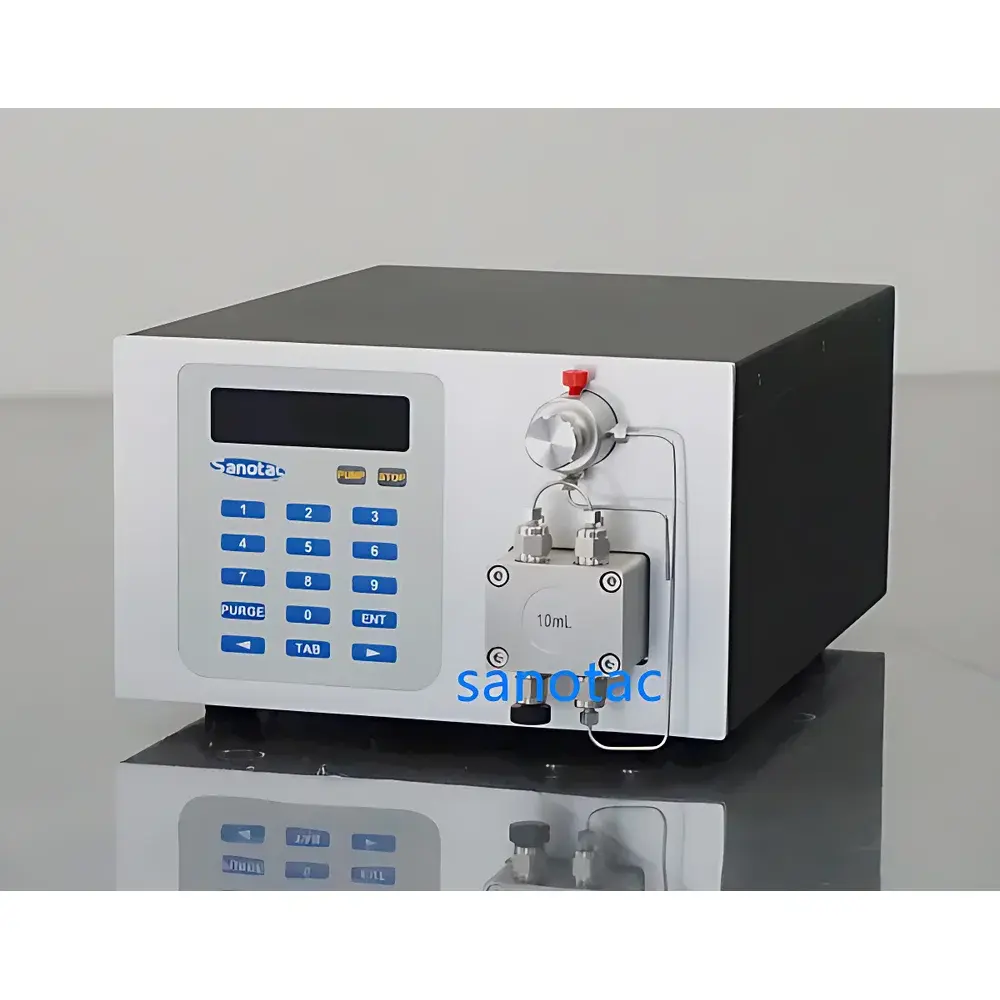
Sanotac MP-1006C High-Pressure Constant Flow Pump for Precise Delivery of DTBP and Initiator A
| Brand | Sanotac |
|---|---|
| Model | MP-1006C |
| Construction Material | 316L Stainless Steel, Sapphire, Zirconia Ceramic |
| Flow Range | 0.1–100.0 mL/min |
| Flow Accuracy | ±1% |
| Flow Precision (RSD) | ≤1% |
| Maximum Pressure | 6 MPa |
| Pressure Pulsation | ≤0.2 MPa |
| Power Supply | 85–264 VAC, 50 Hz |
| Power Consumption | 75 W |
| Weight | 12 kg |
| Communication | RS232 (standard), RS485/422 (optional) |
Overview
The Sanotac MP-1006C is a high-precision, dual-piston parallel constant flow pump engineered for reliable, pulse-minimized delivery of reactive and thermally sensitive liquid reagents under elevated pressure. It operates on a reciprocating dual-plunger architecture—where left and right pistons alternate in suction and discharge strokes, synchronized with check valve actuation—to achieve continuous, laminar, and highly reproducible fluid displacement. This design eliminates flow interruption inherent in single-piston systems and ensures stable volumetric delivery across the full operating range (0.1–100.0 mL/min) at pressures up to 6 MPa. The MP-1006C is specifically validated for metering highly reactive organic peroxides—including di-tert-butyl peroxide (DTBP), commonly referenced as Initiator A or vulcanizing agent DTBP—in melt-blown polypropylene R&D and pilot-scale synthesis. Its chemically inert wetted path—comprising 316L stainless steel, sapphire seats, and zirconia ceramic plungers—resists corrosion, swelling, and catalytic decomposition when handling aggressive oxidizers, acidic catalysts, or halogenated solvents.
Key Features
- Dual-piston parallel architecture delivering true continuous flow with ≤0.2 MPa pressure pulsation—critical for microreactor integration and kinetic studies requiring steady-state conditions.
- Wetted materials certified for compatibility with peroxides: 316L stainless steel housing, sapphire inlet/outlet valves, and zirconia ceramic plunger surfaces—minimizing metal-catalyzed decomposition pathways.
- Flow accuracy of ±1% and repeatability (RSD) ≤1% across the full range—validated per ISO 5725-2 for precision liquid dispensing in GLP-compliant laboratories.
- RS232 interface standard; optional RS485/422 with support for both proprietary Sanotac command protocol and industry-standard Modbus RTU—enabling seamless integration into automated reaction platforms and SCADA-controlled process lines.
- Wide input voltage tolerance (85–264 VAC) and low thermal load (75 W)—suitable for continuous operation in controlled environments including Class I Div 2 hazardous locations when paired with appropriate enclosures.
Sample Compatibility & Compliance
The MP-1006C is routinely deployed for the controlled delivery of low-viscosity, volatile, and thermally labile reagents including DTBP (CAS 110-05-4), benzoyl peroxide, azobisisobutyronitrile (AIBN), and other radical initiators used in polymerization, crosslinking, and functionalization workflows. Its flow path meets ASTM D3924-18 requirements for material compatibility testing of elastomeric components and complies with USP guidelines for analytical instrument qualification (AIQ) when configured with audit-trail-enabled software. While not intrinsically rated for explosive atmospheres, the pump may be installed in explosion-proof cabinets meeting IEC 60079-13 for use with flammable peroxides—subject to site-specific HAZOP review.
Software & Data Management
Sanotac’s PumpControl Suite (v3.2+) provides real-time monitoring, programmable multi-step flow profiles, and timestamped event logging—including pressure fault detection, valve cycle count, and flow deviation alerts. All operational parameters are stored with electronic signatures and time-stamped metadata compliant with FDA 21 CFR Part 11 Annex 11 requirements when deployed with validated user access controls and system audit trails. Data export is supported in CSV and XML formats compatible with LIMS and ELN platforms such as LabVantage and Benchling.
Applications
- Precise dosing of DTBP into molten PP streams during melt-blown nonwoven fiber production—enabling controlled molecular weight reduction and improved fiber uniformity.
- Continuous feeding of initiators into microfluidic reactors for living free-radical polymerization (e.g., RAFT, ATRP) where stoichiometric consistency directly impacts dispersity (Đ) and end-group fidelity.
- Integration with high-pressure liquid chromatography (HPLC) and supercritical fluid chromatography (SFC) auxiliary injection modules for reactive derivatization pre-column.
- Automated reagent addition in calorimetric reaction screening (RC1e, EasyMax) where exotherm management relies on sub-second flow stability.
- Delivery of corrosive catalysts (e.g., TiCl₄ in THF, AlEt₃ in hexane) in organometallic synthesis under inert atmosphere glovebox interfaces.
FAQ
Is the MP-1006C suitable for pumping di-tert-butyl peroxide (DTBP) at elevated temperatures?
Yes—its sapphire/zirconia valve train and 316L wetted path remain dimensionally stable and non-catalytic up to 80 °C. For extended DTBP service above 60 °C, we recommend active cooling of the pump head and upstream solvent chilling to suppress premature decomposition.
Can the MP-1006C be integrated into a PLC-controlled chemical plant pilot line?
Yes—via RS485 Modbus RTU, it supports register-mapped control of flow setpoint, start/stop, and fault reset, with status feedback on pressure limit alarms and motor current anomalies.
Does Sanotac provide IQ/OQ documentation for GMP-regulated environments?
Yes—qualified installation and operational protocols (IQ/OQ) are available upon request, aligned with ASTM E2500-13 and ISPE GAMP 5 principles for laboratory automation equipment.
What maintenance intervals are recommended for continuous DTBP operation?
Valve assemblies should be inspected every 200 hours of cumulative DTBP exposure; full seal replacement is advised every 500 hours or after 50 kg of peroxide processed—whichever occurs first.
Is remote firmware update supported over RS232?
No—firmware updates require local USB connection using Sanotac’s authorized FlashTool v2.4; network-based updates are intentionally disabled to maintain regulatory traceability and prevent unauthorized configuration changes.



