
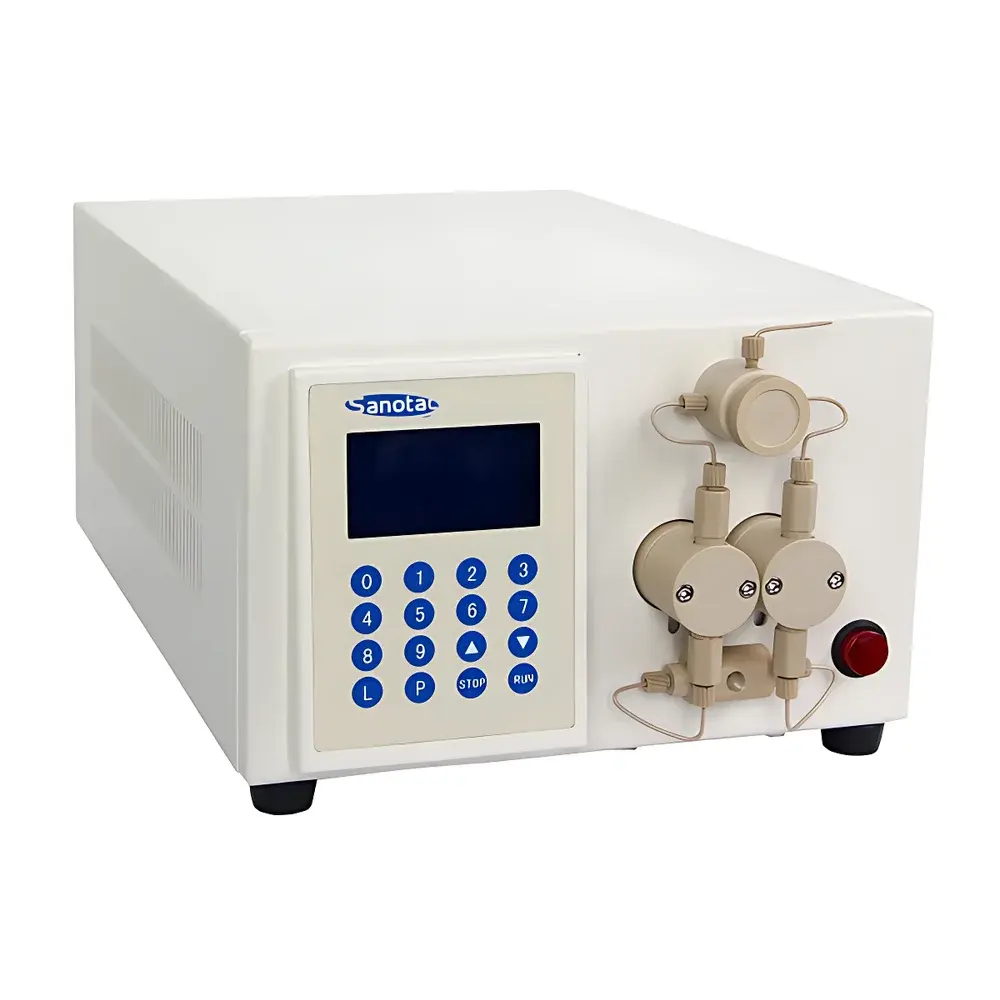
Sanotac MPK0510 PEEK Medium-Pressure Prep Chromatography Pump
| Brand | Sanotac |
|---|---|
| Origin | Shanghai, China |
| Manufacturer Type | Direct Manufacturer |
| Regional Category | Domestic (China) |
| Model | MPK0510 |
| Price Range | USD 1,400 – 2,800 |
| Flow Range | 0.1–50.00 mL/min |
| Increment | 0.1 mL/min |
| Flow Accuracy | ±1% |
| Flow Precision (RSD) | ≤1% |
| Pressure Pulsation | ≤0.1 MPa |
| Max Operating Pressure | 6 MPa (with PEEK pump head) |
| Delivery Mode | Dual-piston parallel design with floating piston support |
| Display | 256×64 dot matrix LCD with uniform self-luminous backlighting |
| Control Interface | Front-panel keypad + RS232/USB for PC remote control |
| Power Supply | 85–264 VAC, 50/60 Hz, 150 W |
Overview
The Sanotac MPK0510 is a high-reliability, medium-pressure preparative chromatography pump engineered for precise, pulse-free solvent delivery in laboratory-scale purification workflows. Designed specifically to serve as the fluidic core of low-to-medium pressure chromatographic systems (typically 0.1–6 MPa), it operates on dual-piston parallel reciprocating mechanics with a patented floating piston support architecture—minimizing mechanical wear and ensuring long-term volumetric consistency across extended operation cycles. Unlike high-pressure HPLC pumps optimized for sub-2 µm particles and >10 MPa conditions, the MPK0510 targets applications where robustness, chemical compatibility, and operational transparency outweigh ultra-high pressure capability: including flash chromatography, gradient-based compound isolation, and multi-step fraction collection in natural product and synthetic chemistry labs. Its PEEK pump head construction provides broad solvent resistance (including DMSO, THF, chlorinated solvents, and aqueous-organic mixtures), making it suitable for both small-molecule and moderately sensitive biomolecular separations.
Key Features
- Dual-piston parallel delivery system with dynamically balanced floating piston support—reducing seal friction and extending service life of both pistons and sealing components by up to 3× versus fixed-bearing designs.
- Wide flow range (0.1–50.00 mL/min) with 0.1 mL/min resolution, enabling flexible method scaling from analytical pre-fractionation to gram-scale purification.
- Flow accuracy of ±1% and repeatability (RSD) ≤1% under standard operating conditions (25°C, methanol/water 80:20, 2 MPa backpressure), validated per ISO 5725-2 guidelines for precision assessment.
- Low pressure pulsation (≤0.1 MPa peak-to-peak) ensures stable baseline performance in UV detection and minimizes column bed disturbance during gradient elution.
- Self-luminous 256×64 dot-matrix LCD display with adjustable backlight intensity—optimized for consistent readability under varied ambient lighting, including fume hood or darkroom environments.
- Native RS232 and USB interfaces support bidirectional communication with third-party chromatography data systems (CDS), enabling full remote parameter setting, real-time flow/pressure monitoring, and audit-trail-capable event logging.
Sample Compatibility & Compliance
The MPK0510 is compatible with standard 1/16″ and 1/8″ stainless steel, PEEK, and fluoropolymer tubing (e.g., FEP, PTFE) and integrates seamlessly with common medium-pressure columns (ID 10–50 mm, packing materials: silica gel, C18-bonded silica, amino, cyano, diol, and polymeric resins). It meets essential safety and electromagnetic compatibility requirements per IEC 61010-1 (Laboratory Equipment Safety) and IEC 61326-1 (EMC for Measurement and Control Equipment). While not certified for GMP production environments, its firmware supports time-stamped parameter change logs and user-accessible calibration records—facilitating GLP-aligned documentation in academic, contract research, and early-stage pharmaceutical development settings.
Software & Data Management
The pump operates in standalone mode via intuitive front-panel controls or integrates into broader workflow automation using Sanotac’s optional ChromaControl software (Windows-based, .NET framework). This platform enables method storage, sequence programming, real-time graphical monitoring of flow rate and system pressure, and export of CSV-formatted operational logs—including timestamps, setpoints, actual values, and error flags. All configuration changes are recorded with user ID (if enabled), date/time stamp, and pre/post-value fields—supporting traceability requirements aligned with FDA 21 CFR Part 11 Annex 11 principles for electronic records in regulated research.
Applications
- Purification of synthetic intermediates and final APIs in medicinal chemistry, particularly where solvent gradients and multi-solvent switching are required.
- Isolation of bioactive constituents (alkaloids, flavonoids, terpenes) from plant extracts using stepwise or linear gradient elution.
- Desalting and buffer exchange of peptides and small proteins prior to lyophilization or further characterization (e.g., MS, CD).
- Method development for scale-up to pilot-scale preparative systems (e.g., Sanotac Pilot100/Pilot200), ensuring seamless transfer of retention and resolution parameters.
- Teaching laboratories requiring durable, serviceable instrumentation for hands-on chromatography training in analytical and organic chemistry curricula.
FAQ
What is the maximum recommended operating pressure for the MPK0510 with the standard PEEK pump head?
6 MPa (870 psi) at 25°C; continuous operation above 5 MPa requires thermal stabilization of the pump head and solvent pre-equilibration.
Can the MPK0510 be used with aggressive solvents such as concentrated acids or bases?
PEEK exhibits excellent resistance to most organic solvents and neutral-to-mildly acidic/basic aqueous solutions (pH 2–10); prolonged exposure to >1 M HCl, HNO₃, or NaOH is not recommended without validation.
Does the pump support gradient mixing internally?
No—the MPK0510 is a single-channel isocratic or externally driven gradient pump; gradient formation requires an external low-dead-volume mixing tee or a separate dual-pump configuration.
Is firmware upgrade available, and how is it performed?
Yes—field-upgradable via USB stick using signed binary files provided through Sanotac’s authorized technical support portal; no hardware modification required.
What maintenance intervals are recommended for optimal long-term performance?
Piston seals should be inspected every 500 hours of operation; full pump head cleaning and seal replacement advised annually or after 2,000 hours—whichever occurs first—under typical lab usage conditions.



