
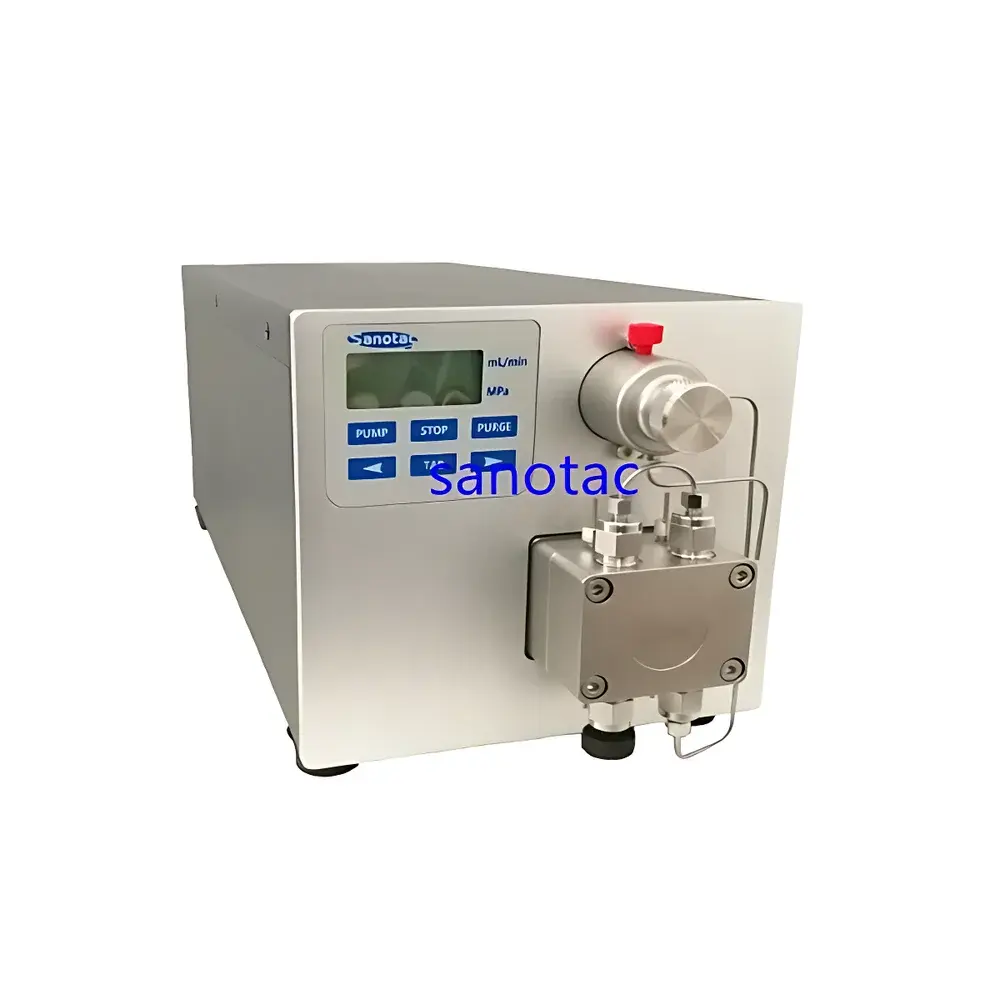
Sanotac HB00530 High-Pressure Constant Flow Dual-Piston HPLC Pump
| Brand | Sanotac |
|---|---|
| Origin | Shanghai, China |
| Manufacturer Type | OEM/ODM Manufacturer |
| Country of Origin | China |
| Model | HB00530 |
| Price Range | USD 1,400 – 2,800 |
| Flow Range | 0.01–50.00 mL/min |
| Flow Increment | 0.01 mL/min |
| Flow Accuracy | ±0.5% |
| Flow Precision (RSD) | ≤0.1% |
| Maximum Pressure | 30 MPa |
| Pressure Pulsation | ≤0.2 MPa |
| Fluidic Path Materials | 316L Stainless Steel, Sapphire, PTFE, Ceramic |
| Tubing Connection | 1/16″ Standard Fitting |
| Display | 256×64 Dot Matrix Backlit LCD |
| Control Interface | Front Panel Keypad + RS232/USB Computer Remote Control (Open Protocol) |
| Power Supply | 85–264 VAC, 50 Hz |
| Dimensions (W×D×H) | 370×240×152 mm |
Overview
The Sanotac HB00530 is a high-precision, dual-piston, constant-flow high-pressure liquid delivery pump engineered for demanding analytical and preparative applications requiring stable, pulse-free fluid transport under elevated pressure. Based on the Couette flow principle and positive displacement mechanics, the HB00530 employs a parallel dual-piston architecture with floating piston design and real-time solvent compressibility compensation—enabling accurate volumetric delivery across a wide dynamic range (0.01–50.00 mL/min) at pressures up to 30 MPa. Its core function is to serve as a robust, low-maintenance fluidic actuator in environmental assessment systems, catalytic reaction evaluation rigs, hydrogenation test platforms, and chromatographic workflows—including HPLC, SFC, and preparative LC where gradient fidelity, long-term flow stability, and chemical compatibility are critical.
Key Features
- Dual-piston parallel drive system with floating piston mechanism reduces seal wear and extends service life of high-pressure seals.
- Microprocessor-controlled flow regulation with multi-point flow calibration curves ensures traceable accuracy (±0.5%) and exceptional repeatability (RSD ≤0.1%) across full flow range.
- Integrated electronic pulse suppression and cam-profile optimization minimize pressure pulsation to ≤0.2 MPa—critical for noise-sensitive detectors and column integrity preservation.
- Chemically inert fluid path constructed from 316L stainless steel, sapphire check valves, PTFE seals, and ceramic components—compatible with aggressive solvents, acids, bases, and halogenated media.
- Open-protocol RS232/USB interface supports bidirectional remote control and integration with third-party chromatography data systems (CDS), LIMS, or custom automation platforms.
- Intuitive front-panel operation with backlit 256×64 dot-matrix display and 10 programmable user methods for flow rate, gradient profile, and hold time sequences.
Sample Compatibility & Compliance
The HB00530 is designed for use with aqueous, organic, and mixed-phase mobile phases commonly employed in environmental contaminant analysis (e.g., EPA Methods 8081, 8270), catalyst performance testing, and green chemistry process validation. Its fluidic materials meet ASTM F2136-19 (standard specification for elastomeric seals in pharmaceutical pumps) and ISO 13485-compliant manufacturing controls. While not certified as a medical device, its construction and documentation support GLP/GMP-aligned laboratory practices—including audit-ready operation logs when paired with compliant CDS software. The pump’s open communication protocol facilitates 21 CFR Part 11-compliant electronic record generation when integrated with validated workstation environments.
Software & Data Management
The HB00530 operates via an embedded firmware platform supporting both standalone keypad programming and external computer control. Its ASCII-based command set is publicly documented, enabling integration with LabVIEW, Python (pySerial), MATLAB, or commercial chromatography software such as Chromeleon, Empower, or OpenLab. All parameter changes—including flow rate, gradient slope, and pressure limits—are timestamped and stored locally in non-volatile memory. When connected to a validated data acquisition system, method parameters, run history, and error events can be exported in CSV or XML format for traceability, trending, and regulatory reporting.
Applications
- Environmental assessment: Continuous eluent delivery in leaching tests (TCLP, SPLP), speciation studies, and on-line solid-phase extraction coupled to ICP-MS.
- Catalysis & reaction engineering: Precise co-feeding of reagents in fixed-bed reactor evaluation systems and hydroprocessing simulation units.
- Pharmaceutical QC/QA: Mobile phase delivery in dissolution testing apparatus interfaced with UV detection, and forced degradation studies requiring pH-stable gradient elution.
- Materials science: Solvent delivery in polymer synthesis reactors, nanoparticle precipitation systems, and battery electrolyte formulation rigs.
- Food & beverage safety: Automated sample introduction in multi-residue pesticide screening workflows using QuEChERS extraction coupled to LC-MS/MS.
FAQ
What is the maximum operating pressure of the HB00530?
The HB00530 is rated for continuous operation up to 30 MPa (4,350 psi) with appropriate fluidic components installed.
Can this pump handle corrosive solvents like hydrochloric acid or sodium hydroxide solutions?
Yes—when equipped with optional PTFE- or PCTFE-wetted parts and sapphire/ ceramic check valves, it supports extended exposure to pH 0–14 aqueous media and common organic acids/bases.
Is gradient programming supported natively on the pump?
Yes—the built-in controller supports isocratic, linear, and step gradients; complex profiles can be defined via front-panel entry or imported from external software.
Does the pump comply with FDA 21 CFR Part 11 requirements?
The pump itself is not Part 11-certified, but its open-command architecture and audit-trail-capable host software enable compliance when deployed within a validated system environment.
What maintenance intervals are recommended for routine operation?
Under normal use (≤20 MPa, organic/aqueous solvents), seal replacement is recommended every 6–12 months; piston wash cycles and valve inspections should occur quarterly per ISO/IEC 17025 preventive maintenance guidelines.



