
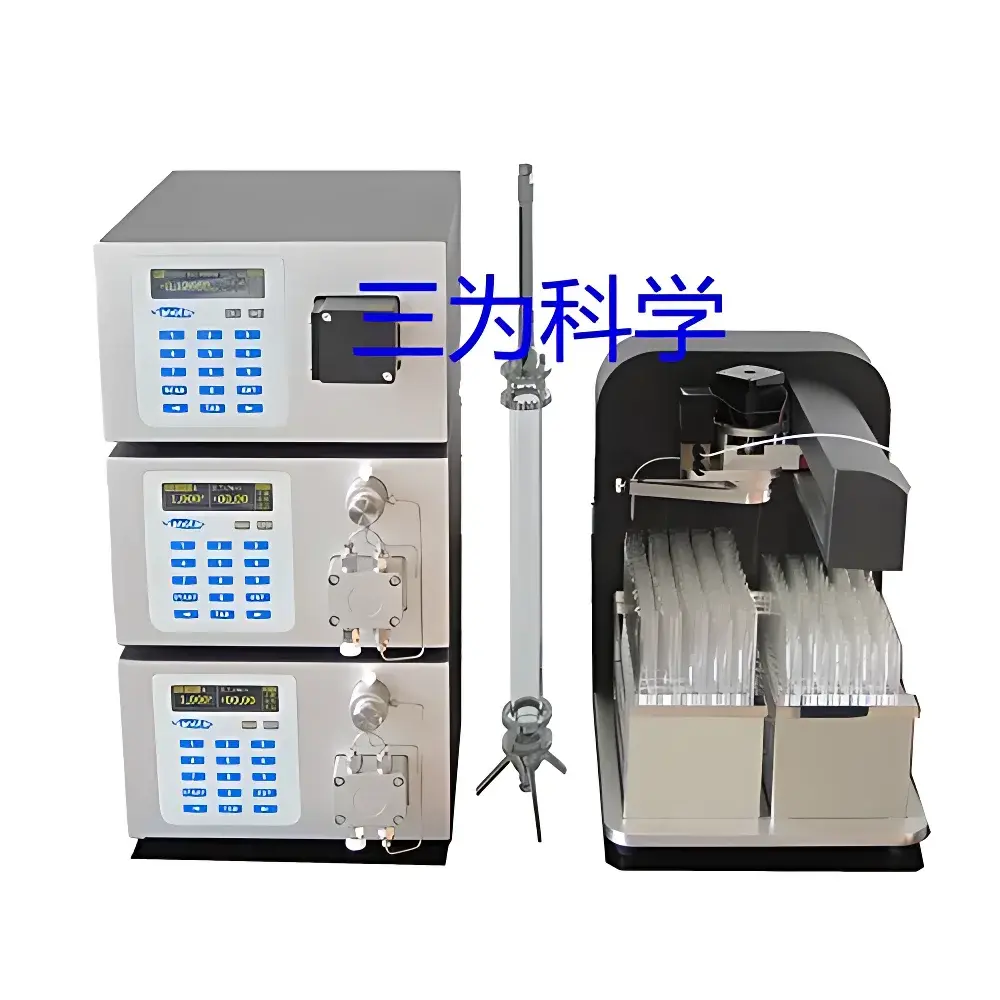
Sanotac Apurifier 150 Medium-Pressure Preparative Liquid Chromatography System
| Brand | Sanotac |
|---|---|
| Origin | Shanghai, China |
| Manufacturer Type | Direct Manufacturer |
| Product Category | Domestic |
| Model | Apurifier 150 |
| Application Level | Laboratory-Scale |
| Instrument Type | Medium-Low Pressure Preparative LC |
| Flow Rate Range | 0.01–150.00 mL/min |
| Flow Accuracy | ±1% |
| Flow Precision (RSD) | ≤0.5% |
| Maximum Pressure | 20 MPa |
| Wavelength Range | 190–800 nm |
| Wavelength Accuracy | ±1 nm |
| Wavelength Repeatability | 0.2 nm |
| Baseline Noise | ±0.75×10⁻⁵ AU (254 nm, TC = 1 s) |
| Data Acquisition Rate | 10 Hz |
Overview
The Sanotac Apurifier 150 is a purpose-engineered medium-pressure preparative liquid chromatography (PLC) system designed for the isolation and purification of bioactive compounds—particularly antibiotics and structurally complex natural products—from crude extracts or synthetic reaction mixtures. Operating within a pressure range up to 20 MPa, it bridges the performance gap between low-pressure flash chromatography and high-pressure preparative HPLC, delivering robust separation efficiency with enhanced solvent compatibility, scalability, and operational safety in laboratory environments. The system employs dual-piston reciprocating pumps with real-time chamber pressure feedback, enabling precise compensation for solvent compressibility and pump refill dynamics across its full flow range (0.01–150.00 mL/min). This architecture ensures exceptional flow stability and reproducibility—critical for consistent fraction collection and method transfer in antibiotic purification workflows where minor impurity carryover can compromise biological activity assessment or regulatory compliance.
Key Features
- Microprocessor-controlled dual-pump system with parallel drive architecture and dynamic pressure feedback for high-fidelity flow delivery under variable backpressure conditions.
- Advanced pulse-dampening via cam-profile flow compensation, reducing baseline noise to ±0.75×10⁻⁵ AU (254 nm, 1 s time constant) and supporting reliable detection of low-abundance antibiotic analogs.
- Multi-point flow calibration across the entire range (0.01–150.00 mL/min), ensuring volumetric accuracy within ±1% and repeatability (RSD ≤0.5%)—essential for quantitative recovery studies.
- Floating plunger design in 316L stainless steel pump heads extends seal lifetime under sustained medium-pressure operation; PEEK pump head option available for aggressive solvents.
- Programmable gradient capability—including linear, step, and user-defined profiles—with on-the-fly modification of flow rate and gradient slope during runtime.
- Dual-wavelength UV-Vis detector (190–800 nm) featuring automatic D₂/W lamp switching, wavelength accuracy ±1 nm, and simultaneous dual-channel signal acquisition for co-elution analysis of parent antibiotics and degradation products.
- Intelligent fraction collector with hybrid linear-rotary motion mechanism, sub-millisecond valve actuation, and integrated delay-volume compensation—enabling precise, drip-free tube switching aligned to chromatographic peaks.
Sample Compatibility & Compliance
The Apurifier 150 accommodates a broad spectrum of antibiotic classes—including β-lactams (penicillins, cephalosporins, carbapenems), aminoglycosides, tetracyclines, macrolides, sulfonamides, quinolones, and lincosamides—as well as synthetic intermediates and peptide-based therapeutics. Its chemically resistant fluid path (316L SS, PEEK, and fused-silica capillaries) supports use of common purification solvents (e.g., methanol, acetonitrile, THF, ethyl acetate, and aqueous buffers pH 2–10). All hardware and software components comply with GLP/GMP-aligned laboratory practices. The Sanochrom control software meets FDA 21 CFR Part 11 requirements for electronic records and signatures, including audit trail logging, user role-based access control, and secure data archiving—facilitating regulatory submissions under ICH Q5, Q7, and USP .
Software & Data Management
Control and data acquisition are managed via Sanochrom—a Windows-based chromatography workstation compatible with Windows 7/8/10. The interface provides intuitive graphical method setup for pump gradients, detector parameters, and fraction collection logic (time-, peak-, threshold-, or slope-triggered modes). Real-time multi-wavelength chromatograms, system pressure/flow telemetry, and collector position mapping are displayed synchronously. Raw data are stored in vendor-neutral .CDF format (compatible with OpenLab CDS, Chromeleon, and Empower), while processed reports support PDF export with embedded metadata (method ID, operator, timestamp, instrument serial number). Audit trails record all parameter changes, user logins, and sequence executions with tamper-proof timestamps—fully traceable for internal QA reviews or external inspections.
Applications
- Purification of fermentation-derived antibiotics prior to structural elucidation (NMR, HRMS) or biological assay.
- Isolation of minor metabolites and biosynthetic intermediates from microbial culture broths.
- Removal of residual catalysts, protecting groups, or side-products in synthetic antibiotic analog campaigns.
- Preparative-scale desalting and buffer exchange of peptide antibiotics prior to lyophilization.
- Method development for QC release testing of active pharmaceutical ingredients (APIs) per EP/USP monographs.
- Stability-indicating purification of stressed samples to identify and isolate degradation products.
FAQ
What pressure range does the Apurifier 150 support, and how does it compare to standard analytical HPLC systems?
The system operates up to 20 MPa (2900 psi), classifying it as a medium-pressure preparative platform—higher than conventional flash systems (60 MPa). This enables higher resolution than flash chromatography without requiring expensive stainless-steel columns or ultra-low-dispersion tubing.
Can the system be validated for GMP manufacturing environments?
While designed for laboratory-scale R&D and pilot purification, the Apurifier 150 supports IQ/OQ documentation packages. Its 21 CFR Part 11-compliant software, calibrated detectors, and traceable hardware specifications allow integration into early-phase process validation protocols—subject to site-specific risk assessment and procedural controls.
Is column equilibration time minimized during gradient reconditioning?
Yes. The dual-pump architecture allows rapid solvent composition switching with minimal dwell volume (<2 mL), reducing re-equilibration time between runs—critical when processing multiple antibiotic batches with varying polarity profiles.
How is carryover addressed in the autosampler and flow path?
The system includes programmable needle wash cycles (up to 3 solvents), post-injection purge steps, and a low-diffusion flow cell design. Typical carryover for antibiotic standards is <0.05% when using recommended cleaning protocols.
Does the system support method transfer from analytical to preparative scale?
Sanochrom software includes retention time normalization tools and scalable gradient translation algorithms. Users routinely scale methods from 4.6 mm ID analytical columns to 10–30 mm ID preparative columns with <10% retention shift—validated across penicillin and cephalosporin separations.
Related Products



