
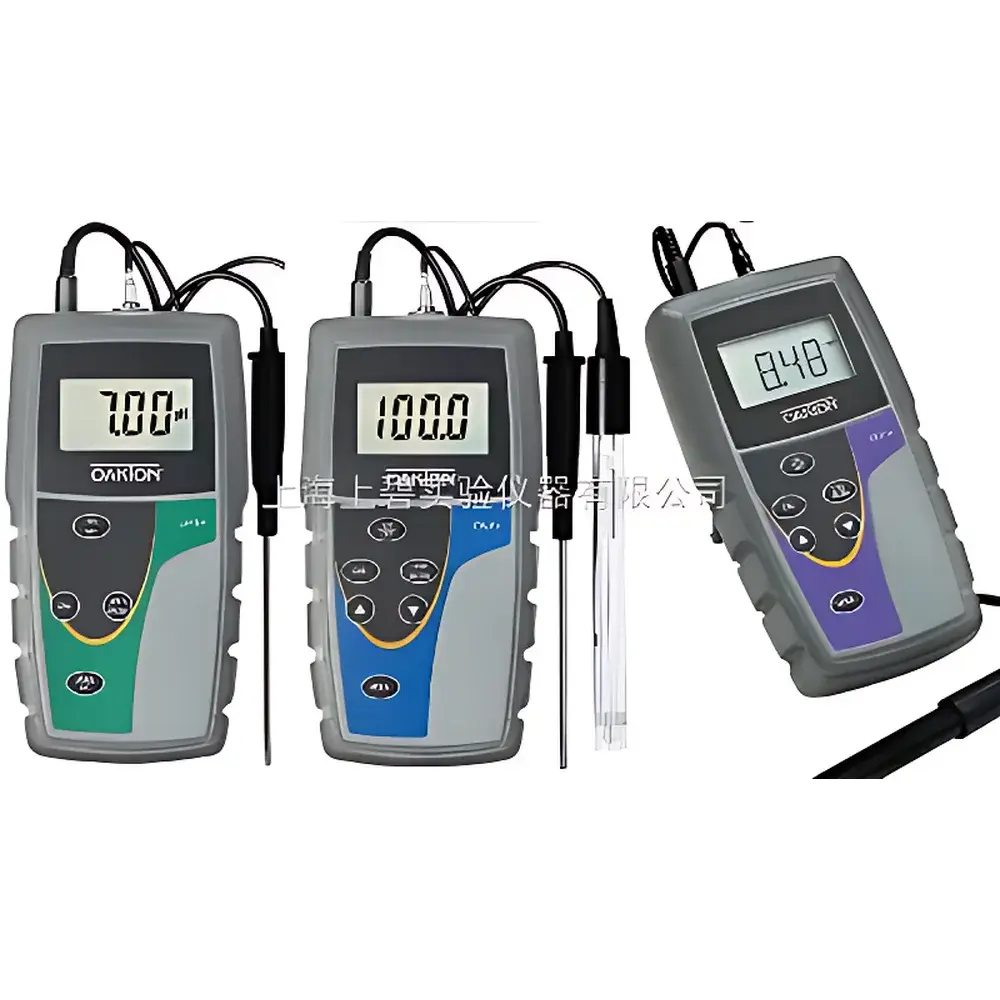
Oakton DO6+ Dissolved Oxygen Meter Model 35613-22
| Origin | USA |
|---|---|
| Manufacturer Type | Authorized Distributor |
| Product Origin | Imported |
| Model | 35613-22 |
| Instrument Type | Benchtop Laboratory Meter |
| Measurement Principle | Galvanic Cell Electrochemical Probe |
| Dissolved Oxygen Range | 0.00–20.00 mg/L (ppm) |
| Saturation Range | 0.0–200.0% |
| DO Accuracy | ±1.5% of full scale |
| Saturation Accuracy | ±1.5% of full scale |
| Resolution | 0.01 mg/L and 0.1% |
| Repeatability | ±0.05% FS |
| Detection Limit | ±2% FS |
| Temperature Range (for DO measurement) | 0–50 °C |
| Temperature Accuracy | ±0.5 °C |
| Temperature Compensation | Automatic or Manual (0–50 °C) |
| Power | 4 × AA batteries (≈500 hours life) |
| Dimensions | 15.7 × 8.5 × 4.2 cm (L×W×H) |
Overview
The Oakton DO6+ Dissolved Oxygen Meter (Model 35613-22) is a precision benchtop laboratory instrument engineered for reliable, traceable dissolved oxygen (DO) quantification in aqueous environmental, wastewater, aquaculture, and research applications. It employs a galvanic cell electrochemical probe—specifically the included Oakton 35642-50 DO sensor—to generate a current proportional to the partial pressure of molecular oxygen diffusing across a gas-permeable membrane. This principle conforms to ASTM D888 and ISO 5814 standards for electrochemical DO determination. Unlike polarographic sensors requiring polarization time, galvanic probes deliver immediate stable readings with no warm-up delay, making them ideal for routine QC labs and field-deployable lab workflows. The meter integrates temperature compensation (automatic or manual, 0–50 °C) to correct for solubility variations per the Benson–Krause equation, ensuring compliance with EPA Method 360.5 and USP for oxygen content verification in pharmaceutical water systems.
Key Features
- Galvanic DO probe (35642-50, 0.9 m cable) with replaceable membrane and electrolyte—designed for low-maintenance operation and extended sensor lifetime
- Simultaneous dual-parameter display: DO concentration (mg/L or ppm) and % saturation, both with 0.01/0.1 resolution
- Automatic temperature compensation (ATC) using integrated thermistor; manual override available for non-standard calibration conditions
- Stable reading hold function with visual indicator—critical for recording measurements in turbulent or low-flow samples
- Auto-power-off after 17 minutes of inactivity to conserve battery life; powered by four standard AA alkaline cells (typical 500-hour service life)
- Robust ABS housing rated IP65 for splash resistance; ergonomic design optimized for benchtop stability and glove-compatible operation
- Calibration support for zero (sodium sulfite solution) and span (air-saturated water or saturated air at known barometric pressure) per ISO 5814 Annex B
Sample Compatibility & Compliance
The DO6+ is validated for use with freshwater, seawater (with salinity compensation), wastewater effluents, biological reactor samples, and purified water matrices. Its galvanic sensor exhibits minimal flow dependence above 5 cm/s—meeting the minimum velocity requirement specified in ISO 5814 for representative sampling. The instrument supports user-entered barometric pressure and salinity inputs to correct DO solubility calculations per APHA Standard Methods 4500-O G. It complies with GLP documentation requirements through timestamped calibration logs (accessible via front-panel review), and its fixed calibration points align with FDA 21 CFR Part 11 expectations for audit-ready instrumentation when used within validated SOPs. No internal memory or electronic signature capability is provided; data export requires external logging.
Software & Data Management
The DO6+ operates as a standalone meter without proprietary software dependency. All calibration events—including date, time, zero and span values, probe ID (if entered), and operator notes—are stored in non-volatile memory and retrievable via the “CAL History” menu. While it lacks USB or Bluetooth connectivity, analog output (0–20 mA or 4–20 mA optional via external adapter) enables integration into SCADA or LIMS environments where analog signal acquisition is standard. Calibration records satisfy basic GLP traceability needs for laboratories operating under ISO/IEC 17025:2017 Clause 7.7 (Ensuring validity of results). For full electronic record retention, users are advised to pair the meter with a validated external data logger compliant with 21 CFR Part 11.
Applications
- Environmental monitoring: BOD incubation verification, river/stream health assessment, wetland restoration projects
- Wastewater treatment: Aeration basin optimization, activated sludge process control, effluent compliance reporting per NPDES permits
- Aquaculture and fisheries: Pond DO profiling, hatchery water quality assurance, hypoxia risk mitigation
- Pharmaceutical water systems: Purified Water (PW) and Water for Injection (WFI) oxygen content verification per USP
- Academic and teaching labs: Principles of aquatic respiration, Henry’s law demonstrations, sensor response kinetics experiments
- Research on biogeochemical cycling: Sediment-water interface O₂ flux studies using diffusion gradient techniques
FAQ
What calibration standards are required for daily operation?
Zero calibration uses freshly prepared sodium sulfite solution (0.00 mg/L); span calibration uses air-saturated water equilibrated at ambient temperature and pressure—or certified zero/span gases for high-accuracy validation.
Can the DO6+ measure in seawater or high-salinity samples?
Yes, provided user-input salinity (in ppt) is entered prior to measurement; the meter applies the Garcia–Gordon solubility correction algorithm per UNESCO Technical Papers in Marine Science.
Is the 35642-50 probe compatible with other Oakton meters?
Yes—it is cross-compatible with the DO6+, PH6+, and ION6+ platforms via the universal 6-pin DIN connector.
How often should the DO probe membrane be replaced?
Typically every 2–4 weeks under continuous use; more frequently in abrasive or protein-rich matrices. Membrane replacement kits (35642-56) include electrolyte solution and O-rings.
Does the meter support barometric pressure compensation?
Yes—manual entry of local atmospheric pressure (mmHg or kPa) is supported to correct for elevation-dependent oxygen solubility deviations.
Related Products







