
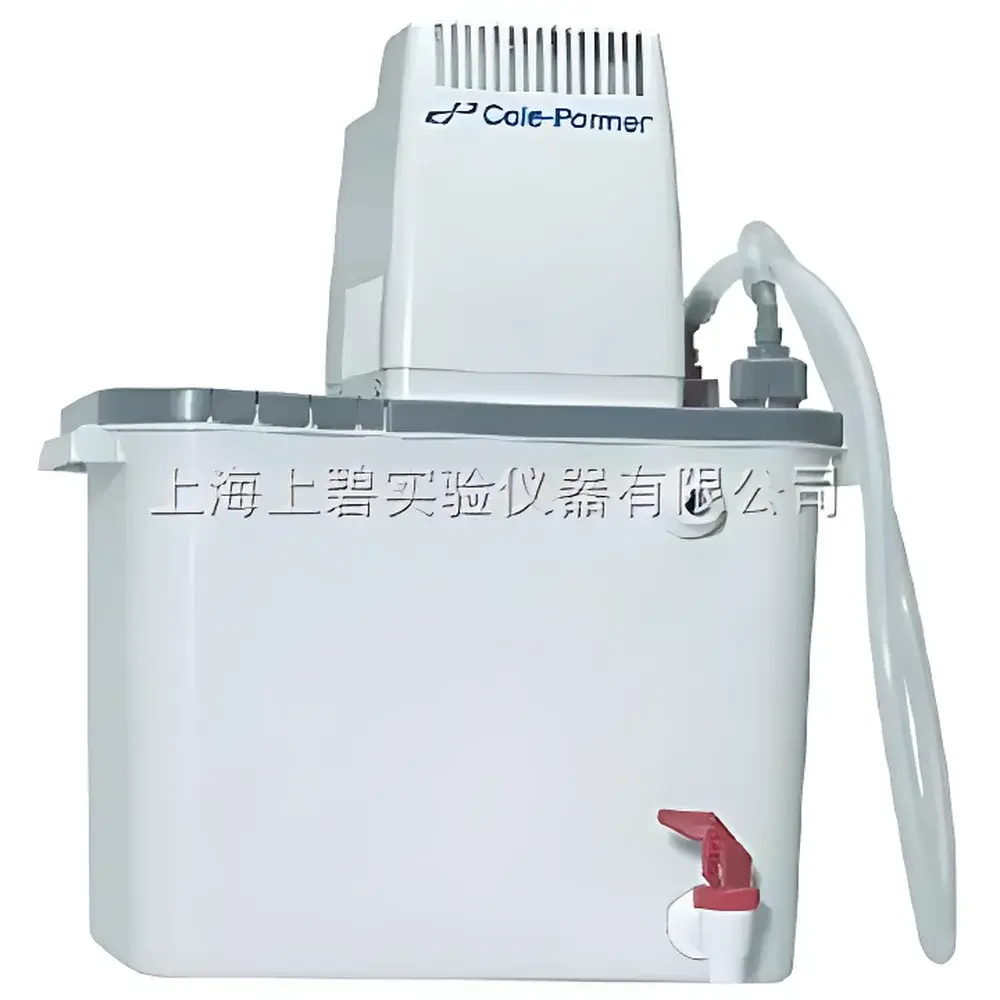
Cole-Parmer 35031-60 Oil-Free Dual-Channel Water Jet Vacuum Pump
| Brand | Cole-Parmer |
|---|---|
| Origin | USA |
| Model | 35031-60 |
| Pump Type | Water Jet (Ejector) Vacuum Pump |
| Oil-Free Design | Yes |
| Vacuum Level | 10 Torr |
| Flow Rate | 18 L/min |
| Water Reservoir Capacity | 9.5 L |
| Noise Level | 60 dB(A) |
| Inlet Port ID | 8 mm |
| Power Supply | 230 V, 50/60 Hz |
| Wetted Materials | Nickel-plated brass, polypropylene, silicone, stainless steel |
| Integrated Check Valve | Yes |
| Drain Port & Faucet | Yes |
| Dual Independent Vacuum Channels | Yes |
Overview
The Cole-Parmer 35031-60 Oil-Free Dual-Channel Water Jet Vacuum Pump is an engineered solution for laboratories requiring reliable, maintenance-free vacuum generation without oil contamination or compressed air dependency. Operating on the principle of the Venturi effect, this water-aspirator pump uses pressurized tap water (or recirculated water via its integrated reservoir system) to generate vacuum through high-velocity fluid dynamics in precision-machined nozzles. Unlike mechanical or diaphragm pumps, it delivers pulse-free vacuum—critical for sensitive applications such as rotary evaporation, vacuum filtration, and solvent removal where pressure fluctuations may compromise sample integrity or process repeatability. Designed for benchtop deployment, the unit integrates a self-contained 9.5 L polypropylene water reservoir with drain port and faucet, eliminating continuous water waste while enabling operation in locations without direct tap access. Its dual independent vacuum channels allow simultaneous operation of two separate vacuum-dependent instruments—e.g., one channel for filtration and another for degassing—without cross-contamination or pressure interference.
Key Features
- Pulse-free vacuum output ensures stable pressure control for precision evaporation and filtration processes
- Integrated 9.5 L recirculating water reservoir with drain valve and spigot enables closed-loop operation and conserves water resources
- Dual independent vacuum ports (8 mm ID each), each equipped with an internal check valve to prevent backflow of water into connected apparatus
- Low-noise design operating at ≤60 dB(A) — suitable for shared laboratory environments and noise-sensitive workflows
- Oil-free and lubricant-free architecture eliminates risk of hydrocarbon contamination; compliant with ISO 8573-1 Class 0 air purity requirements for vacuum lines
- Chemically resistant wetted materials: nickel-plated brass nozzle and body components, polypropylene reservoir, food-grade silicone gaskets, and stainless steel fasteners
- Plug-and-play operation: fill reservoir, connect vacuum tubing, and power on—no priming, calibration, or scheduled maintenance required
Sample Compatibility & Compliance
This pump is compatible with standard laboratory glassware (e.g., Büchner funnels, filter flasks, rotary evaporator condensers) using 8 mm ID vacuum tubing. It supports aqueous and moderately polar solvent systems but is not recommended for highly volatile, low-boiling-point solvents (e.g., diethyl ether, pentane) without cold trap integration due to vapor entrainment limitations inherent to water-jet technology. The device meets CE marking requirements for electrical safety (EN 61000-6-3, EN 61000-6-4) and complies with RoHS 2015/863/EU. While not certified to UL or CSA standards, its construction adheres to general laboratory equipment safety guidelines per ANSI Z9.5–2022 (Laboratory Ventilation). For GLP/GMP-regulated environments, users may implement procedural controls—including logbook entries for reservoir refills, visual inspection of check valves, and periodic verification of vacuum stability—to support audit readiness.
Software & Data Management
The 35031-60 operates as a standalone analog instrument with no embedded firmware or digital interface. However, optional accessories enable basic vacuum monitoring and control: the 35031-16 vacuum gauge and regulator assembly provides real-time analog readout (0–30 Torr range) and adjustable needle-valve throttling for fine-tuned pressure regulation. When used in validated workflows, this configuration supports manual data recording aligned with FDA 21 CFR Part 11 principles—provided operators maintain contemporaneous handwritten logs or integrate readings into validated LIMS or ELN platforms. No proprietary software or driver installation is required.
Applications
- Vacuum-assisted gravity and pressure filtration using filter flasks and sintered glass funnels
- Rotary evaporation of heat-sensitive compounds under controlled sub-atmospheric conditions
- Desiccation and drying of crystalline or hygroscopic samples in vacuum desiccators
- Gas-phase extraction and degassing of liquid reagents prior to chromatographic analysis
- Support vacuum for manifold-based solid-phase extraction (SPE) systems
- Education and teaching labs—ideal for demonstrating fundamental vacuum physics and fluid dynamics principles
FAQ
Is this pump suitable for use with organic solvents?
Yes, with caution: it is appropriate for water-miscible or moderately volatile solvents (e.g., ethanol, acetone, ethyl acetate) when paired with an inline cold trap. Highly volatile solvents (e.g., diethyl ether, dichloromethane) require additional condensation protection to prevent pump performance degradation and potential vapor saturation of the water reservoir.
Can the water reservoir be refilled during operation?
Yes—the reservoir features a sealed lid with vented cap and accessible fill port; topping up is possible without interrupting vacuum generation, provided water level remains above the nozzle intake threshold.
What maintenance is required?
None beyond periodic visual inspection of the check valves, cleaning of the reservoir interior with deionized water every 2–4 weeks (depending on water hardness and usage frequency), and replacement of silicone tubing per institutional preventive maintenance schedules.
Does the pump meet ISO or ASTM standards for vacuum generation?
While not formally certified to ISO 27427 (vacuum pump performance testing) or ASTM D3924 (laboratory vacuum system specifications), its documented performance parameters (10 Torr ultimate vacuum, 18 L/min flow at 10 Torr) align with typical Class II water aspirator benchmarks defined in ASTM E1252–98 (Standard Guide for General Atmospheric Sampling).
Can I connect more than two devices simultaneously?
No—the dual-channel architecture supports only two independent vacuum circuits. Branching a single port using Y-fittings is discouraged, as it compromises flow balance, vacuum stability, and check valve functionality.



