
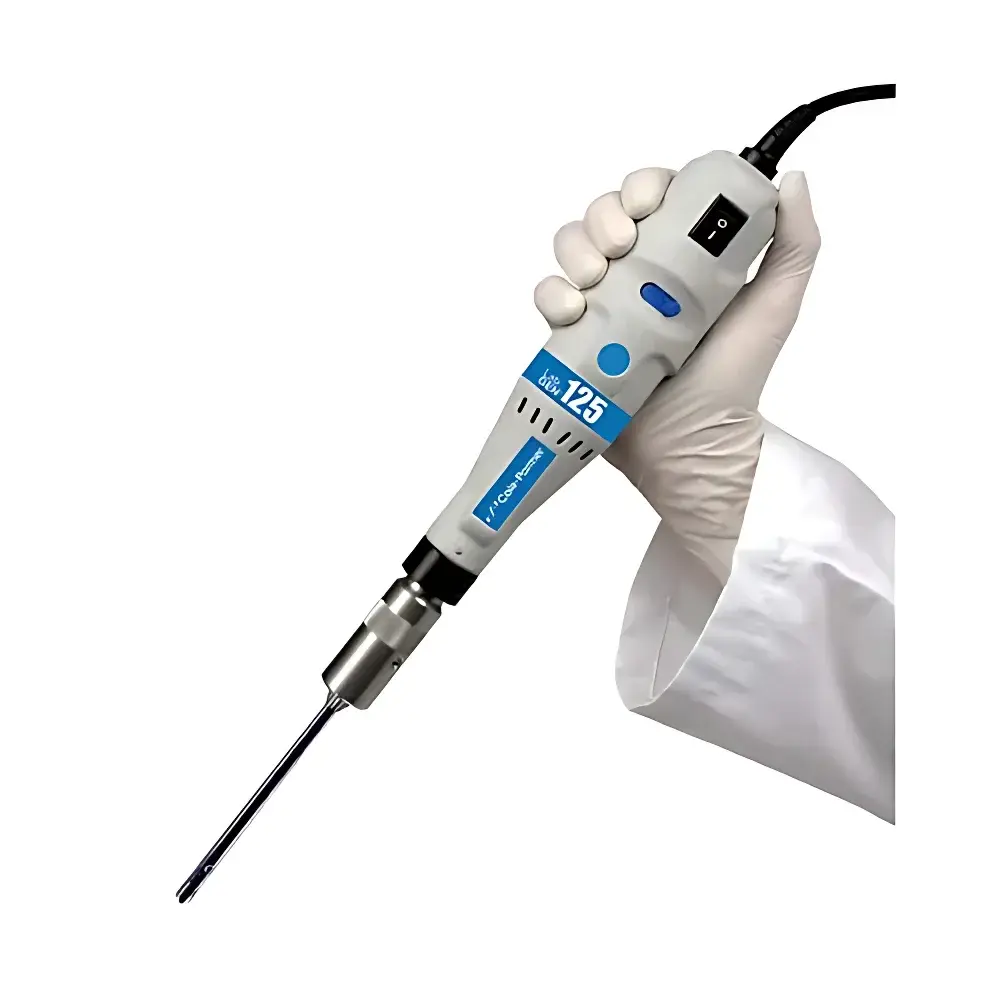
Labgen Labgen125 Handheld Homogenizer
| Origin | USA |
|---|---|
| Manufacturer Type | Distributor |
| Origin Category | Imported |
| Model No. | 04727-02 |
| Instrument Type | Handheld Homogenizer |
| Instrument Subtype | Tissue Disruptor Homogenizer |
| Sample Volume Range | 0.05–100 mL |
| Speed Range | 10,000–30,000 rpm |
| Power Input | 220 V, 50/60 Hz, 125 W |
| Compliance | CE, RoHS |
| Probe Options | Stainless Steel (F/C series) and Autoclavable Polypropylene Probes |
Overview
The Labgen Labgen125 Handheld Homogenizer is a high-performance, variable-speed tissue disruption system engineered for reproducible mechanical lysis of biological samples in molecular biology, clinical diagnostics, and pharmaceutical R&D laboratories. Utilizing high-shear rotor-stator homogenization principles, the Labgen125 delivers controlled energy input to rapidly disrupt cell membranes, homogenize soft and hard tissues, and suspend particulates in viscous or heterogeneous matrices. Its compact, ergonomic design supports both handheld operation for flexibility and benchtop mounting via optional base stand (04727-89) for hands-free, repeatable processing—critical for standardized workflows under GLP or ISO 17025-compliant environments.
Key Features
- Variable speed control from 10,000 to 30,000 rpm with digital feedback ensures precise shear energy delivery across diverse sample viscosities and cellular resilience profiles.
- Dual-probe compatibility: Interchangeable stainless steel probes (F-series for soft tissue dispersion; C-series for cryogenic or fibrous tissue homogenization) and autoclavable polypropylene probes (F/C-type), validated for ≥20 cycles at 121 °C, 15 psi, minimizing cross-contamination risk in RNA/DNA extraction workflows.
- Robust 125 W brushless motor provides consistent torque output even during extended operation or high-viscosity loading—essential for reproducible lysis efficiency in qPCR, NGS library prep, and protein extraction protocols.
- Ergonomic, non-slip grip housing with integrated thermal management reduces operator fatigue and prevents overheating during sequential sample processing.
- Modular probe interface with universal adapter (04727-88) enables rapid probe swaps without tools—supporting seamless transition between sterile disposable and reusable probe configurations.
Sample Compatibility & Compliance
The Labgen125 accommodates sample volumes from 0.05 mL (e.g., single-cell lysates, microdissected biopsies) up to 100 mL (bulk tissue suspensions), with probe-specific volume envelopes aligned to ASTM D4084-21 guidance for homogenizer validation. Stainless steel probes (e.g., 04727-60, 04727-77, 191F) are electropolished and passivated per ASTM A967 for biocompatibility and corrosion resistance. Plastic probes (04727-84, 04727-86) comply with USP Class VI and ISO 10993-5 cytotoxicity standards. The system meets CE marking requirements for electromagnetic compatibility (EN 61326-1) and safety (EN 61010-1), supporting audit readiness for FDA 21 CFR Part 11–aligned data integrity practices when paired with timestamped log files generated by external lab information systems.
Software & Data Management
While the Labgen125 operates as a standalone analog-controlled instrument, its speed stability and repeatability enable integration into validated digital workflows. Users may document operating parameters—including speed setpoint, duration, probe type, and sample ID—in electronic lab notebooks (ELNs) compliant with ALCOA+ principles. When mounted on the 04727-89 benchtop stand, the unit supports time-synchronized video capture for SOP verification and training documentation. All probe SKUs include traceable lot numbers and material certifications (e.g., RoHS DoC, PP biocompatibility reports), facilitating full chain-of-custody tracking per ISO/IEC 17025 clause 7.7.
Applications
- Molecular biology: Efficient lysis of mammalian cells, bacteria, yeast, and plant tissues for downstream nucleic acid isolation (RNA integrity number ≥8.5 achievable with optimized F-probe selection).
- Clinical pathology: Homogenization of frozen tumor biopsies, FFPE tissue sections, and cerebrospinal fluid sediments prior to immunoassay or mass spectrometry analysis.
- Pharmaceutical QA/QC: Dispersion of active pharmaceutical ingredients (APIs) in suspension formulations and particle size reduction validation per USP .
- Toxicology & environmental testing: Extraction of analytes from soil, sediment, and biological matrices per EPA Method 3540C and ISO 11466.
- Vaccine development: Emulsification of adjuvant-oil phases and cell pellet resuspension during upstream process development.
FAQ
Is the Labgen125 compatible with GLP or GMP-regulated environments?
Yes—the device’s mechanical consistency, probe traceability, and operational repeatability support qualification per ICH Q5C and Annex 15. Full validation packages (IQ/OQ/PQ templates) are available upon request.
Can plastic probes be used for BSL-2 or higher containment work?
Autoclavable polypropylene probes (04727-84/86) are validated for steam sterilization and routinely deployed in BSL-2 labs; however, users must verify sterility assurance level (SAL 10⁻⁶) via biological indicators per ISO 17665-1 for specific cycle parameters.
What maintenance is required to ensure long-term speed accuracy?
Annual calibration of the tachometer circuit using a certified optical tachometer (e.g., Fluke 971) is recommended. Motor brushes are not serviceable—brushless architecture eliminates scheduled wear-part replacement.
How does probe selection affect shear rate distribution?
Shear rate scales with tip speed (π × diameter × rpm). Smaller-diameter probes (e.g., 5 mm) generate higher localized shear for small-volume, high-integrity nucleic acid recovery; larger tips (10–35 mm) optimize bulk homogenization throughput while reducing cavitation-induced degradation.
Is there a service network available outside North America?
Labgen-certified technical partners operate in EU, APAC, and LATAM regions; repair turnaround time is ≤10 business days with return shipping included under warranty.



