
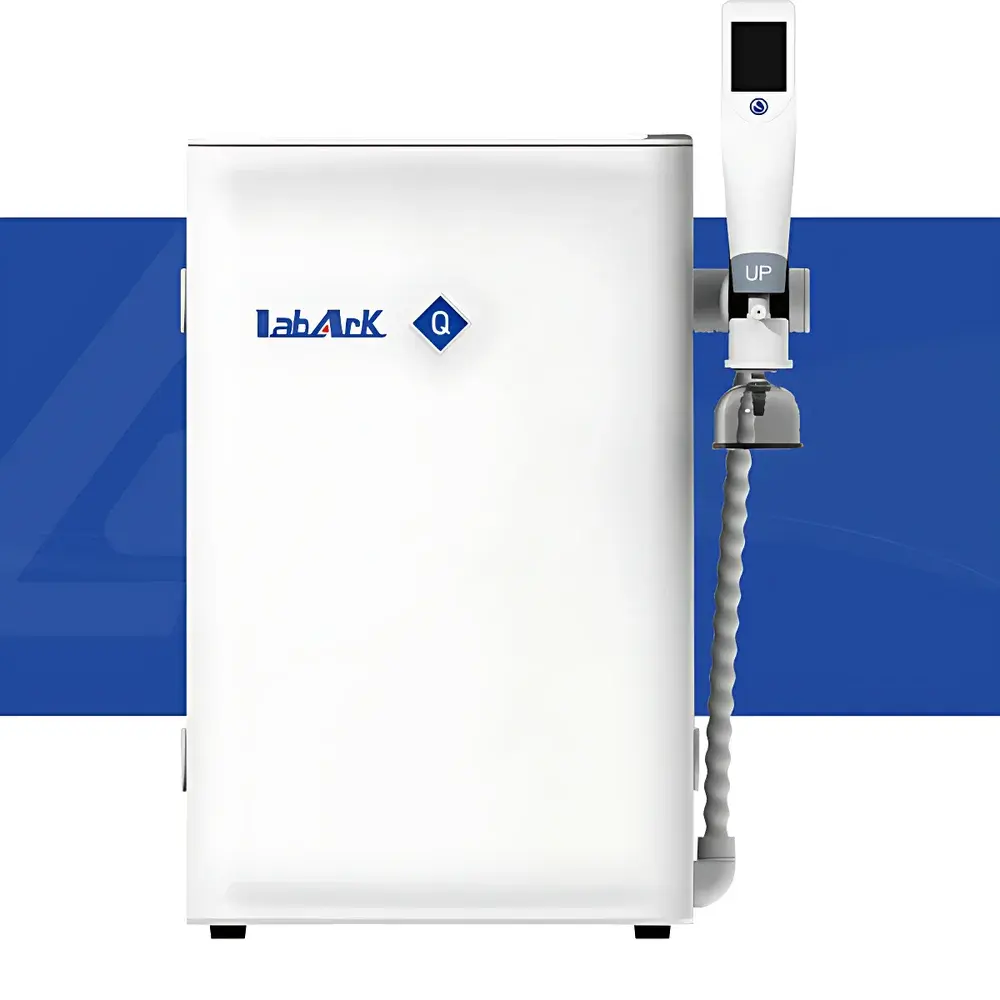
LabArk Q Ultra Pure Water System
| Brand | LabArk |
|---|---|
| Origin | USA |
| Model | LS0Q00000K |
| Input Water | EDI, RO or Distilled Water |
| Inlet Temp | 5–35°C |
| Inlet Pressure | 0–0.1 MPa |
| Ultrapurified Water Flow Rate | 0–2 L/min |
| Resistivity | 18.2 MΩ·cm @ 25°C |
| TOC | < 5 ppb |
| Particles > 0.22 µm | None Detected |
| Microbial Count | < 0.01 CFU/mL (with 0.2 µm final filter) |
| Dimensions | 41 × 21 × 64 cm |
| Net Weight | 18 kg |
| Power Supply | 100–240 VAC input, 24 VDC system |
| Max Power Consumption | < 190 W |
| Data Storage Duration | ≥ 2 years |
| Compliance | GB/T 6682-2008, GB/T 11446.1-2013, ASTM D1193-20, ISO 3696:1987, GB/T 33087-2016 |
Overview
The LabArk Q Ultra Pure Water System is an engineered solution for laboratories requiring continuous, on-demand production of Type I ultrapure water compliant with international analytical and life science standards. It operates via a multi-stage purification architecture: prefiltration, reverse osmosis (RO) or electrodeionization (EDI) feedwater conditioning, dual-wavelength UV photooxidation (185 nm + 254 nm), and final polishing through mixed-bed ion exchange resins and a 0.2 µm terminal membrane filter. Unlike single-pass systems, the LabArk Q incorporates an internal recirculation loop that continuously circulates ultrapure water through the UV chamber and polishing cartridge at defined intervals—ensuring consistent TOC reduction and microbial suppression without operator intervention. Designed for integration into regulated environments, the system maintains stable resistivity ≥ 18.2 MΩ·cm at 25°C, with real-time monitoring of conductivity, temperature, flow rate, and UV lamp intensity.
Key Features
- Automated closed-loop recirculation: Ultrahigh-purity water is cycled hourly through 185/254 nm UV lamps and high-capacity mixed-bed resin cartridges to suppress organic regrowth and maintain TOC < 5 ppb.
- Dual-interface data governance: Embedded Ethernet (LAN) and USB 2.0 ports support secure export of audit-ready logs—including timestamped conductivity, pressure, UV intensity, and alarm events—for GLP/GMP-aligned documentation.
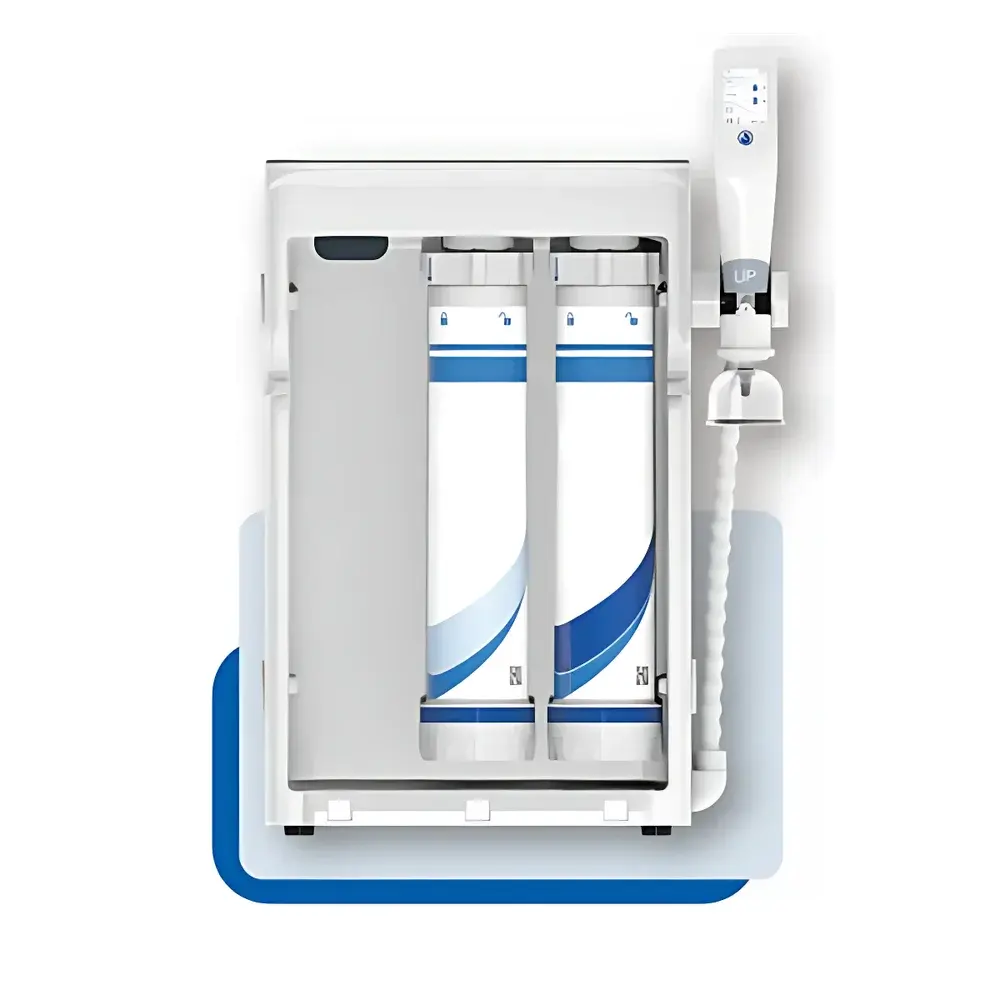
- Tool-free modular architecture: All consumables—including integrated resin cartridges, 0.2 µm final filters, and UV lamps—are designed for user replacement without service tools or field engineer support.
- Intuitive HMI interface: A 5.7-inch color touchscreen provides real-time access to water quality metrics, programmable dispensing modes (volume-based, timed, or manual), adjustable flow control (0.1–2.0 L/min), and configurable system alerts (e.g., low resin capacity, UV lamp degradation, filter saturation).
- Space-optimized footprint: Compact vertical chassis (41 × 21 × 64 cm) accommodates under-bench or wall-mounted installation; magnetic, height-adjustable dispensing arm enables ergonomic operation with or without gloves.
Sample Compatibility & Compliance
The LabArk Q delivers water meeting or exceeding the most stringent specifications for critical applications including HPLC mobile phase preparation, ICP-MS calibration, cell culture media formulation, and molecular biology reagent synthesis. Its output satisfies Type I water requirements per ASTM D1193-20 (Grade I), ISO 3696:1987 (Grade 1), and GB/T 6682-2008 (Grade 1). For semiconductor and photovoltaic R&D, it complies with GB/T 33087-2016 for high-purity water used in wafer cleaning and etch processes. All electronic logging adheres to ALCOA+ principles (Attributable, Legible, Contemporaneous, Original, Accurate, Complete, Consistent, Enduring, Available), supporting FDA 21 CFR Part 11 readiness when deployed with validated network authentication protocols.
Software & Data Management
The embedded firmware supports long-term, tamper-resistant storage of ≥ 2 years’ operational history, including daily calibration logs, UV lamp operating hours, cumulative volume dispensed, and event-triggered alarms. Data export formats include CSV and PDF reports compatible with laboratory information management systems (LIMS). Optional firmware upgrades enable time-stamped digital signatures, role-based user access control (administrator/operator), and automated report scheduling via SMTP email or network share. No cloud dependency is required—full local data sovereignty is maintained unless explicitly configured otherwise per institutional IT policy.
Applications
- HPLC, UHPLC, and LC-MS solvent preparation where trace metals and organics compromise column longevity and detection sensitivity.
- ICP-OES and ICP-MS analysis requiring sub-ppt elemental blank levels and minimal polyatomic interference from chloride or sulfate residues.
- Mammalian and stem cell culture workflows demanding endotoxin-free, nuclease-free water for media and buffer preparation.
- Next-generation sequencing library construction and CRISPR reagent dilution where RNase/DNase contamination risks must be eliminated.
- Calibration of clinical chemistry analyzers and reference material preparation under CLIA and CAP accreditation frameworks.
FAQ
What feedwater sources are compatible with the LabArk Q?
The system accepts pretreated feedwater with conductivity ≤ 100 µS/cm at 25°C—including RO permeate, EDI product water, or distilled water. Municipal tap water or untreated groundwater is not permitted.
How often must consumables be replaced?
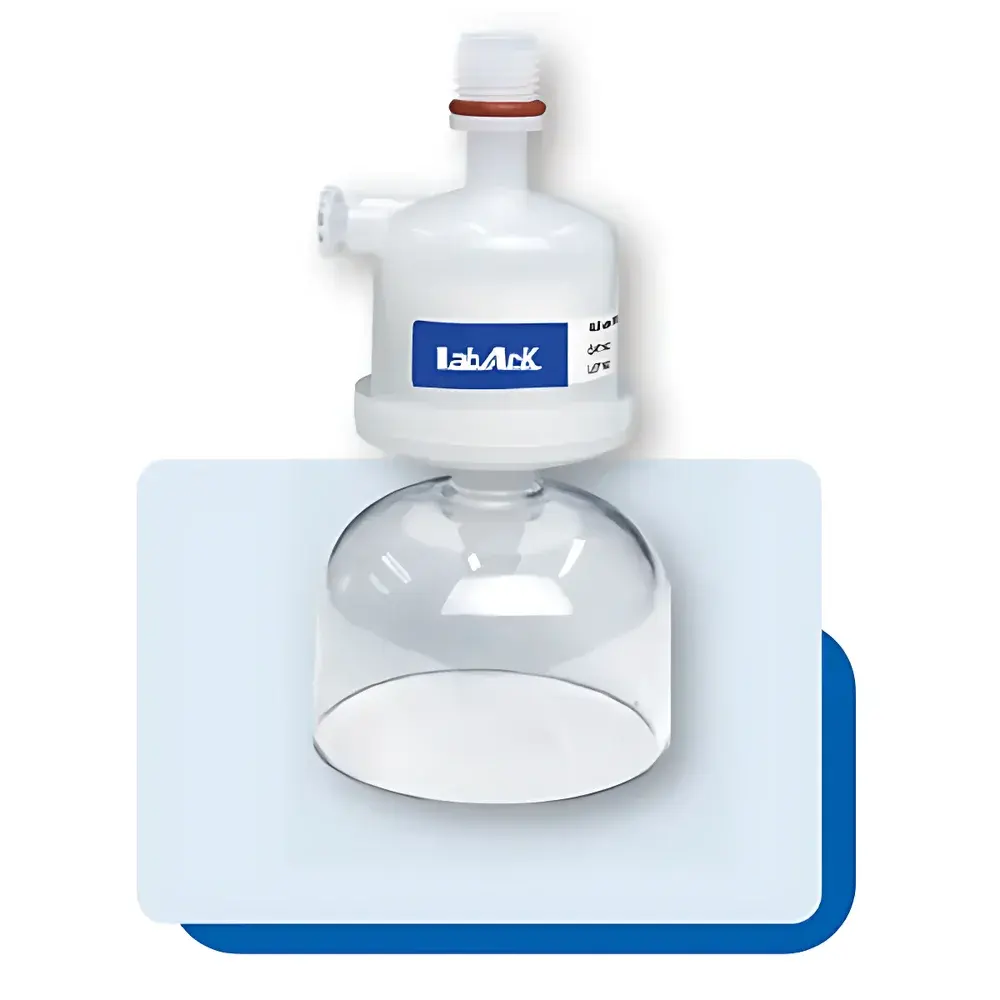
Resin cartridge lifespan depends on inlet water quality and daily usage volume; typical replacement intervals range from 6–12 months under standard lab conditions (≤ 100 L/day). The 0.2 µm final filter is rated for ≥ 1,500 L and includes a built-in pressure differential sensor for predictive replacement alerts.
Does the system support 21 CFR Part 11 compliance?
Yes—the firmware supports electronic signatures, audit trail generation, and user-level permissions. Full Part 11 validation requires site-specific IQ/OQ/PQ execution and integration with institutional identity management infrastructure.
Can the LabArk Q be integrated into a building’s central water distribution network?
No. It is a point-of-use (POU) system designed for standalone operation. Centralized distribution would compromise TOC and particle integrity due to biofilm formation and leaching in external piping.
Is remote monitoring supported?
Local network monitoring via static IP or DHCP is enabled by default. Remote access beyond the LAN requires deployment behind an institutionally approved firewall and TLS-secured reverse proxy—no inbound internet connectivity is enabled out-of-the-box.
Related Products



