
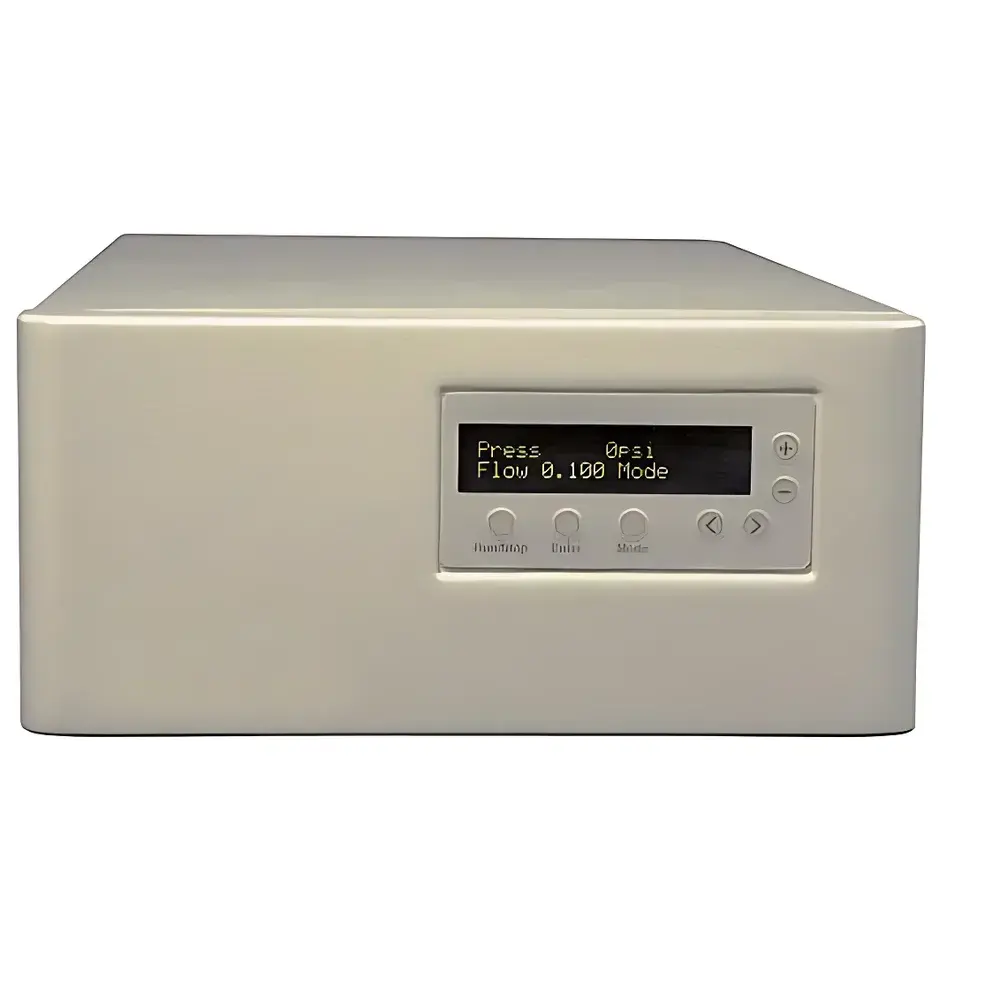
Cole-Parmer 74930-65 High-Pressure Low-Flow Plunger Pump
| Brand | Cole-Parmer |
|---|---|
| Origin | USA |
| Model | 74930-65 |
| Flow Range | 0.001–12.000 mL/min |
| Max Pressure | 18,000 psi (1241 bar) |
| Flow Increment | 1 µL |
| Accuracy | ±2% (full pressure), ±1% (at 1000 psi / 1 mL/min) |
| Precision | <1% over 30 s, 0.5% RSD |
| Materials | 316 stainless steel housing, sapphire valves, PTFE fluid path, UHMW-PE seals, integrated pressure transducer |
| Operating Temp. | up to 100°C |
| Ambient | 0–80°C, ≤98% RH |
| Power | 100–220 VAC, 50/60 Hz |
| Dimensions (W×H×D) | 14×27×45 cm |
| Weight | 15 kg |
| Interface | RS-232 |
| Self-Priming | No |
Overview
The Cole-Parmer 74930-65 High-Pressure Low-Flow Plunger Pump is an engineered precision positive displacement pump designed for ultra-high-pressure liquid delivery in analytical and preparative applications requiring exceptional flow stability and pressure resilience. Based on dual-plunger reciprocating architecture with active solvent recompression algorithms and real-time pressure-compensated flow control, this pump delivers minimal pulsation (<0.5% RSD) across its full operational envelope—critical for maintaining column integrity in high-resolution liquid chromatography (LC), ultra-high-performance liquid chromatography (UHPLC), and microfluidic reaction systems operating at pressures up to 18,000 psi (1241 bar). Its design accommodates sub-microliter flow resolution (1 µL increments) while sustaining rated pressure, enabling precise metering in capillary-scale separations, catalyst screening under supercritical conditions, and continuous-flow synthesis where narrow residence time distributions are essential.
Key Features
- Dual-plunger architecture with adaptive solvent recompression to suppress pulsation and ensure flow continuity during high-frequency stroke cycles
- Real-time pressure feedback loop dynamically adjusts plunger velocity to maintain setpoint flow accuracy within ±1% RSD at 1 mL/min and 1000 psi, and <1% deviation over 30-second intervals across full pressure range
- Chemically inert fluid path: sapphire check valves, PTFE-lined pump heads, UHMW-PE seals, and 316 stainless steel wetted housing ensure compatibility with aggressive solvents (e.g., THF, DCM, concentrated acids/bases) and extended service life
- Integrated piezoresistive pressure transducer with digital readout on front-panel LCD; simultaneous display of actual pressure, setpoint pressure, flow rate, and elapsed run time
- RS-232 serial interface supports bidirectional communication with external controllers or chromatography data systems (CDS), enabling remote parameter setting, status monitoring, and event logging
- Thermally stable construction rated for continuous operation up to 100°C ambient cabinet temperature; conformal coating on internal electronics enhances reliability in high-humidity environments (≤98% RH)
Sample Compatibility & Compliance
The 74930-65 is validated for use with aqueous, organic, and mixed mobile phases common in LC method development—including acetonitrile/water gradients, TFA-containing buffers, and chlorinated solvents. Its material compatibility profile aligns with ASTM F2136-19 (standard specification for elastomeric seals in pharmaceutical processing) and USP for polymeric components. While not certified as GMP-compliant out-of-the-box, the pump’s deterministic flow behavior, audit-ready RS-232 command log, and pressure trace recording capability support integration into GLP/GMP workflows when paired with compliant CDS software that enforces 21 CFR Part 11 electronic signature and audit trail requirements.
Software & Data Management
No proprietary software is bundled; however, the pump responds to ASCII-based SCPI (Standard Commands for Programmable Instruments) over RS-232, facilitating seamless integration with LabVIEW, Python (pySerial), MATLAB, or third-party chromatography platforms. All commands—including flow setpoint changes, pressure limit activation, purge initiation, and status queries—return machine-readable responses with timestamped acknowledgments. Internal non-volatile memory retains last-used parameters after power cycling. For regulatory environments, users may implement external data acquisition systems to capture pressure/flow logs with cryptographic hash verification and immutable storage per ALCOA+ principles.
Applications
- UHPLC and nano-LC systems employing sub-2-µm particle columns (e.g., C18, HILIC, chiral phases)
- High-pressure reaction monitoring in flow chemistry reactors (e.g., hydrogenation, photochemical transformations at >1000 psi)
- Calibration of pressure sensors and flow meters traceable to NIST standards
- Long-term stability testing of membrane filtration modules under constant flux conditions
- Delivery of viscous polymer solutions (e.g., PMMA in toluene) in rheology-coupled extrusion studies
- Controlled infusion in preclinical pharmacokinetic assays requiring precise bolus timing and volume fidelity
FAQ
Does the 74930-65 support gradient elution?
No—it is a single-channel isocratic pump. Gradient functionality requires integration with a low-pressure mixing module or external proportioning valve system.
Can it prime automatically without manual venting?
No self-priming capability is included; initial priming must be performed manually using the front-panel purge function and syringe-assisted venting of the inlet line.
Is the pressure transducer user-calibratable?
Field calibration is not supported; factory calibration is performed per ISO/IEC 17025-accredited procedures and documented in the supplied certificate of conformance.
What maintenance intervals are recommended?
Sapphire valves and seals should be inspected every 500 hours of operation or annually—whichever occurs first—and replaced if scoring or leakage is observed; pump head lubrication is not required due to dry-running ceramic-coated plunger surfaces.
Is CE marking applicable?
Yes—the unit complies with EU Directive 2014/30/EU (EMC) and 2014/35/EU (LVD) and bears the CE mark; full technical documentation is available upon request for conformity assessment.



