
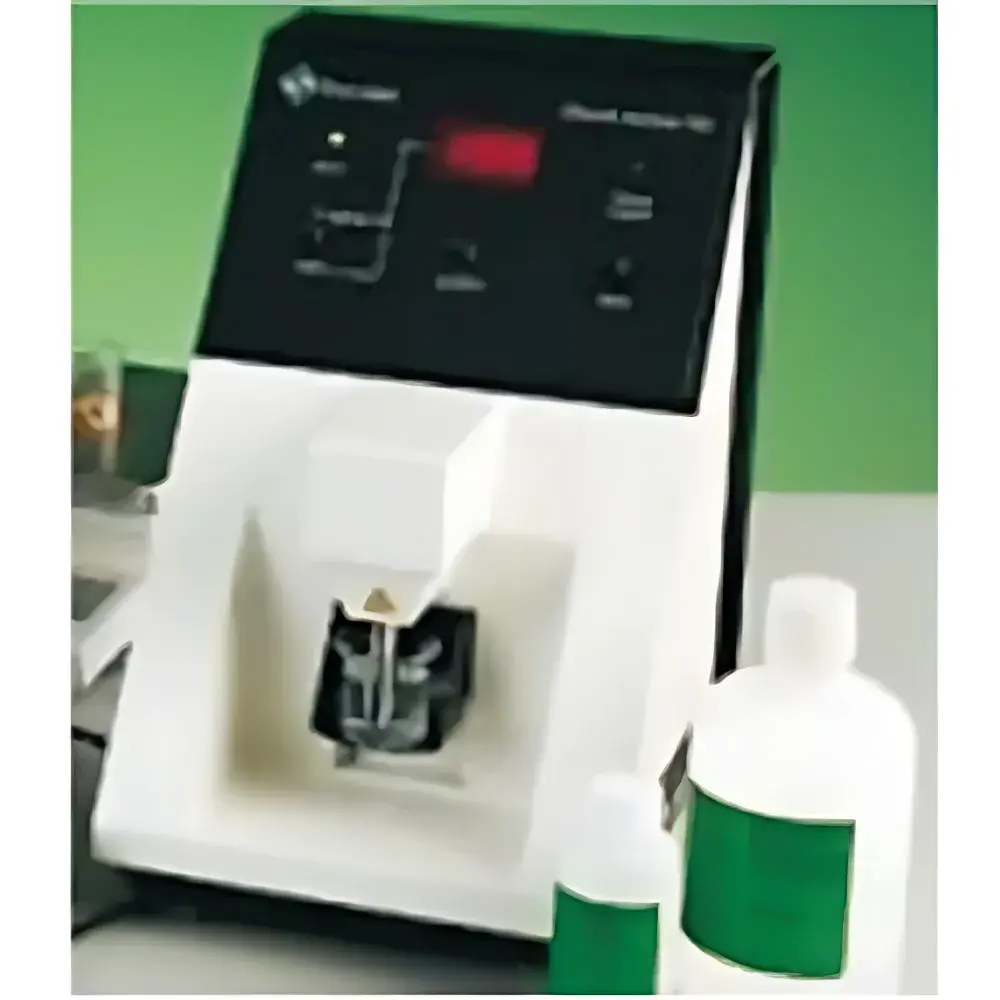
Sherwood Scientific 926 and 926S Chloride Analyzers
| Origin | UK |
|---|---|
| Manufacturer Type | Authorized Distributor |
| Origin Category | Imported |
| Model | 926, 926S |
| Instrument Type | Benchtop Laboratory Analyzer |
| Measurement Principle | Coulometric Titration (Silver Nitrate Generation) |
| Measured Parameters | Chloride ion (Cl⁻), Salt (% w/v, mg/L, mmol/L) |
| Range | 10–999 mg/L Cl⁻ |
| Accuracy | SD <1% @ 0.1% Cl⁻ Std Solution |
| Repeatability | <1.5% RSD @ 200 mg/L Cl⁻ and @ 100 mmol/L Cl⁻ |
| Resolution | 0.01 ppm Cl⁻ |
| Detection Limit | 200 mg/L Cl⁻ |
| Sample Volume | 500 µL (926), 20 µL (926S) |
| Analysis Time | ≤35 sec (Cl⁻), ≤72 sec (full titration cycle) |
| Calibration Units | mg/L, mmol/L, % Salt |
| Compliance | ASTM D4327, ISO 9297, USP <731>, FDA 21 CFR Part 11 (with optional audit trail software) |
Overview
The Sherwood Scientific 926 and 926S Chloride Analyzers are precision benchtop instruments engineered for absolute, reagent-free quantification of chloride ions in diverse liquid and semi-solid matrices. Unlike spectrophotometric (e.g., DPD-based) or ion-selective electrode methods, these analyzers employ coulometric titration — an absolute analytical technique standardized under ASTM D4327 and ISO 9297. In this method, silver ions (Ag⁺) are electrochemically generated *in situ* at a constant current between pure silver electrodes, eliminating the need for volumetric standard solutions and associated calibration drift. The endpoint is detected potentiometrically via dual sensing electrodes that monitor the abrupt change in solution conductivity upon excess Ag⁺ accumulation — a principle aligned with official titrimetric procedures such as those described in USP . This architecture ensures traceable, matrix-robust measurement without reliance on color development, optical path length, or complex sample digestion.
Key Features
- True coulometric titration platform: Quantitative Ag⁺ generation eliminates reagent stability concerns and pipetting errors inherent in manual or photometric methods.
- Dual-model flexibility: The 926 accommodates 500 µL samples for routine lab throughput; the 926S achieves high sensitivity with only 20 µL — critical for clinical specimens (e.g., serum, CSF) and micro-volume process streams.
- Integrated acid buffer system: A non-hazardous acetic/nitric acid formulation ensures complete dissolution of AgCl precipitate and suppresses interference from bromide, iodide, and carbonate — validated per ISO 9297 interference protocols.
- Self-diagnosing electrode array: Includes one cathode, two anodes, and a reference sensor; all fabricated from high-purity silver to maintain stoichiometric 1:1 Ag⁺:Cl⁻ reaction fidelity.
- Benchtop efficiency: Compact footprint (24 × 30 × 20 cm), <72-second full analysis cycle, and digital display of results in mg/L Cl⁻, mmol/L Cl⁻, or % salt — no manual unit conversion required.
- Electrode maintenance suite: Supplied silver cleaning polish (25 g) and standardized conditioning protocol preserve electrode surface integrity over >5,000 analyses.
Sample Compatibility & Compliance
The 926/926S analyzers demonstrate robust performance across heterogeneous sample types without dilution or pre-treatment in most cases. Validated applications include raw milk, whey permeate, boiler feedwater, soil leachates (slurries), pharmaceutical excipient solutions, and human serum. For high-salinity matrices (e.g., seawater, brines), automated dilution modules (optional) extend dynamic range while preserving GLP-compliant audit trails. All measurements comply with regulatory frameworks governing quality control in food (FDA FSMA, EU Regulation 1169/2011), pharmaceuticals (ICH Q2(R2), USP ), and environmental monitoring (EPA Method 300.0, ISO 10304-1). When paired with LIMS-integrated software, the system satisfies 21 CFR Part 11 requirements for electronic records and signatures, including user authentication, operation logging, and immutable result archiving.
Software & Data Management
Standard RS232 interface enables direct connection to PCs running Windows-based data acquisition software (supplied). The software supports real-time graphing of titration curves, automated calibration curve generation (multi-point mg/L and mmol/L), and export to CSV, Excel, or SQL databases. Audit trail functionality logs operator ID, timestamp, sample ID, electrode status, buffer lot number, and raw coulomb count — meeting GLP/GMP documentation standards. Optional LIMS drivers facilitate bidirectional communication with Thermo Fisher SampleManager, LabVantage, and Waters Empower platforms. No cloud dependency: all processing occurs locally to ensure data sovereignty and cybersecurity compliance (NIST SP 800-53).
Applications
- Food & Dairy: Rapid NaCl quantification in cheese brines, fermented meats, and infant formula — critical for shelf-life prediction and regulatory labeling (EU Nutrition Declaration).
- Clinical Diagnostics: Quantitative chloride in 20 µL serum/plasma for cystic fibrosis screening (sweat test correlation) and acid-base balance assessment (anion gap calculation).
- Environmental Monitoring: Soil salinity profiling (ECs estimation), wastewater chloride load tracking, and desalination plant feed/brine analysis.
- Pharmaceutical Manufacturing: Excipient purity testing (e.g., sodium chloride in lyophilized formulations), cleaning validation swab extracts, and water-for-injection (WFI) monitoring per USP .
- Industrial Process Control: Boiler water chloride monitoring to prevent stress corrosion cracking; polymer wash effluent analysis; cement slurry chloride content verification per ASTM C1157.
FAQ
How does coulometric titration differ from DPD-based chlorine measurement?
DPD methods measure oxidized chlorine species (e.g., free Cl₂, HOCl) via colorimetry and cannot quantify total chloride (Cl⁻) — a distinct ionic species. The 926/926S measures Cl⁻ specifically via stoichiometric Ag⁺ titration, unaffected by oxidants or organic interferences.
Can the analyzer handle turbid or particulate-laden samples like soil slurries?
Yes — the coulometric endpoint detection is insensitive to turbidity, color, or suspended solids. Filtration is unnecessary unless particles risk clogging the sample port; vortex-mixed slurries yield reproducible results per ISO 11265 protocols.
What maintenance is required beyond electrode polishing?
Annual verification of current source accuracy and electrode surface area (via certified reference standards) is recommended. Buffer reagent lot-to-lot consistency is tracked using NIST-traceable chloride standards (included).
Is method validation support available for regulated industries?
Sherwood provides IQ/OQ documentation templates, validation protocols aligned with ICH Q2(R2), and on-site installation qualification services — all compliant with FDA, EMA, and PMDA expectations.
Related Products







