
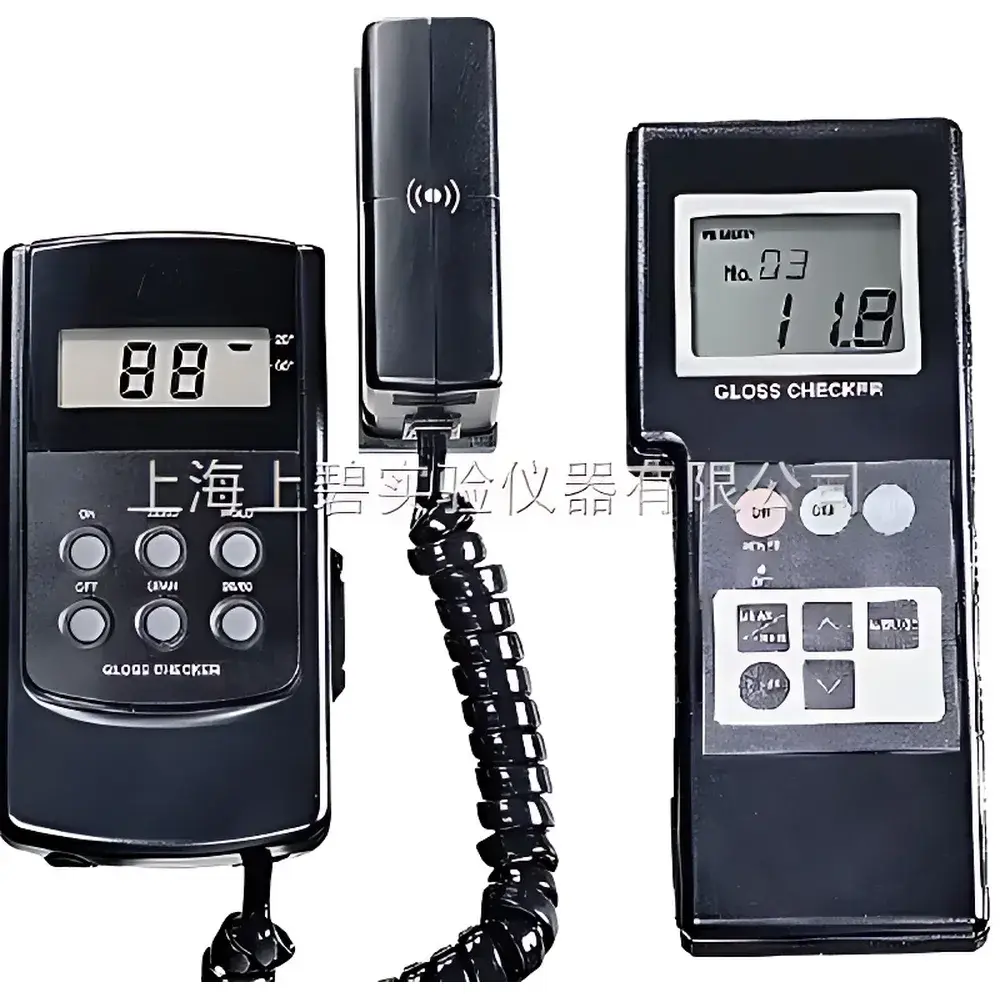
Horiba IG-320 Portable Gloss Meter
| Origin | Japan |
|---|---|
| Manufacturer Type | Authorized Distributor |
| Origin Category | Imported |
| Model | IG-320 |
| Pricing | Upon Request |
| Measurement Angles | 60° / 20° (switchable) |
| Measurement Range | 0–100 GU |
| Resolution | 0.1 GU |
| Accuracy | ±0.5% F.S., ±1 digit |
| Spot Size | 12 × 16 mm elliptical |
| Light Source | LED (880 nm) |
| Detector | High-precision silicon photodiode (SPD) |
| Calibration | Auto-zero & auto-span with included certified gloss standard |
| Power Supply | 9V alkaline battery (IEC 6LR61/S-006P) |
| Operating Temperature | 0–40 °C |
| Dimensions (W×H×D) | 78 × 189 × 58 mm |
| Weight | 400 g (including battery) |
| Data Storage | 99 measurement records |
| Display Range | 0–199.9 GU |
| Additional Functions | Low-battery warning, keypress audio feedback, auto/manual power-off, over-range alert |
| Compliance | Designed to meet ISO 2813 and ASTM D523 requirements for specular gloss measurement |
Overview
The Horiba IG-320 Portable Gloss Meter is an industrial-grade, hand-held instrument engineered for precise, repeatable specular gloss measurement across diverse surface types—including painted metals, automotive finishes, architectural coatings, plastics, ceramics, and printed materials. Based on the principle of specular reflectance at defined geometric angles, the IG-320 quantifies surface gloss as gloss units (GU) by measuring the ratio of reflected luminous flux to incident flux under controlled illumination (880 nm near-infrared LED) and detection (silicon photodiode). Its dual-angle capability—60° and 20°—enables compliance with international standards for both medium- and high-gloss surfaces, ensuring traceable, objective evaluation where visual assessment proves subjective or unreliable. Unlike benchtop glossmeters, the IG-320’s modular design separates the sensor head from the display unit, enhancing ergonomics during extended field use and enabling access to confined or vertically oriented surfaces without repositioning the entire device.
Key Features
- Dual-angle measurement geometry: switchable 60° (ISO 2813 primary angle for general-purpose gloss evaluation) and 20° (optimized for high-gloss surfaces ≥70 GU, per ASTM D523 Annex A2)
- Modular probe–display architecture: detachable sensor head connected via shielded cable, improving measurement stability on curved, vertical, or hard-to-reach substrates
- One-touch auto-calibration: executes full zero and span calibration sequence using the supplied NIST-traceable ceramic gloss standard (typically 100 GU @ 60°)
- High-resolution digital display: 0.1 GU resolution over 0–199.9 GU range; real-time numeric readout with backlight for low-ambient conditions
- Robust optical system: 880 nm LED source ensures minimal interference from ambient visible light; SPD detector provides stable, temperature-compensated response
- Field-ready operation: 400 g weight, compact footprint (78 × 189 × 58 mm), and single 9V battery enable all-day portability without external power
- On-device data management: stores up to 99 measurements with timestamp-free recall; supports statistical averaging for QC batch verification
Sample Compatibility & Compliance
The IG-320 accommodates flat, slightly curved, or textured surfaces within its 12 × 16 mm elliptical measurement aperture. It is validated for use on coated steel, aluminum panels, laminated wood, PVC sheeting, automotive clearcoats, marble cladding, and polymer films—provided surface roughness remains below Ra < 0.8 µm to avoid scattering-induced deviation. The instrument conforms to ISO 2813:2014 (Paints and varnishes — Determination of specular gloss at 20°, 60° and 85°) and ASTM D523-14 (Standard Test Method for Specular Gloss), supporting GLP-compliant documentation when paired with Horiba’s optional PC interface software. While not FDA 21 CFR Part 11-certified out-of-the-box, audit trails and raw data export are achievable via third-party LIMS integration.
Software & Data Management
Though the IG-320 operates autonomously without software, Horiba provides optional Windows-compatible communication software (Horiba GlossLink v2.x) for USB-connected data transfer. This application enables export of measurement logs (.csv), generation of trend charts, pass/fail threshold alerts, and report generation aligned with internal quality protocols. All stored values retain their original GU units and measurement angle metadata. For regulated environments, users may implement manual SOPs governing calibration frequency (recommended before each shift), standard verification (daily), and environmental monitoring (temperature/humidity logging per ISO 2813 Section 6).
Applications
- Automotive OEM and after-market: clearcoat gloss uniformity mapping on body panels, bumper trims, and wheel finishes
- Architectural coatings: QA of façade paints, anodized aluminum, and stone sealants pre- and post-installation
- Printing and packaging: gloss consistency verification of UV-cured inks, laminated cartons, and metallized films
- Plastics manufacturing: inline gloss validation of injection-molded housings, extruded profiles, and thermoformed sheets
- Building maintenance: periodic assessment of floor wax degradation, tile glaze wear, and elevator panel reflectivity
- R&D laboratories: correlation studies between curing parameters (time/temperature/UV dose) and final surface gloss development
FAQ
What standards does the IG-320 comply with?
The IG-320 is designed and verified to meet ISO 2813:2014 and ASTM D523-14 for 20° and 60° specular gloss measurement.
Can the IG-320 measure curved or textured surfaces?
Yes—within limits. Its 12 × 16 mm elliptical aperture allows measurement on gently curved surfaces; however, pronounced curvature or surface roughness > Ra 0.8 µm may reduce accuracy due to beam divergence and scatter.
How often should calibration be performed?
Horiba recommends performing auto-calibration with the supplied standard before first use each day, and whenever ambient temperature changes exceed ±5 °C or after physical shock.
Is the 880 nm LED source compliant with eye-safety regulations?
Yes—the 880 nm near-infrared output falls outside the photobiological hazard range (400–700 nm) and complies with IEC 62471:2006 Risk Group 0 (Exempt) classification.
Does the IG-320 support statistical analysis onboard?
It calculates and displays arithmetic mean of consecutive readings but does not compute standard deviation or Cp/Cpk; such analysis requires export to spreadsheet or QC software.




