
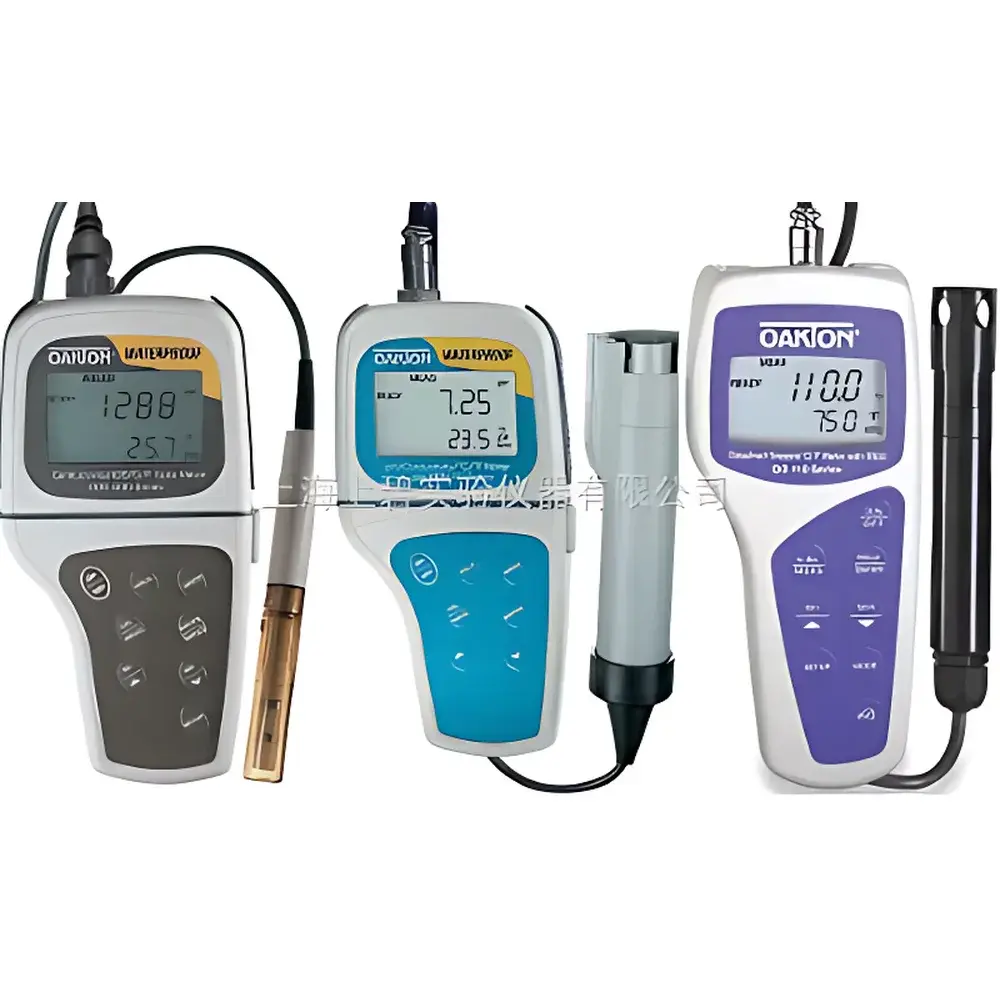
Oakton DO110 Dissolved Oxygen Meter
| Origin | USA |
|---|---|
| Manufacturer Type | Authorized Distributor |
| Product Origin | Imported |
| Model | 35615-20 |
| Price Range | USD 1–4,999 |
| Instrument Type | Benchtop Laboratory Meter |
| Measurement Principle | Electrochemical Galvanic Cell Probe |
| Measurement Range | 0.00–19.9 mg/L (ppm) |
| Accuracy | ±1.5% of full scale |
| Repeatability | ±0.05% of reading |
| Detection Limit | 0.00 mg/L (±2% relative error at low concentration) |
| Saturation Range | 0.0–199.9% |
| Saturation Accuracy | ±1.5% of full scale |
| Temperature Range | 0–50 °C |
| Temperature Resolution | 0.1 °C |
| Temperature Accuracy | ±0.5 °C |
| Temperature Compensation | Automatic or manual, 0–50 °C |
| Data Storage | 100 readings |
| Interface | RS232 serial output |
| Power | 4 × 1.5 V AA batteries (>200 hours continuous operation) |
| Dimensions | 8.9 × 18.6 × 4.4 cm (W × H × D) |
| IP Rating | IP67 (for optional field-capable configurations) |
Overview
The Oakton DO110 Dissolved Oxygen Meter (Model 35615-20) is a precision benchtop instrument engineered for reliable, traceable dissolved oxygen (DO) quantification in laboratory and quality control environments. It employs a galvanic cell electrochemical probe — a self-polarizing, zero-power-consumption sensor technology that delivers stable, drift-free measurements without external polarization voltage. This principle ensures rapid response (<60 seconds to 90% of final value), minimal maintenance, and long-term calibration stability — critical attributes for routine water quality analysis per ASTM D888, ISO 5814, and EPA Method 360.5. Designed and assembled in the United States, the DO110 integrates seamlessly into regulated workflows requiring documented measurement integrity, including environmental monitoring labs, municipal wastewater facilities, and pharmaceutical process water validation.
Key Features
- Galvanic DO probe interface supporting interchangeable sensors with 3 m, 7.6 m, 15 m, and 30 m cable options (e.g., model 35640-50, 35640-52, 35640-54, 35640-56) for flexible sample handling — from beaker immersion to deep-water profiling.
- Benchtop meter with dual-parameter display: simultaneous readout of DO concentration (mg/L or ppm) and percent saturation, both compensated in real time for temperature and atmospheric pressure (barometric correction via user input).
- High-resolution measurement: 0.01 mg/L resolution across the full 0.00–19.9 mg/L range; 0.1% resolution for saturation mode.
- Robust data management: Stores up to 100 timestamped readings with automatic date/time stamping when paired with optional RS232 interface (cable 35615-09) and compatible software.
- IP67-rated enclosure option available for splash-resistant operation in humid or controlled cleanroom settings — compliant with IEC 60529 standards.
- Auto-off function after 20 minutes of inactivity conserves battery life; powered by standard AA cells with >200 hours of operational runtime.
Sample Compatibility & Compliance
The DO110 is validated for aqueous matrices including potable water, surface water, wastewater effluent, aquaculture systems, and purified water (PW) used in biopharmaceutical manufacturing. Its galvanic probe exhibits minimal interference from common ions (Cl⁻, NO₃⁻, SO₄²⁻) and low sensitivity to flow rate variations — enabling consistent results in stirred, static, or low-flow samples. The instrument supports compliance with GLP and GMP documentation requirements through audit-ready data export and traceable calibration records. While not inherently 21 CFR Part 11 compliant, its RS232 output enables integration with validated LIMS or ELN platforms that enforce electronic signature and change-control protocols. Calibration follows standardized procedures using certified zero-oxygen (sodium sulfite) and air-saturated water standards per ISO 5814 Annex A.
Software & Data Management
The DO110 communicates via RS232 serial protocol (9-pin D-sub, 1 m cable included with select kits) to Windows-based PCs. Oakton-provided software enables real-time data streaming, batch export to CSV/Excel, calibration curve logging, and user-defined report generation. All stored readings retain metadata: measurement ID, DO value, saturation %, temperature, date, and time. Software-generated calibration reports include slope, offset, and R² values — essential for internal QA audits and third-party accreditation (e.g., ISO/IEC 17025). Firmware updates are delivered via serial interface, ensuring long-term platform support and regulatory alignment.
Applications
- Environmental laboratories performing routine DO analysis for NPDES permit compliance and ambient water quality assessment.
- Drinking water treatment plants verifying aeration basin efficiency and distribution system residual oxygen levels.
- Pharmaceutical and biotech facilities monitoring USP and EP 2.2.43 purified water and water-for-injection (WFI) systems.
- Academic research labs studying biochemical oxygen demand (BOD₅) kinetics, nitrification/denitrification rates, and aquatic ecosystem respiration.
- Food and beverage QA/QC departments assessing dissolved oxygen in brewing wort, carbonated beverages, and sterile packaging headspace verification.
FAQ
What type of dissolved oxygen sensor is compatible with the DO110?
The DO110 is designed exclusively for galvanic (non-polarized) DO probes — specifically Oakton’s 35640-series sensors with BNC connectors and integrated thermistors for automatic temperature compensation.
Does the DO110 require daily calibration?
Calibration frequency depends on application stringency; for GLP-compliant work, a two-point calibration (zero and air-saturated) is recommended before each analytical session or every 8 hours of continuous use.
Can the DO110 measure dissolved oxygen in seawater?
Yes — when used with salinity-compensated calibration and appropriate probe selection (e.g., 35640-56 with extended cable for depth profiling), though users must manually input salinity and barometric pressure for accurate mg/L conversion.
Is the DO110 suitable for ISO/IEC 17025-accredited testing?
When operated within documented SOPs, calibrated against NIST-traceable standards, and coupled with validated data export procedures, the DO110 meets technical requirements for inclusion in accredited test methods.
How is temperature compensation applied?
The instrument uses an integrated thermistor in the DO probe to measure sample temperature continuously; compensation follows the Winkler-derived temperature-solubility relationship per ISO 5814, with user-adjustable barometric pressure input.
Related Products







