
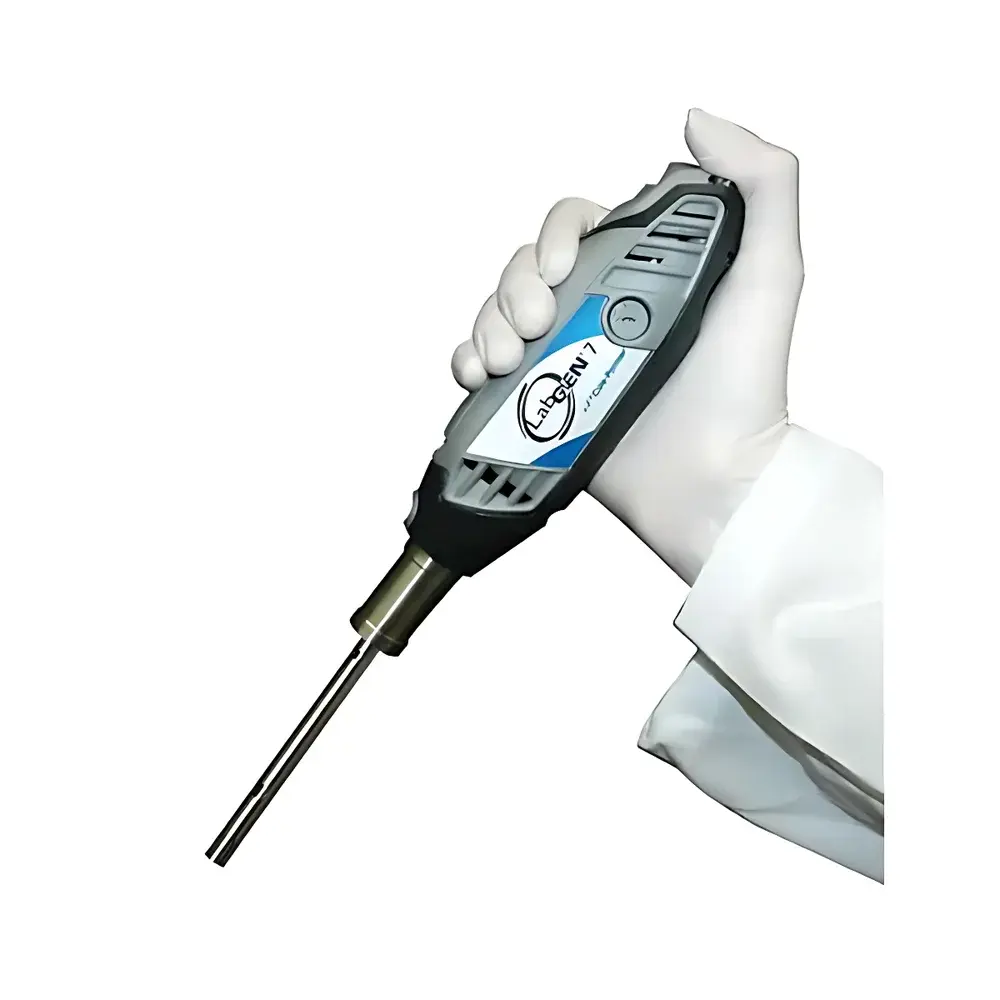
Labgen 7 & Labgen 7b Handheld Homogenizers
| Origin | USA |
|---|---|
| Manufacturer Type | Authorized Distributor |
| Origin Category | Imported |
| Model No. | 04727-07 |
| Instrument Type | Handheld Homogenizer |
| Instrument Subtype | Tissue Disruptor Homogenizer |
| Sample Volume Range | 0.25–30 mL |
| Speed Range | 5,000–35,000 rpm |
| Motor Power | 125 W (Labgen 7), 50 W (Labgen 7b) |
| Noise Level | <72 dB(A) |
| Probe Dimensions | Ø7 mm × 85 mm |
| Input Voltage | 220 V AC (Labgen 7) |
| Optional Accessory | Homogenization Stand (Cat. No. 04727-16) |
Overview
The Labgen 7 and Labgen 7b handheld homogenizers are precision-engineered tissue disruptors designed for rapid, reproducible mechanical lysis of biological samples in research, clinical, and quality control laboratories. Based on high-shear rotor-stator principle, these instruments generate intense localized fluid shear forces through the rotation of a stainless-steel probe within a sample tube—effectively disrupting cell membranes, homogenizing fibrous or frozen tissues, and dispersing particulates without significant thermal degradation when operated under controlled durations. The Labgen 7 delivers consistent performance at higher torque and power (125 W), making it optimal for dense, cryopreserved, or collagen-rich specimens such as liver, muscle, or tumor biopsies. The Labgen 7b variant integrates a dual-power architecture—supporting both mains-powered operation and portable use via its rechargeable lithium-ion battery—enabling field-deployable sample preparation where benchtop access is limited.
Key Features
- High-efficiency brushless motor with speed control across 5,000–35,000 rpm, enabling precise optimization for diverse sample viscosities and cellular robustness
- Low-noise design (<72 dB[A]) compliant with ISO 7779 and ANSI S12.2 standards, supporting sustained operator comfort in shared lab environments
- Ergonomic, non-slip grip housing with balanced weight distribution to minimize hand fatigue during extended manual operation
- Interchangeable stainless-steel probes (standard Ø7 mm × 85 mm; optional sizes available) compatible with common microcentrifuge tubes (1.5–15 mL) and conical vessels
- Labgen 7b-specific integrated battery management system with LED charge status indicator and USB-C recharging interface
- Optional homogenization stand (Cat. No. 04727-16) enables hands-free, vibration-dampened operation for time-critical or multi-sample protocols
Sample Compatibility & Compliance
These homogenizers accommodate a broad spectrum of biological matrices—including mammalian tissues (fresh, frozen, or fixed), plant material, bacterial pellets, yeast cultures, and soft food matrices—within the validated volume range of 0.25–30 mL. Probe sterilization is achievable via autoclaving (121°C, 20 min) or chemical immersion (e.g., 70% ethanol, 10% bleach), ensuring compliance with GLP and GMP environmental monitoring workflows. Device construction adheres to IEC 61000-6-3 (EMC emissions) and IEC 61000-6-2 (immunity), while electrical safety conforms to IEC 61010-1 for laboratory equipment. No regulatory claims are made regarding FDA 510(k) clearance or CE marking for in vitro diagnostic use; users must validate method suitability per ISO/IEC 17025 or internal SOP requirements.
Software & Data Management
As analog-controlled instruments, the Labgen 7 and 7b do not incorporate embedded firmware, touchscreen interfaces, or digital data logging. This architecture eliminates software validation overhead and supports audit-ready manual recordkeeping in regulated environments. Operators document speed settings, runtime, probe type, and sample ID directly in lab notebooks or LIMS-integrated electronic batch records. For automated traceability, integration with external timers or programmable lab automation systems (e.g., via TTL-triggered start/stop signals using optional accessories) is feasible. All accessories—including spare batteries (Cat. No. 04727-17) and probe calibration certificates—are assigned unique catalog numbers traceable to distributor inventory and shipment logs.
Applications
- Routine preparation of lysates for Western blotting, ELISA, and nucleic acid extraction (DNA/RNA) from solid tissues
- Homogenization of pharmacokinetic tissue samples prior to LC-MS/MS bioanalysis
- Dispersion of nanoparticle suspensions and emulsion formulation development in formulation science labs
- Field-based environmental sampling—e.g., soil slurry homogenization or aquatic organism tissue disruption—using the battery-operated Labgen 7b
- QC release testing of sterile injectables or topical suspensions requiring uniform particle distribution verification
FAQ
What is the maximum continuous run time recommended for the Labgen 7?
For thermal stability and motor longevity, continuous operation should not exceed 60 seconds per cycle, followed by a minimum 30-second cooling interval—particularly when processing viscous or thermosensitive samples.
Can the Labgen 7b be used while charging?
No. The device automatically disables motor operation during USB-C charging to ensure electrical isolation and battery safety per UL 2054 guidelines.
Is the standard probe compatible with organic solvents?
Yes—the 316 stainless-steel probe exhibits excellent resistance to common solvents including chloroform, methanol, acetone, and aqueous buffers; however, prolonged exposure to strong oxidizers (e.g., concentrated nitric acid) is not advised.
Does the homogenizer require routine calibration?
Speed calibration is not user-serviceable; periodic verification against a certified tachometer (e.g., ASTM E1577-22 Annex A1) is recommended annually or after impact damage to the probe shaft.
Are replacement probes supplied with traceable certification?
Yes—each probe batch is accompanied by a Certificate of Conformance specifying dimensional tolerances (±0.05 mm), surface finish (Ra ≤ 0.8 µm), and material test report per ASTM A276.



