
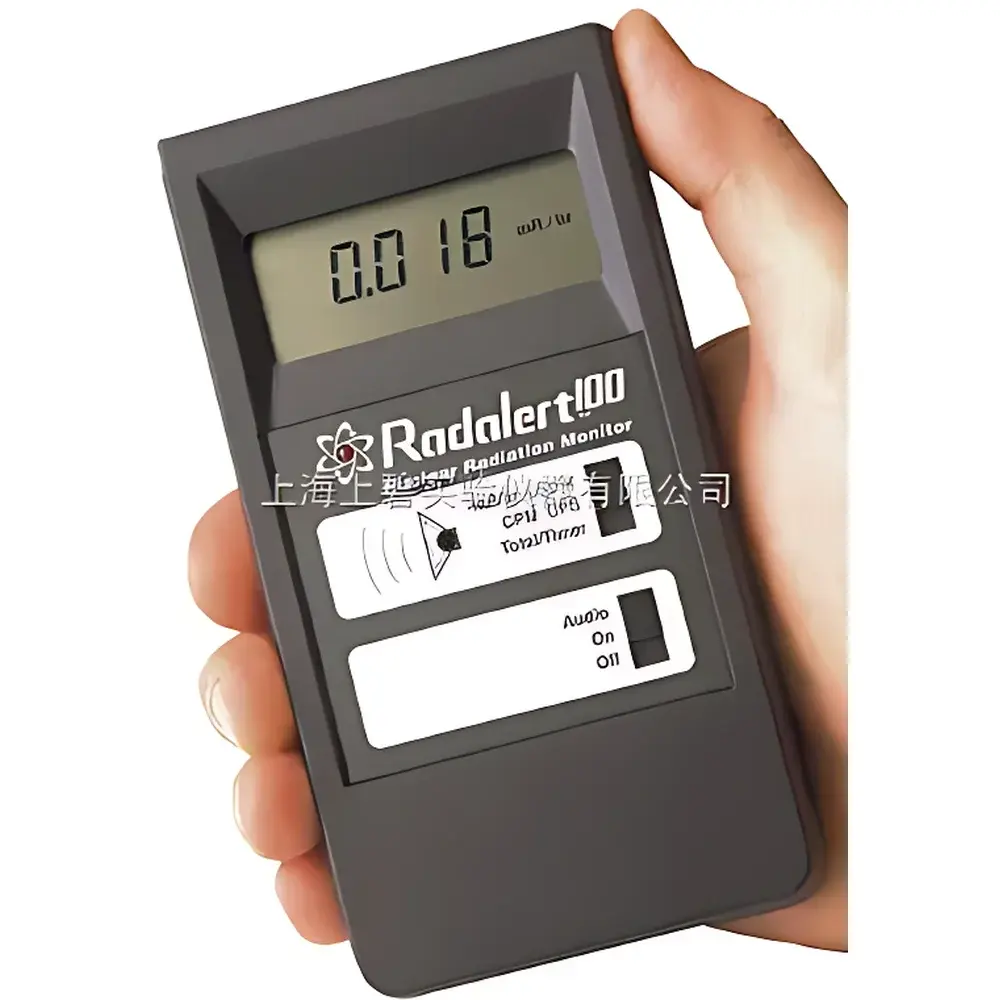
Radiation Alert Radalert100 Geiger-Müller Counter
| Origin | USA |
|---|---|
| Manufacturer Type | Authorized Distributor |
| Origin Category | Imported |
| Model | Radalert100 |
| Instrument Type | Portable Radiation Survey Meter |
| Detection Modes | α, β, γ, X-ray |
| Display | LCD with Dual-Unit Readout (mR/hr, µSv/hr, CPM, CPS, Total Count) |
| Measurement Ranges | 0.001–110 mR/hr |
| Timer Function | Up to 40 hours |
| Accuracy | ±10% of reading (±15% max in mR/hr and µSv/hr modes) |
| Detector | Halogen-quenched GM tube calibrated to Cs-137 (1000 cpm/mR/hr sensitivity) |
| Interface | RS-232 serial port for PC connectivity and data logging |
| Dimensions (L×W×H) | 8 × 3 × 15 cm |
| Audible/Visual Alarms | Adjustable threshold with red LED flash and piezoelectric buzzer |
| Power | 9 V alkaline battery (typical life: 2000+ hours) |
Overview
The Radiation Alert Radalert100 is a compact, field-deployable Geiger-Müller (GM) radiation survey meter engineered for reliable detection and quantitative assessment of ionizing radiation across alpha (α), beta (β), gamma (γ), and X-ray emissions. Designed in accordance with ANSI N42.32 and IEC 60846-1 standards for portable radiation detection instruments, the Radalert100 operates on the principle of gas ionization within a halogen-quenched GM tube—providing real-time measurement of exposure rate (mR/hr, µSv/hr), count rate (CPM, CPS), and cumulative total counts. Its Cs-137 traceable calibration ensures metrological consistency for environmental monitoring, nuclear facility perimeter surveys, radiological emergency response, and routine contamination screening in laboratories, mining sites, scrap metal yards, and building material inspection workflows.
Key Features
- Multi-radiation detection capability: Simultaneous response to α, β, γ, and X-ray photons—optimized for low-energy β emitters (e.g., Sr-90/Y-90) and high-energy γ sources (e.g., Cs-137, Co-60)
- Triple-unit display: Real-time switching between exposure rate (mR/hr and µSv/hr), count rate (CPM/CPS), and integrated total counts—enabling both instantaneous hazard evaluation and long-term accumulation tracking
- Adjustable alarm thresholds: User-defined setpoints trigger simultaneous visual (pulsed red LED) and audible (85 dB piezoelectric buzzer) alerts—critical for personnel safety in dynamic radiation zones
- Extended timer function: Built-in 40-hour countdown/timer supports timed measurements for decay curve analysis or regulatory hold-period verification
- RS-232 serial interface: Enables direct connection to Windows-based PCs for raw data export, time-stamped logging, and integration into laboratory information management systems (LIMS)
- Rugged ergonomic housing: Compact form factor (8 × 3 × 15 cm) with chemical-resistant ABS casing—designed for glove-compatible operation in controlled and uncontrolled environments
Sample Compatibility & Compliance
The Radalert100 is routinely deployed for surface contamination assessment of materials including granite countertops, recycled steel, ceramic tiles, soil samples, and air filter media—particularly relevant in post-Fukushima Cs-137 screening protocols and radon progeny deposition studies. It meets performance criteria outlined in ASTM D3648 (Standard Test Methods for Radioactivity in Water) for gross beta/gamma screening and supports preliminary compliance checks per EPA Method 900.0 (Gross Alpha/Beta Particle Activity in Drinking Water). While not a certified radon-specific monitor, its sensitivity to alpha-emitting decay products (e.g., Po-218, Po-214) enables qualitative assessment of elevated radon progeny levels in enclosed spaces when used with appropriate sampling geometry and background subtraction.
Software & Data Management
Data acquisition is supported via Radiation Alert’s proprietary PC software (compatible with Windows 7–11), which captures timestamped readings at user-selectable intervals (1–60 sec). Export formats include CSV and TXT for downstream analysis in Excel, MATLAB, or statistical packages. Audit trails include operator ID entry, instrument serial number, calibration date, and firmware version—supporting GLP-compliant documentation requirements. The RS-232 protocol is ASCII-based and fully documented, permitting custom script integration for automated reporting in regulated QA/QC environments subject to 21 CFR Part 11 controls (when paired with validated third-party software).
Applications
- Environmental health & safety (EHS) teams conducting routine area monitoring around nuclear medicine departments, industrial radiography facilities, and decommissioning sites
- Geological surveyors evaluating natural radioactivity in uranium-bearing ores, phosphate rock, and volcanic tuffs
- Recycling industry inspectors screening imported ferrous/non-ferrous scrap for orphan radioactive sources (e.g., Ra-226, Co-60)
- Academic researchers performing educational demonstrations of inverse-square law, shielding effectiveness, and half-life verification
- First responders deploying rapid-scanning protocols during radiological dispersal device (RDD) incidents or lost-source recovery operations
- Building material compliance screening per EU Council Directive 2013/59/Euratom on natural radioactivity in construction products
FAQ
Is the Radalert100 suitable for measuring radon gas concentration directly?
No—the instrument detects alpha particles from radon decay products deposited on surfaces or airborne particulates, but does not quantify gaseous radon (Rn-222) concentration. For accurate radon gas measurement, use an electret ion chamber or continuous radon monitor calibrated per ISO 11665.
What is the recommended calibration interval?
Annual calibration against a traceable Cs-137 source is advised per ANSI N42.20; field verification with check sources (e.g., KCl or uranium ore) should be performed before each shift.
Can the Radalert100 distinguish between radiation types?
It provides gross count-based detection without energy discrimination. Alpha/beta differentiation requires physical filtering (e.g., removable mylar shield); gamma/X-ray identification necessitates spectroscopic instrumentation.
Does it comply with FDA or EPA regulatory requirements for environmental testing?
It serves as a screening tool aligned with EPA guidance documents (e.g., EPA 402-R-21-001) but is not EPA-certified for compliance-level reporting. Final analytical confirmation requires lab-based gamma spectrometry (e.g., HPGe) per EPA Method 901.1.
How is background radiation accounted for in measurements?
Users must perform a 2–5 minute background count in a known low-radiation environment prior to sample measurement; subtracted values are applied manually or via software baseline correction.
Related Products







