
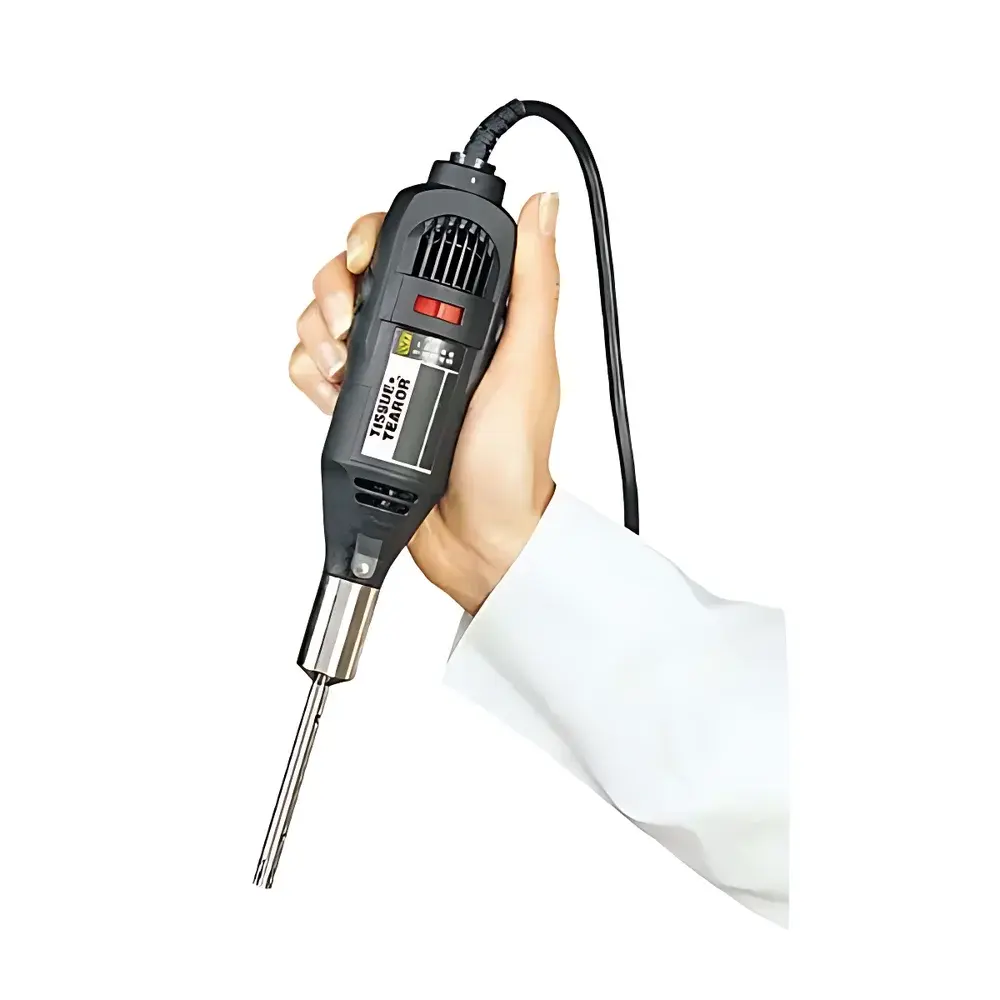
Cole-Parmer 04750-55 Handheld Homogenizer with Stainless Steel Probe
| Brand | Cole-Parmer (Masterflex) |
|---|---|
| Country of Origin | USA |
| Model | 04750-55 |
| Instrument Type | Handheld Homogenizer |
| Application | Tissue Homogenization |
| Sample Volume Range | 0.5–50 mL |
| Speed Range | 4,500–30,000 rpm |
| Probe Material | 316 Stainless Steel |
| Probe Dimensions (04750-91) | Ø7 × 10.9 mm |
| Input Voltage | 220 V, 50 Hz, 0.6 A |
| Safety Restriction | Not suitable for flammable solvents |
Overview
The Cole-Parmer 04750-55 Handheld Homogenizer is a precision-engineered, high-speed mechanical homogenization system designed for rapid and reproducible disruption of biological tissues, cells, and soft-to-medium-hard samples in laboratory settings. Operating on the principle of high-shear rotor-stator homogenization, this device utilizes a rotating stainless steel probe that generates intense localized turbulence, cavitation, and fluid shear forces within the sample vessel—effectively lysing cell membranes, dispersing aggregates, and achieving uniform suspensions. Its variable-speed control enables optimization across diverse sample viscosities and structural resistances, making it especially suited for applications requiring scalability from micro-volume (0.5 mL) to moderate-volume (50 mL) processing without cross-contamination or thermal runaway. The unit is engineered for benchtop flexibility, ergonomic operation, and compliance with standard biosafety workflows in molecular biology, pharmacology, and clinical diagnostics laboratories.
Key Features
- Adjustable speed control from 4,500 to 30,000 rpm for precise shear-force tuning across sample types
- Durable 316 stainless steel probe (model 04750-91: Ø7 × 10.9 mm) resistant to corrosion, sterilization, and repeated autoclaving (up to 121°C, 20 min)
- Integrated ergonomic handle with non-slip grip and integrated on/off switch for single-hand operation
- Compact, lightweight design (approx. 0.8 kg) with integrated support stand for hands-free stabilization during extended use
- Thermally protected induction motor with consistent torque delivery across speed range; no gear reduction or brush wear
- Electrical safety certified for 220 V / 50 Hz mains supply (0.6 A draw); includes 1.5 m UL-listed power cord with grounded plug
- Designed exclusively for aqueous or low-volatility buffers—explicitly not rated for use with flammable, volatile, or highly viscous organic solvents
Sample Compatibility & Compliance
This homogenizer accommodates a broad spectrum of biological matrices—including mammalian tissues (liver, spleen, brain), cultured cells, plant leaves, microbial pellets, and soft fibrous materials—provided sample volume remains within the validated 0.5–50 mL range and container geometry permits adequate probe submersion (minimum depth ≥15 mm). It is compatible with standard glass, polypropylene, and polycarbonate tubes (e.g., 15 mL conical, 50 mL centrifuge tubes) and supports cold homogenization when used with chilled vessels or ice-jacketed sleeves. While not intrinsically compliant with ISO/IEC 17025 or GLP as a standalone instrument, its operational consistency, traceable probe geometry, and repeatable speed calibration support audit-ready documentation when integrated into validated SOPs. Users are advised to validate homogenization efficiency per application using established metrics such as protein yield, DNA integrity (via gel electrophoresis), or particle size distribution (via dynamic light scattering).
Software & Data Management
The 04750-55 operates as a stand-alone analog instrument with no embedded firmware, digital interface, or data logging capability. Speed selection is performed manually via a calibrated rotary dial, ensuring robustness, electromagnetic immunity, and zero software-related failure modes—advantageous in environments where regulatory traceability of electronic records is either unnecessary or managed externally. For laboratories operating under FDA 21 CFR Part 11 or EU Annex 11 requirements, process parameters (speed, duration, probe type, sample volume) must be recorded manually in bound lab notebooks or ELN systems. Optional accessories—including calibrated tachometers and temperature probes—may be employed to augment procedural documentation without compromising instrument simplicity.
Applications
- Routine lysis of cultured mammalian and insect cells prior to nucleic acid or protein extraction
- Homogenization of frozen or fresh tissue biopsies for metabolite profiling, enzyme assays, or histopathological suspension preparation
- Preparation of uniform suspensions for flow cytometry, ELISA, or mass spectrometry sample introduction
- Dispersion of nanoparticles, liposomes, or micelles in aqueous media for stability testing
- Disaggregation of bacterial biofilms or fungal hyphae for viability assessment and antimicrobial susceptibility testing
- Supporting sample prep workflows aligned with ASTM D7216 (standard practice for homogenization of biological samples) and USP <1043> (cellular and gene therapy product characterization)
FAQ
Can this homogenizer be used with flammable solvents such as chloroform or ethanol?
No. The motor and electrical components are not explosion-proof or intrinsically safe. Operation with flammable, volatile, or highly corrosive solvents is strictly prohibited and voids warranty.
Is the probe autoclavable?
Yes. The 316 stainless steel probe (04750-91) is fully autoclavable at 121°C for 20 minutes. Ensure complete drying before reuse to prevent water-induced pitting.
What is the minimum recommended sample volume for effective homogenization?
For optimal cavitation and shear transfer, maintain a minimum liquid height of 15 mm above the probe tip. With the 04750-91 probe, this corresponds to ~0.5 mL in a standard 15-mL conical tube.
Does Cole-Parmer provide calibration certificates for speed accuracy?
No factory-issued calibration certificate is included. Users may verify rotational speed using a contact or non-contact tachometer traceable to NIST standards as part of internal equipment qualification.
Can the unit be operated continuously for extended periods?
Continuous duty cycle is limited to ≤5 minutes per activation to prevent motor overheating. Allow ≥2 minutes cooling between cycles. For high-throughput workflows, staggered batch processing is recommended.
Related Products



