
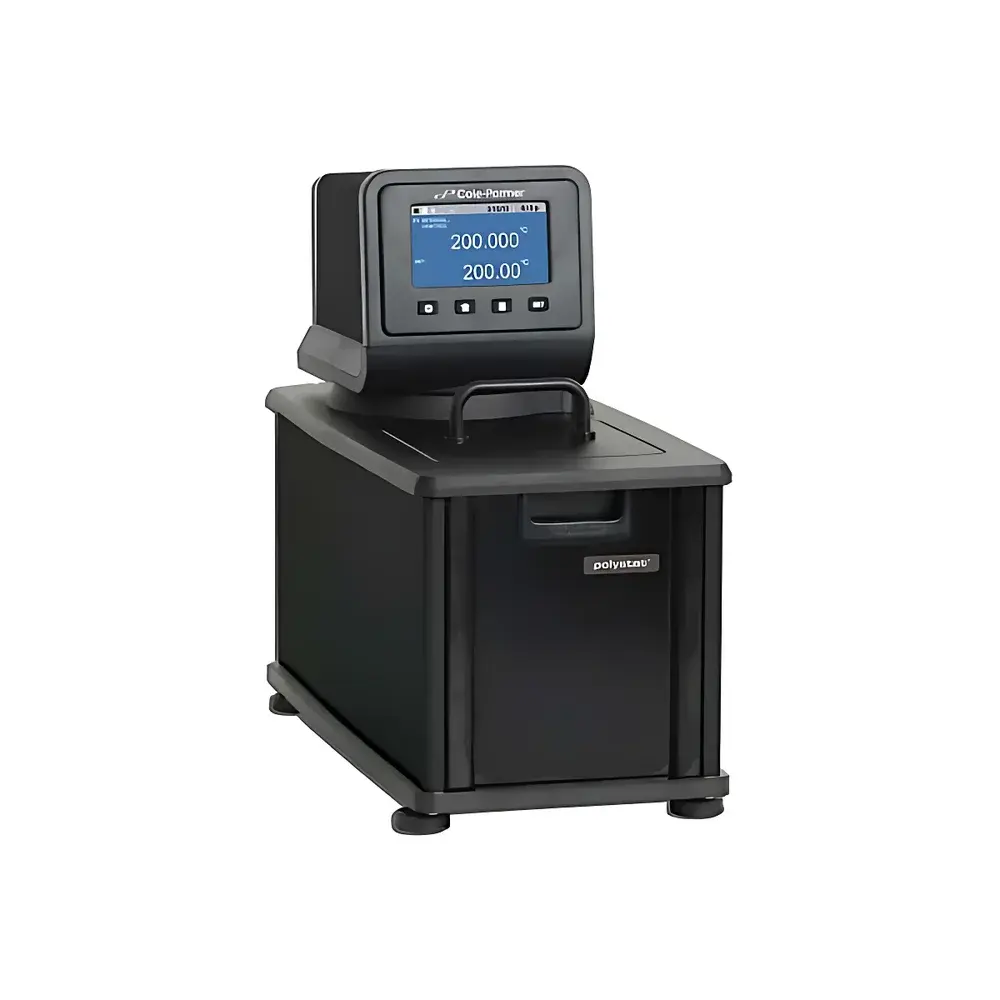
Polystat 12134-62 Heated Circulating Bath – Cole-Parmer
| Key Features | Stainless steel reservoir |
|---|---|
| Temperature range | ambient to +100 °C |
| Stability | ±0.1 °C across full range |
Overview
The Polystat 12134-62 Heated Circulating Bath is a precision-engineered thermal management system designed for laboratory applications requiring stable, uniform, and controllable temperature environments. Built by Cole-Parmer and manufactured in the United States, this unit operates on a dual-mode thermoelectric principle—combining resistive heating with vapor-compression refrigeration (R-134a)—to deliver accurate temperature regulation from ambient up to +100 °C. Its stainless steel reservoir ensures long-term corrosion resistance and compatibility with aqueous and mild chemical solutions. The integrated high-efficiency circulation pump provides internal recirculation at up to 15 L/min, enabling rapid thermal equilibration and minimizing spatial gradients within the bath medium. Unlike passive water baths, the 12134-62 actively maintains setpoint accuracy through continuous feedback control using a calibrated Pt100 platinum resistance thermometer, making it suitable for calorimetry, viscometry, reaction kinetics, and equipment jacketing where thermal reproducibility is critical.
Key Features
- Stainless steel bath reservoir (24 L capacity) with polished interior for easy cleaning and chemical compatibility
- PID-based digital temperature controller with intuitive touch-key interface and dual-line LCD display showing both setpoint and real-time bath temperature
- Internal recirculation pump with dual-speed operation—optimized for both low-noise lab environments and high-flow external loop integration
- Integrated R-134a refrigeration system enabling precise sub-ambient-to-100 °C operation without external chillers
- Triple-layer safety architecture: programmable over-temperature cutoff, automatic low-fluid-level shutoff, and thermal fuse backup
- High-stability performance: ±0.1 °C temperature uniformity across the entire operating range (ambient to +100 °C)
- Compliant power input: 230 V, 50 Hz, 1200 W — engineered for consistent performance under standard European and international mains conditions
Sample Compatibility & Compliance
The 12134-62 accommodates a wide range of sample vessels—including glass flasks, jacketed reactors, and analytical probes—within its 30 × 12.4 × 31 cm internal dimensions. Its non-reactive stainless steel construction supports use with deionized water, glycol/water mixtures, and other common heat-transfer fluids compatible with R-134a systems. From a regulatory standpoint, the unit meets IEC 61010-1:2010 safety requirements for laboratory electrical equipment and carries CE marking for conformity with EU health, safety, and environmental protection standards. While not inherently GLP/GMP-certified as a standalone device, its programmable setpoints, stable thermal output, and built-in audit-ready safety logs support integration into validated workflows compliant with ISO/IEC 17025, ASTM E2877 (for temperature calibration baths), and FDA 21 CFR Part 11 when paired with appropriate data acquisition software.
Software & Data Management
The 12134-62 features three user-programmable temperature setpoints accessible via front-panel controls, allowing sequential ramp-and-hold protocols without external intervention. Though it does not include native USB or Ethernet connectivity (unlike the higher-tier 12121-series models), its analog-friendly design permits integration with third-party DAQ systems via optional 0–5 V or 4–20 mA process outputs (available as factory-installed options). Temperature logging and remote monitoring can be achieved using industry-standard SCADA platforms or LabVIEW-compatible modules. For laboratories requiring electronic records, the unit’s deterministic thermal response and repeatable stability profiles facilitate traceable calibration against NIST-traceable reference thermometers per ISO/IEC 17025 Clause 6.5.
Applications
- Temperature control of spectrophotometer cuvette holders and HPLC column ovens
- Thermal conditioning of viscosity standards and rheological test samples
- Jacketed reactor temperature maintenance in small-scale synthesis and polymerization studies
- Calibration of thermocouples, RTDs, and digital thermometers across the 0–100 °C range
- Stabilization of optical benches and interferometric setups sensitive to thermal drift
- Pre-conditioning of biological samples prior to enzymatic assays or PCR setup
FAQ
What is the maximum recommended fluid volume for optimal thermal stability?
The 24 L reservoir is rated for full fill; however, for best uniformity and fastest response, operate between 18–24 L using deionized water or 30% ethylene glycol/water mixture.
Can this unit be used for external recirculation loops?
Yes—the dual-speed pump supports external circulation at up to 15 L/min; ensure inlet/outlet fittings are properly sealed and tubing is rated for continuous operation at 100 °C.
Is the temperature sensor calibrated and traceable to NIST standards?
The factory-installed Pt100 sensor is calibrated during production; users may perform field verification using a NIST-traceable reference thermometer per ASTM E74 or ISO 17025 procedures.
Does the unit meet requirements for ISO 17025-accredited laboratories?
When operated within specified parameters and maintained per manufacturer guidelines, the 12134-62 satisfies metrological requirements for temperature-controlled equipment in accredited testing labs—particularly when supported by documented calibration and preventive maintenance records.
What maintenance intervals are recommended for long-term reliability?
Inspect coolant levels and clean reservoir quarterly; replace R-134a refrigerant only if pressure diagnostics indicate leakage—typically beyond 8–10 years under normal lab use.



