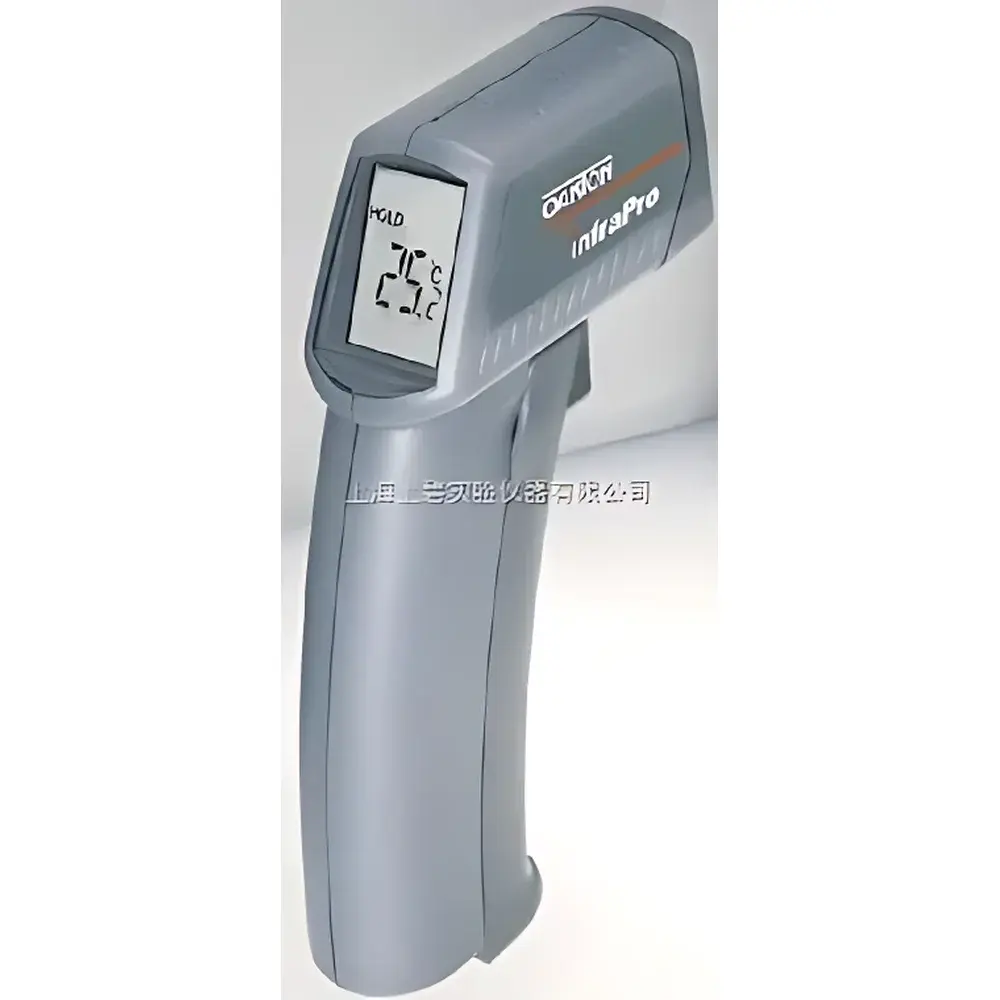
Oakton Mini-InfraPro4 and Mini-InfraPro6 Infrared Thermometers
| Origin | USA |
|---|---|
| Manufacturer Type | Authorized Distributor |
| Origin Category | Imported |
| Model | Mini-InfraPro4 |
| Price | Upon Request |
| Temperature Range (Mini-InfraPro4) | –18 °C to 400 °C |
| Temperature Range (Mini-InfraPro6) | –30 °C to 500 °C |
| Resolution | 0.1 °C/°F |
| Accuracy | ±3 °C (–18 to –1 °C), ±1 °C (10 to 30 °C), ±2% or ±2 °C (whichever is greater) for –1 to 400 °C |
| Response Time | 500 ms (95% response) |
| Emissivity | Fixed at 0.95 |
| Laser Targeting | Single-point, Class II |
| Distance-to-Spot Ratio | 8:1 (Mini-InfraPro4), 10:1 (Mini-InfraPro6) |
| Dimensions (L × W × H) | 10.2 × 15.2 × 4.0 cm |
Overview
The Oakton Mini-InfraPro4 and Mini-InfraPro6 are compact, handheld infrared thermometers engineered for non-contact surface temperature measurement in industrial, laboratory, food safety, HVAC, and maintenance environments. Based on passive infrared radiation detection, these instruments operate on the principle of Planck’s law—measuring the thermal energy emitted from a target surface within the 8–14 µm spectral band—and converting it into a calibrated temperature reading without physical contact. This eliminates cross-contamination risks, enables safe measurement of moving, electrically live, or thermally hazardous surfaces (e.g., steam lines, conveyor belts, oven interiors), and supports rapid screening workflows where traditional contact probes are impractical or unsafe. Designed for field reliability and intuitive operation, both models feature rugged ABS housing, ergonomic grip, and low-power consumption for extended battery life.
Key Features
- Two precision-configured models: Mini-InfraPro4 (–18 °C to 400 °C) and Mini-InfraPro6 (–30 °C to 500 °C), optimized for distinct operational envelopes including low-temperature refrigeration and high-heat industrial processes.
- High-speed thermal response: 500 ms time constant achieving 95% of final reading—critical for dynamic process monitoring and spot-checking across production lines.
- Fixed emissivity setting (0.95) calibrated for common organic and painted surfaces; suitable for routine applications where emissivity variation is minimal and user calibration is not required.
- Class II single-point laser targeting system compliant with IEC 60825-1:2014, providing precise aiming reference without introducing measurement bias or safety hazards associated with dual-laser crosshairs.
- Distance-to-spot ratios of 8:1 (Mini-InfraPro4) and 10:1 (Mini-InfraPro6) ensure accurate spot size definition at varying working distances—enabling reliable measurements on targets as small as 12.5 mm diameter at 125 mm distance (Mini-InfraPro4) or 10 mm at 100 mm (Mini-InfraPro6).
- Backlit LCD display with dual °C/°F units, max-hold function (7-second auto-hold), continuous scanning mode, and real-time current-temperature readout—all accessible via tactile push-button interface.
Sample Compatibility & Compliance
These thermometers are validated for use on non-reflective, matte-finish, and oxidized surfaces—including metal housings, plastic enclosures, food packaging, baked goods, and HVAC ductwork—where emissivity remains stable near 0.95. They are not recommended for highly polished metals, mirrors, or transparent materials (e.g., glass, thin plastic films) without external emissivity correction. The devices comply with CE marking requirements (EMC Directive 2014/30/EU and RoHS Directive 2011/65/EU), meet UL/CSA electrical safety standards for portable test equipment, and conform to ISO 13153:2013 for infrared thermometer performance testing methodology. While not FDA-cleared medical devices, they support HACCP-aligned food surface temperature verification per USDA FSIS guidelines and are routinely deployed in GMP-compliant manufacturing environments for equipment surface monitoring.
Software & Data Management
The Mini-InfraPro series operates as a standalone instrument with no embedded data logging or PC connectivity. All measurements are displayed in real time and retained only during active hold mode. For traceable documentation, users may manually record values alongside contextual metadata (time, location, operator ID) in paper-based or LIMS-integrated electronic logbooks. When integrated into quality management systems requiring audit trails, the instruments support GLP/GMP-aligned procedural controls—such as defined calibration intervals (recommended annually per ISO/IEC 17025), documented verification against NIST-traceable blackbody sources, and controlled issuance under instrument inventory protocols.
Applications
- Preventive maintenance: Monitoring motor windings, bearings, electrical panels, and transformer surfaces for abnormal thermal signatures.
- Food safety compliance: Verifying holding temperatures of hot/cold holding units, checking surface temps of cooked meats or chilled produce prior to packaging.
- Electronics manufacturing: Assessing solder joint integrity, PCB component heating, and thermal management of power supplies during burn-in testing.
- HVAC diagnostics: Identifying duct leakage, insulation gaps, coil frost patterns, and airflow imbalances through comparative surface mapping.
- Research & education: Demonstrating heat transfer principles, emissivity effects, and radiative cooling behavior in undergraduate physics and engineering labs.
FAQ
What is the typical calibration interval for the Mini-InfraPro series?
Annual calibration against a NIST-traceable blackbody source is recommended under ISO/IEC 17025 and internal quality system requirements.
Can the emissivity setting be adjusted on these models?
No—emissivity is fixed at 0.95 and not user-configurable. For applications requiring variable emissivity, consider Oakton’s Pro-Series infrared thermometers with adjustable settings.
Is this instrument suitable for measuring human body temperature?
No—it is not designed, validated, or certified for clinical or medical use per FDA 21 CFR Part 801 or IEC 60601-2-56.
How does distance-to-spot ratio affect measurement accuracy?
A higher ratio (e.g., 10:1) allows accurate targeting of smaller areas from greater distances; exceeding the specified ratio results in averaging over unintended background surfaces and reduced spatial resolution.
Does the laser serve a measurement function?
No—the laser is solely an aiming aid and contributes no energy to the measurement; all thermal data is derived exclusively from passive infrared detection.