
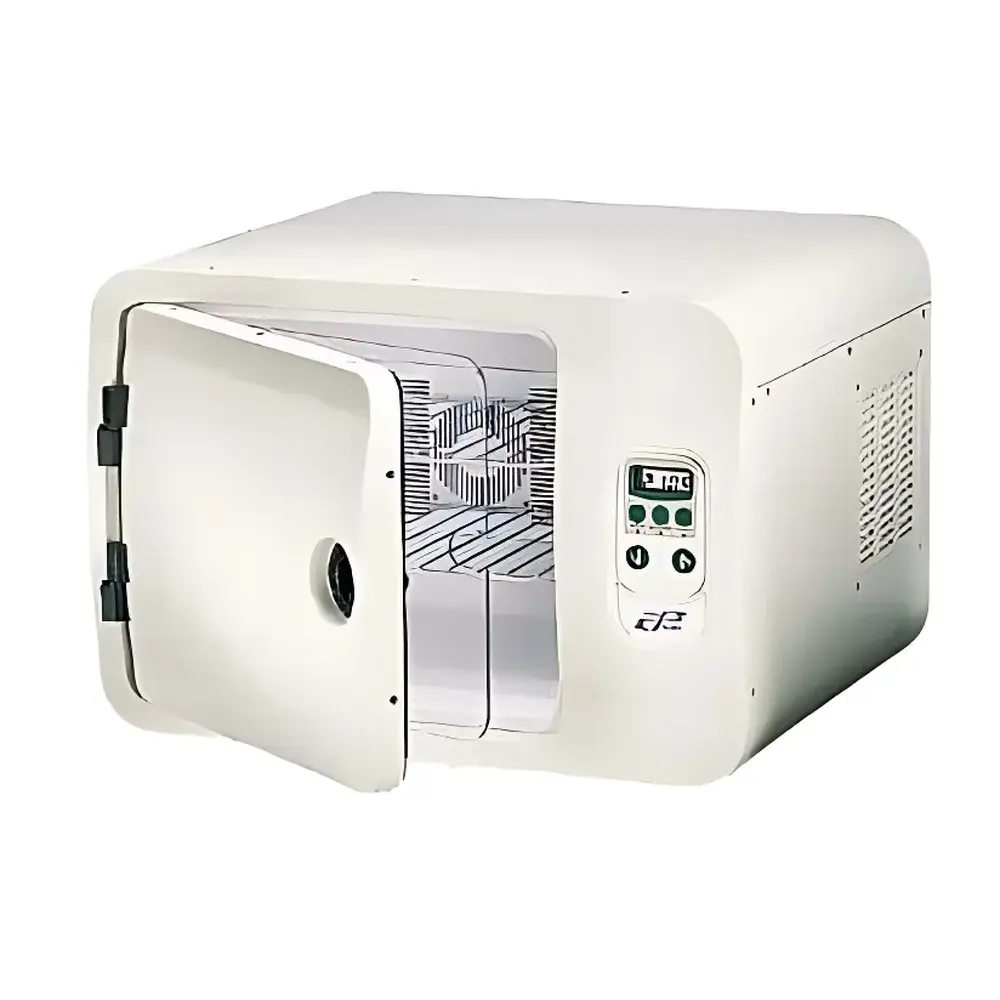
Cole-Parmer Peltier-Based Low-Temperature Biochemical Incubator Model 39050-25
| Brand | Cole-Parmer |
|---|---|
| Origin | USA |
| Model | 39050-25 |
| Temperature Range | 4–70 °C |
| Temperature Accuracy | ±0.2 °C |
| Chamber Volume | 28.3 L |
| Internal Dimensions (L×W×H) | 35.6 × 30.5 × 35.6 cm |
| External Dimensions (L×W×H) | 57 × 40 × 47 cm |
| Power Supply | 230 V, 50/60 Hz |
| Power Consumption | 300 W |
| Net Weight | 30 kg |
| Programmable Timer | Up to 99 h 59 min with audible alarm and auto-shutdown |
| RS-232 Interface | Yes |
| Display | Digital, programmable |
| Shelving | 4 total shelves (2 standard included) |
| Door | Dual-layer, inner transparent ABS panel |
| Construction | Metal outer cabinet, ABS interior |
Overview
The Cole-Parmer Peltier-Based Low-Temperature Biochemical Incubator Model 39050-25 is an electronically controlled, solid-state temperature management system engineered for precision incubation across life science, pharmaceutical, and academic research laboratories. Unlike conventional compressor-driven units, this incubator utilizes thermoelectric (Peltier) technology for both heating and active cooling—enabling stable, bidirectional thermal regulation without refrigerants, CFCs, or mechanical compressors. This architecture delivers rapid thermal response, low-vibration operation, and consistent uniformity across the entire 28.3 L chamber—critical for sensitive applications including forced degradation studies of biologics, protein crystallization, enzyme kinetics, and plant tissue culture under tightly defined ambient conditions. The unit maintains setpoints from 4 °C to 70 °C with an accuracy of ±0.2 °C and operates reliably at ambient temperatures up to 30 °C, eliminating the need for external air conditioning in most laboratory environments.
Key Features
- Thermoelectric (Peltier) dual-mode temperature control—no refrigerant, no oil, no moving parts beyond internal fans; compliant with Montreal Protocol and EU F-Gas Regulation requirements
- Digital programmable controller with intuitive interface supporting up to three independent multi-step protocols (10 steps per program, up to 9 repeats per step)
- RS-232 serial interface for direct connection to laboratory PCs running custom or third-party data acquisition software (e.g., LabVIEW, MATLAB, or Cole-Parmer’s optional LogEasy™ suite)
- Transparent ABS inner door integrated into a dual-pane insulated door assembly—permits non-invasive visual monitoring while minimizing thermal load and condensation
- Programmable timer with user-configurable duration (00:01 to 99:59), audible alert, and automatic power cutoff upon completion
- Robust construction: powder-coated steel exterior, chemical-resistant ABS interior lining, and reinforced corner joints for long-term durability in shared core facilities
- Four adjustable stainless-steel shelves (two supplied standard); shelf spacing optimized for compatibility with standard petri dishes, multiwell plates, and Erlenmeyer flasks
Sample Compatibility & Compliance
The 39050-25 accommodates common life science sample formats—including cell culture flasks (T25–T175), microtiter plates (96-/384-well), glass vials, and botanical growth vessels—without compromising thermal homogeneity. Its sealed chamber design minimizes humidity loss during extended runs, though optional humidification accessories are available for specialized protocols. From a regulatory standpoint, the incubator supports GLP- and GMP-aligned workflows: its digital logging capability (via RS-232) enables traceable temperature history when paired with validated software meeting FDA 21 CFR Part 11 requirements for electronic records and signatures. While not certified as a medical device, it conforms to IEC 61010-1 (Safety Requirements for Electrical Equipment for Measurement, Control, and Laboratory Use) and meets electromagnetic compatibility standards per EN 61326-1.
Software & Data Management
Through its native RS-232 port, the 39050-25 supports real-time parameter streaming—including current temperature, setpoint, elapsed time, and alarm status—to host systems capable of ASCII-based serial communication. Users may implement automated logging via terminal emulators (e.g., PuTTY, Tera Term) or integrate the device into broader lab automation frameworks using Modbus RTU over serial (with appropriate protocol translation). For audit-ready documentation, time-stamped CSV exports can be generated for retrospective analysis of thermal profiles, supporting root cause investigations during stability testing or process validation. Firmware updates are performed offline using Cole-Parmer-provided utilities, ensuring version control and integrity verification prior to deployment.
Applications
- Forced degradation studies of monoclonal antibodies and other therapeutic proteins per ICH Q5C guidelines
- Controlled-temperature crystallization screening for structural biology (X-ray crystallography, cryo-EM sample prep)
- Plant photobiology experiments requiring precise sub-ambient or mild hyperthermic regimes
- Microbial growth curve analysis under defined thermal stress conditions (e.g., heat shock response, cold acclimation)
- Stability testing of diagnostic reagents and assay kits per CLSI EP25-A and ISO 15197:2013
- Long-duration enzymatic assays where vibration-free thermal stability is essential for kinetic reproducibility
FAQ
Does this incubator require external ventilation or refrigerant servicing?
No. The Peltier-based thermal module operates without compressors, refrigerants, or exhaust ducting—making it suitable for benchtop use in standard laboratory spaces.
Can temperature data be exported for regulatory submission?
Yes—when connected to a validated PC-based data acquisition system, continuous temperature logs with timestamps, operator ID, and event annotations can be generated in compliance with FDA 21 CFR Part 11 Annex 11 requirements.
Is the inner chamber resistant to common laboratory solvents and disinfectants?
The ABS interior lining demonstrates resistance to 70% ethanol, isopropanol, diluted sodium hypochlorite (≤0.5%), and quaternary ammonium compounds—validated per ISO 10993-5 cytotoxicity screening protocols.
What is the maximum allowable ambient operating temperature?
The unit is rated for continuous operation in ambient environments up to 30 °C; performance specifications assume stable room temperature and adequate airflow around rear and side vents.
Are calibration certificates available?
NIST-traceable factory calibration reports are provided with each unit; on-site IQ/OQ/PQ qualification support is available through Cole-Parmer’s global service network.
Related Products




