
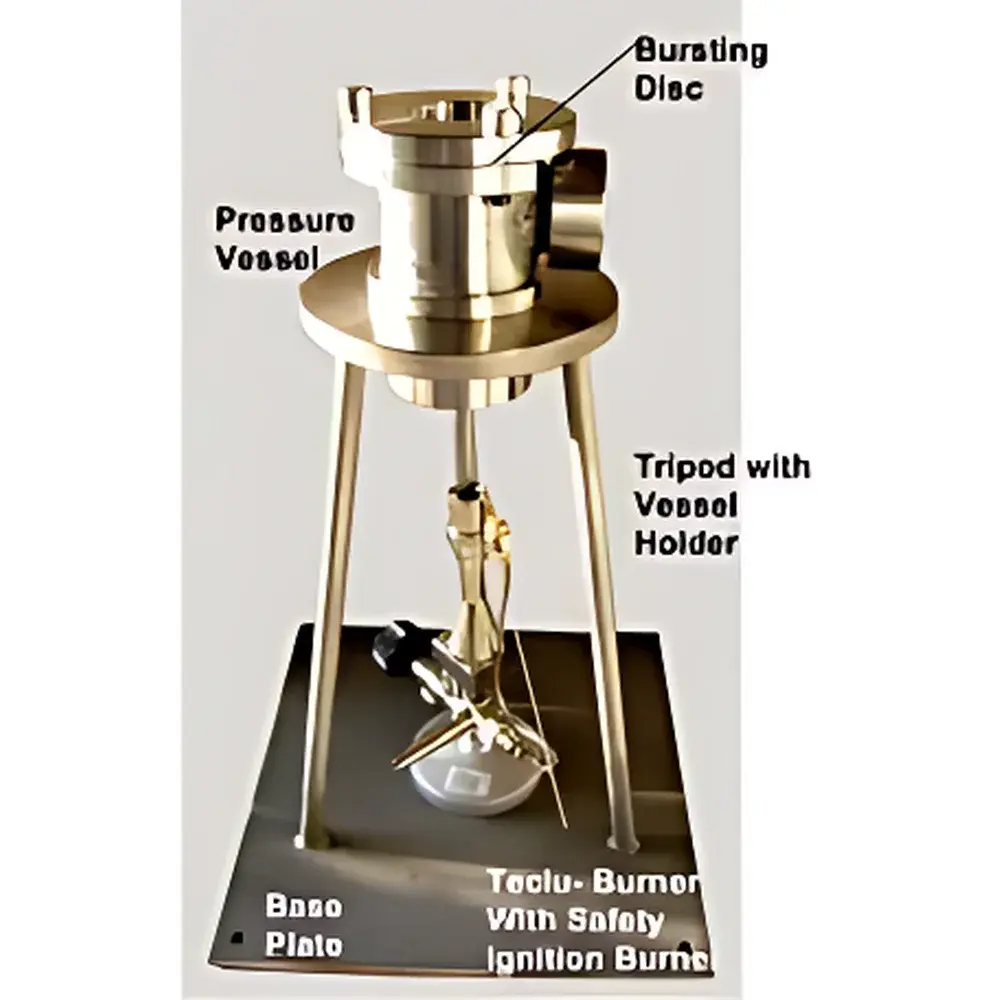
R&P HPV High-Pressure Vessel Test Apparatus
| Brand | R&P |
|---|---|
| Origin | Germany |
| Model | HPV |
| Pressure Vessel Material | AISI 316 Stainless Steel |
| Internal Diameter | 50 mm |
| Internal Height | 94.5 mm |
| Burst Disc Rating | 6.2 bar ±10% at 22 °C |
| Nozzle Orifice Diameters | 1.0, 2.0, 3.5, 6.0, 9.0, 12.0, 16.0, 24.0 mm |
| Compliance | UN Manual of Tests and Criteria, Part I, Section 12 (Test Series 1) |
| Accessories | Tripod Stand, Base Plate, Protective Sleeve, 8 Nozzle Plates, 20 Burst Discs |
Overview
The R&P HPV High-Pressure Vessel Test Apparatus is a rigorously engineered system designed to assess the thermal sensitivity of solid and liquid substances under confined, high-pressure conditions—specifically for classification and hazard evaluation in accordance with the United Nations Recommendations on the Transport of Dangerous Goods, Manual of Tests and Criteria (Rev. 7, 2021), Section 12 of Part I (Test Series 1: “Thermal Sensitivity of Substances in Confined Conditions”). This apparatus operates on the principle of controlled exothermic decomposition initiation within a sealed stainless-steel pressure vessel, followed by real-time monitoring of pressure rise rate, peak pressure, and time-to-rupture. The test provides critical data for assigning UN hazard classes (e.g., Class 1 explosives, Class 4.1 self-reactive substances) and determining appropriate packaging groupings. Its design adheres to strict dimensional and material specifications defined in the UN test protocol to ensure inter-laboratory reproducibility and regulatory acceptability.
Key Features
- Pressure vessel constructed from certified AISI 316 stainless steel, offering superior corrosion resistance and mechanical integrity at elevated temperatures and pressures.
- Precisely dimensioned internal geometry: 50 mm inner diameter × 94.5 mm internal height—matching UN-specified vessel volume (~185 mL) for standardized energy confinement.
- Modular nozzle plate set (8 plates) with calibrated orifices ranging from 1.0 mm to 24.0 mm, enabling systematic variation of venting resistance to characterize pressure development dynamics across diverse decomposition behaviors.
- Integrated safety ignition burner with flame stabilization and fail-safe shut-off, ensuring reliable and repeatable thermal initiation without external spark sources.
- Pre-calibrated burst disc assembly (20 units supplied), rated at 6.2 bar ±10% at 22 °C, traceable to ISO/IEC 17025-accredited calibration records—critical for defining the pressure threshold for vessel failure and quantifying decomposition energy release.
- Robust mechanical support architecture comprising tripod stand, rigid base plate, and protective sleeve, minimizing vibration-induced measurement artifacts and ensuring operator safety during high-energy events.
Sample Compatibility & Compliance
The HPV apparatus accommodates samples in solid, paste, or low-viscosity liquid form, with typical sample mass ranging from 10 g to 50 g depending on density and expected energy output. It supports testing of organic peroxides, nitro compounds, azo initiators, metal hydrides, and other thermally unstable materials classified under UN Class 4.1 (Self-Reactive Substances) and Class 5.2 (Organic Peroxides). All operational procedures align with GLP principles and are fully compatible with audit requirements under ISO/IEC 17025:2017. Test reports generated using this system meet evidentiary thresholds for submission to regulatory authorities including ECHA, DOT, and IMDG Code compliance officers. The apparatus itself does not require electrical certification for intrinsic safety, as ignition is purely thermal and containment is passive—reducing complexity in hazardous area deployment.
Software & Data Management
While the HPV is a manually operated, analog-dominant system (consistent with UN-prescribed methodology), it is fully compatible with third-party digital data acquisition systems. Users may integrate calibrated pressure transducers (e.g., piezoresistive sensors with 0–100 bar range, ±0.25% FS accuracy) and high-speed temperature loggers (Type K thermocouples, 100 Hz sampling) via standard 4–20 mA or USB-TTL interfaces. R&P provides detailed signal conditioning guidelines and timestamp-synchronization protocols to ensure traceable, CFR Part 11–compliant data archiving when paired with validated laboratory information management systems (LIMS). Raw pressure–time traces are exportable in CSV format for post-test analysis using ASTM E691–based uncertainty quantification frameworks.
Applications
- Determination of thermal stability limits for new chemical entities prior to scale-up synthesis.
- Classification testing for SDS Section 9 (Physical and Chemical Properties) and Section 14 (Transport Information).
- Root-cause analysis of thermal runaway incidents in pilot-scale reactors or storage facilities.
- Validation of stabilizer efficacy in peroxide formulations under accelerated aging protocols.
- Supporting REACH registration dossiers requiring UN test data for hazard communication.
- Training laboratories and national reference centers in standardized dangerous goods testing methodology.
FAQ
Is the HPV apparatus certified for use in accredited testing laboratories?
Yes—the HPV system complies with the physical and procedural requirements of UN Manual of Tests and Criteria, Section 12. Laboratories performing official classification testing must validate their full test method per ISO/IEC 17025; R&P supplies technical documentation packages supporting method validation.
Can the HPV be used for liquids with high vapor pressure?
Yes, provided the sample’s boiling point at atmospheric pressure exceeds 60 °C and its saturated vapor pressure at test temperature remains below 10% of the burst disc rating. Pre-test vapor pressure estimation using Antoine equation or DSC-derived volatility data is recommended.
What maintenance is required for long-term reliability?
Annual verification of burst disc lot certification, visual inspection of vessel interior for pitting or stress cracking, and recalibration of ignition burner gas flow rate (using certified rotameter) are advised. No firmware or software updates apply, as the system contains no embedded electronics.




