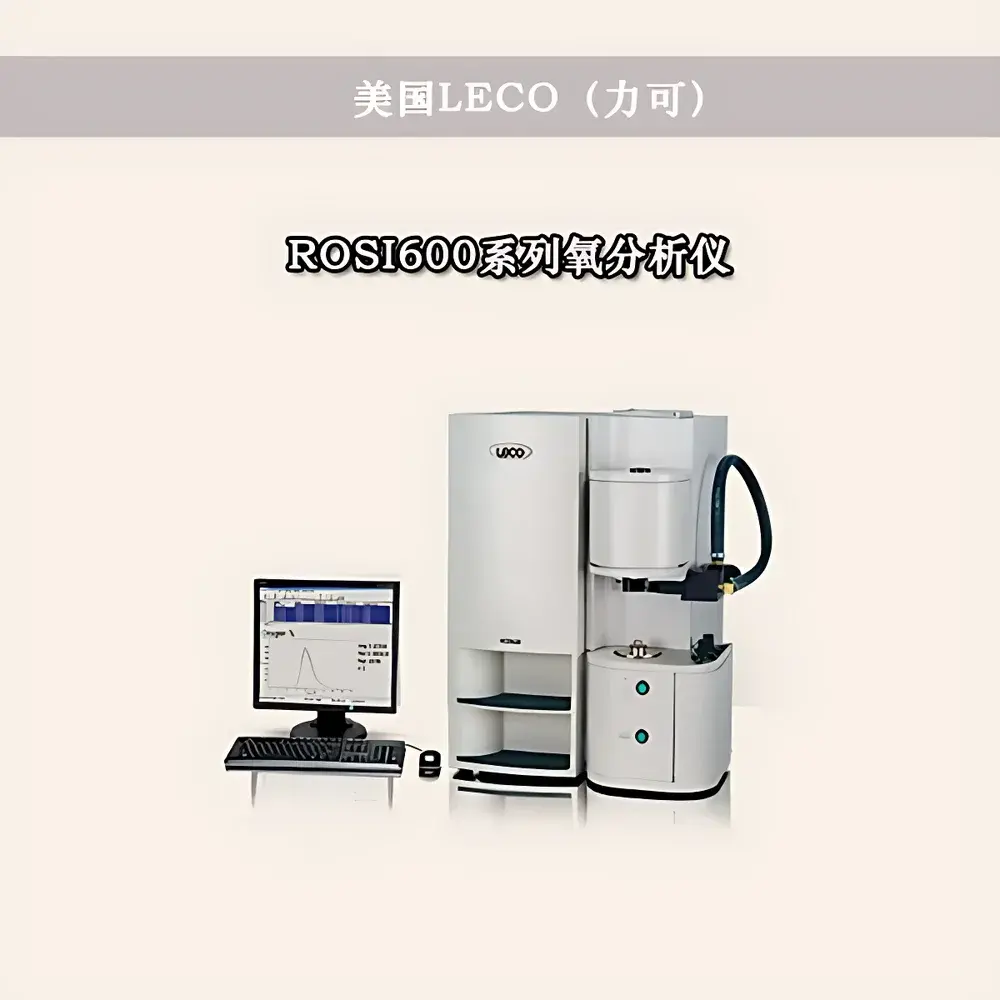
ROSI600 Series Oxygen Analyzer
| Origin | USA |
|---|---|
| Manufacturer Type | Authorized Distributor |
| Origin Category | Imported |
| Model | ROSI600 |
| Price Range | USD 1,400 – 4,200 |
Overview
The ROSI600 Series Oxygen Analyzer is a high-performance, solid-state non-dispersive infrared (NDIR) analyzer engineered for ultra-trace oxygen quantification in high-purity semiconductor and advanced metallurgical materials. It operates on the principle of infrared absorption spectroscopy, where molecular oxygen (O₂) exhibits characteristic absorption bands in the mid-infrared region—specifically leveraging a proprietary solid-state detector optimized for stability, low noise, and long-term baseline reproducibility. Unlike conventional paramagnetic or electrochemical sensors, the ROSI600 employs a fully sealed, purged optical path coupled with a programmable pulse-heated electrode furnace, enabling quantitative liberation of interstitial and substitutional oxygen from refractory matrices—including monocrystalline silicon wafers, high-purity copper, gallium arsenide, and sapphire substrates. Its design targets applications demanding detection limits at the sub-ppm level (≤0.1 ppm O₂ equivalent), with measurement traceability aligned to ISO/IEC 17025-accredited reference gas standards and compatible with GLP/GMP documentation workflows.
Key Features
- Non-dispersive solid-state infrared (NDIR) detector with temperature-stabilized optics and integrated signal processing for <0.05 ppm O₂ resolution and ≤±0.2 ppm absolute accuracy (based on certified calibration gases)
- Programmable pulse-heated electrode furnace with independent power and current control—enabling precise thermal ramping profiles (up to 3000 °C) and reproducible oxygen release kinetics from solid samples
- Sub-ppm analytical precision: typical RSD <1.5% at 1–10 ppm O₂ level across ≥50 consecutive analyses under controlled lab conditions
- Low-blank sample introduction system featuring dual magnetic-sealed sliding tray, inert-gas purged loading chamber, and integrated oxygen/moisture getter cartridges to maintain carrier gas purity >99.9999% (6N)
- Safety-engineered reagent containment module compliant with IEC 61010-1 for handling reactive fluxes (e.g., graphite crucibles, nickel vanadium alloys)
- Modular gas-path architecture with minimal dead volume, electropolished stainless-steel manifolds, and leak-tight VCR fittings—reducing maintenance intervals by ≥40% versus legacy systems
- Oxygen concentration output in parts-per-quadrillion (ppqa) and parts-per-trillion (ppt) scalable units; configurable ppma (parts-per-million atomic) reporting per ASTM E1447 and SEMI F57 standards
- Native Windows® 10 IoT Enterprise OS with real-time data acquisition, multi-user role-based access, and audit trail logging compliant with FDA 21 CFR Part 11 requirements
Sample Compatibility & Compliance
The ROSI600 supports solid-state samples up to 1.0 g mass and 25 mm diameter, including polished silicon wafers (200 mm / 300 mm), copper rod segments, tungsten carbide powders, and ceramic substrates. Sample geometry is accommodated via interchangeable trays with vacuum-assisted alignment. All wetted surfaces contact only high-purity alumina, fused quartz, or electropolished 316L SS—ensuring no catalytic interference or memory effects. The system meets ISO 14040 lifecycle assessment criteria for energy-efficient operation and complies with CE marking (EMC Directive 2014/30/EU, Low Voltage Directive 2014/35/EU). Calibration verification adheres to ASTM E1019 (Standard Test Methods for Determination of Carbon, Sulfur, Nitrogen, and Oxygen in Steel, Iron, Nickel, and Cobalt Alloys) and SEMI MF1390 (Specification for Oxygen Content in Silicon Wafers).
Software & Data Management
The embedded AnalytiCAL™ v4.2 software provides full instrument control, method development, and automated report generation. It supports CSV, XML, and PDF export formats with embedded metadata (operator ID, timestamp, calibration history, furnace profile logs). Audit trails record all parameter changes, result modifications, and user logins with immutable timestamps. Optional SmartLine® Remote enables encrypted TLS 1.3 secure diagnostics, predictive maintenance alerts, and over-the-air firmware updates—all accessible via browser-based interface without exposing internal network infrastructure. Data integrity safeguards include electronic signatures, password-protected method locking, and automatic backup to network-attached storage (NAS) or cloud-hosted repositories meeting HIPAA-compliant encryption standards.
Applications
- Quantitative oxygen profiling in Czochralski-grown silicon ingots per SEMI PV28 and ASTM F1260
- Residual oxygen analysis in oxygen-free high-conductivity (OFHC) copper used in RF shielding and quantum computing cryostats
- Quality control of sintered metal powders (e.g., Ti-6Al-4V, Inconel 718) for aerospace additive manufacturing feedstock certification
- Validation of getter performance in ultra-high vacuum (UHV) chamber components
- Research-grade oxygen stoichiometry mapping in transition metal oxides (e.g., LiCoO₂, NiO) for battery cathode development
FAQ
What detection principle does the ROSI600 employ, and why is it preferred for silicon analysis?
It uses solid-state NDIR spectroscopy—offering superior long-term stability and immunity to electromagnetic interference compared to paramagnetic sensors, critical for cleanroom-integrated process monitoring.
Can the ROSI600 analyze powdered samples without pelletization?
Yes—using optional graphite crucible inserts and customized furnace ramp profiles to ensure complete oxygen liberation without agglomeration artifacts.
Is the system compliant with pharmaceutical or medical device manufacturing regulations?
While primarily deployed in semiconductor and metallurgy labs, its 21 CFR Part 11–compliant software and documented IQ/OQ protocols support validation in regulated environments upon customer-specific qualification.
What carrier gas is required, and what purity specifications apply?
Ultra-high-purity helium (≥99.9999%) or argon (≥99.9995%) is mandatory; impurities must be <0.1 ppm O₂ and <0.05 ppm H₂O to maintain blank integrity.
How frequently must the infrared detector be recalibrated?
Factory calibration remains valid for 12 months under normal operation; annual verification using NIST-traceable O₂-in-He standards is recommended per ISO/IEC 17025 clause 7.7.