
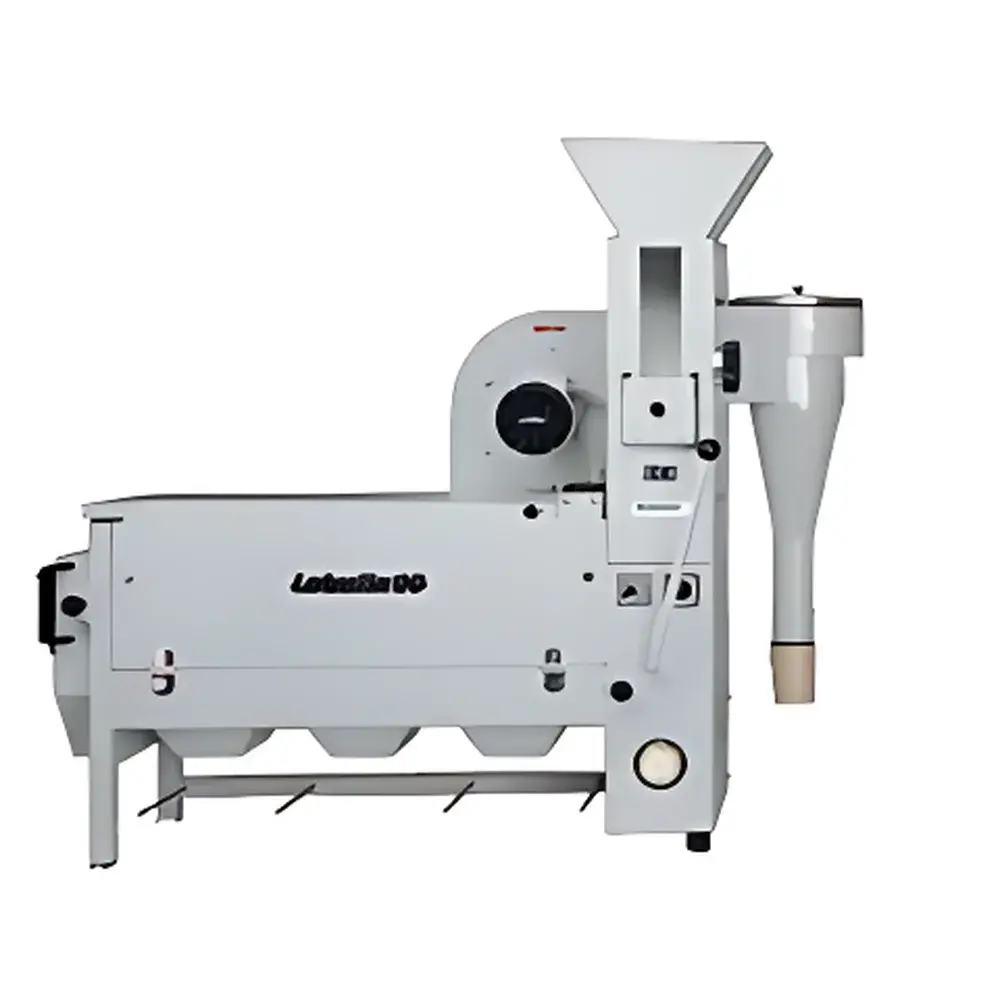
Brabender Labofix Small-Scale Cleaning and Grading Unit
| Brand | Brabender |
|---|---|
| Origin | Germany |
| Model | Labofix |
| Compliance | EU Regulation (EC) No. 824/2000 |
| Sample Capacity | 50 g to ~50 kg/h |
| Screening Options | Flat Sieve / Rotary Cylinder / Air Aspirator |
| Adjustable Inclination | ±10° |
| Noise Level | <65 dB(A) |
| Dust-Free Operation | Yes |
| Quick-Change Mechanism | Integrated for sieves and grading cylinders |
| Output Mode | Continuous discharge |
Overview
The Brabender Labofix Small-Scale Cleaning and Grading Unit is a compact, fully automated laboratory-scale system engineered for precise physical separation and impurity quantification of granular agricultural materials. Designed in accordance with the requirements of EU Regulation (EC) No. 824/2000 — which defines official methods for determining impurities in cereals and seeds — the Labofix integrates three core unit operations into a single, robust enclosure: air aspiration (density-based separation), mechanical screening (size-based fractionation), and rotary drum classification (shape- and density-assisted sorting). Unlike benchtop sifters or standalone aspirators, the Labofix replicates the functional sequence of industrial cleaning lines at a miniature scale, enabling representative small-batch analysis without compromising process fidelity. Its modular architecture allows users to configure the sequence and combination of separation stages — e.g., air aspirator first for light chaff removal, followed by flat-sieve grading and optional rotary cylinder polishing — ensuring method adaptability across diverse grain types and regulatory testing protocols.
Key Features
- Integrated tri-stage separation: Aspiration, planar sieving, and rotary drum grading within a single footprint (W × D × H: 650 × 520 × 980 mm)
- Adjustable inclination mechanism (±10°) for controlled residence time modulation — critical for optimizing separation efficiency on low-density contaminants (e.g., straw fragments, husk pieces) or fragile seeds
- Quick-lock mounting system enables tool-free replacement of sieves (standard ISO 3310-1 mesh ranges: 0.25–8.0 mm) and grading cylinders (diameter 100–200 mm, variable aperture geometry)
- Dust-tight construction with sealed airflow path and integrated HEPA-filtered exhaust — compliant with OSHA and EU Directive 2004/37/EC occupational exposure limits
- Low-noise operation (<65 dB[A] at 1 m) achieved via balanced rotor dynamics, vibration-damped mounting, and acoustic enclosure design
- Consistent performance across sample mass ranges: validated repeatability (RSD <2.5%) for impurity quantification using 50 g reference samples and 2–5 kg routine batches
Sample Compatibility & Compliance
The Labofix is validated for use with cereal grains (wheat, rye, barley, oats, maize, sorghum, rice), oilseeds (rapeseed, sunflower), legumes (soybean, pea), and botanical seeds (vegetable, flower, grass). It supports official testing under EU Regulation (EC) No. 824/2000 for determination of “foreign matter” — including broken kernels, dust, sand, stones, weed seeds, and organic debris — in soft wheat, durum wheat, barley, maize, and sorghum. The system meets ISO/IEC 17025:2017 general requirements for competence of testing laboratories when operated with documented SOPs, calibrated airflow meters (traceable to NIST standards), and certified reference sieves. Optional digital mass balance integration enables GLP-compliant weight logging synchronized with stage-specific output fractions.
Software & Data Management
While the Labofix operates as a stand-alone electromechanical unit, its process parameters are fully documentable via external lab information management systems (LIMS). Airflow velocity (m³/h), sieve aperture (mm), drum rotation speed (rpm), and inclination angle (°) are manually set but logged per test in standardized electronic worksheets aligned with Annex II of EC 824/2000. Optional USB-connected anemometer and load-cell interfaces support automated data capture compatible with CSV export and audit-trail-enabled LIMS platforms compliant with FDA 21 CFR Part 11. All configuration changes are timestamped and user-identified for traceability during regulatory inspections.
Applications
- Regulatory impurity testing in accredited grain inspection laboratories
- Pre-milling cleaning validation for flour mill quality assurance programs
- Seed purity certification per ISTA Rules (International Seed Testing Association)
- R&D screening of new grain varieties for threshing efficiency and hull adhesion characteristics
- Teaching and method development in food science and agricultural engineering curricula
- Verification of cleaning equipment performance in pilot-scale processing trials
FAQ
Does the Labofix comply with official EU grain testing regulations?
Yes — it is explicitly designed to execute the physical separation procedures mandated by EU Regulation (EC) No. 824/2000 for impurity determination in cereals.
Can it handle sticky or damp samples?
Samples must be conditioned to ≤14.5% moisture content (wb) prior to analysis; excessive moisture causes blinding of sieves and reduces aspiration efficiency.
Is calibration required before each test?
Airflow and inclination settings are mechanically fixed and verified annually using traceable instruments; no per-test recalibration is needed if maintenance logs are up to date.
What maintenance intervals are recommended?
Daily visual inspection of sieves and aspirator ducts; monthly lubrication of drum bearings; annual verification of airflow sensor accuracy and sieve mesh integrity.
Is technical support available outside Germany?
Brabender’s global distributor network provides local service, spare parts logistics, and application engineering support in over 60 countries, with documentation available in English, French, Spanish, and Chinese.





