
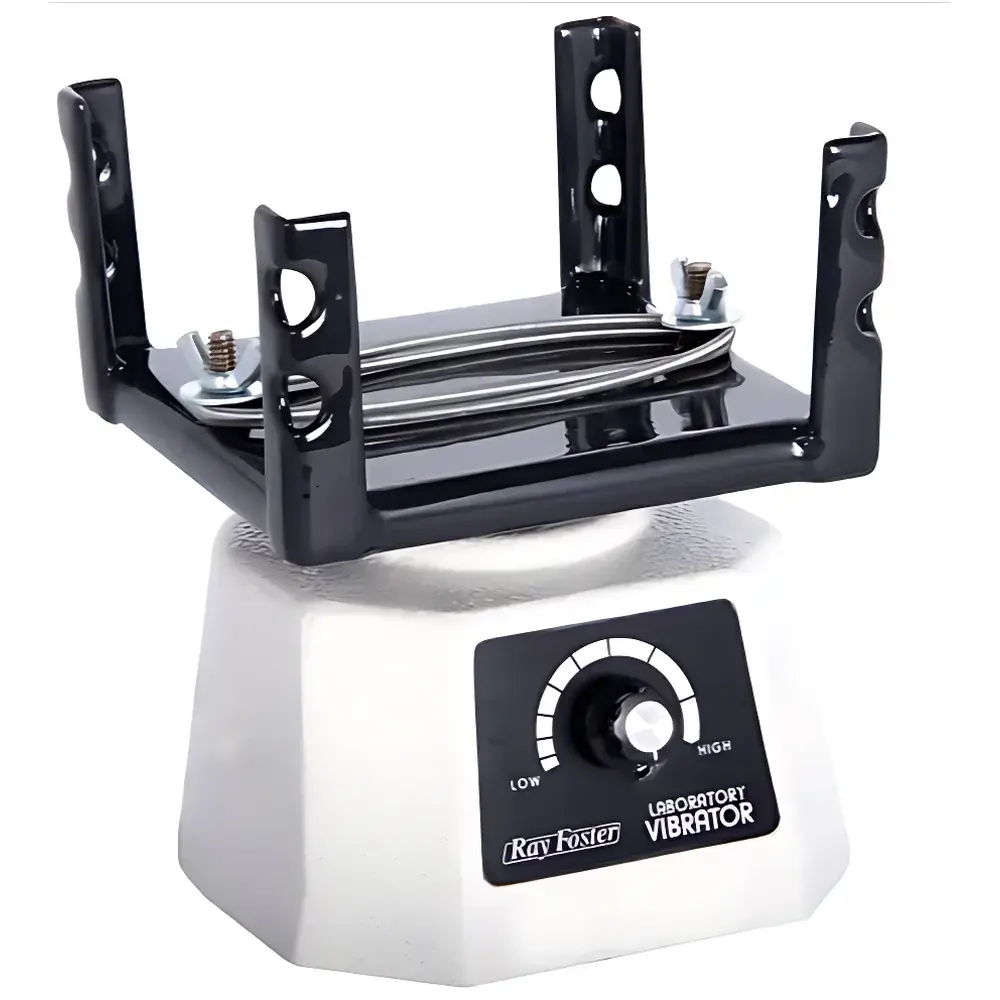
Gilson Vibra Pad SS-28 / SS-28F Dual-Function Vibratory Sieve Shaker & Specific Gravity Agitator
| Origin | USA |
|---|---|
| Manufacturer Type | Authorized Distributor |
| Origin Category | Imported |
| Model | SS-28 (115 V, 50–60 Hz) / SS-28F (230 V, 50–60 Hz) |
| Power Input | 1.4 A (SS-28) / 0.7 A (SS-28F) |
| Platform Size | 133 mm × 133 mm (5.25 in square), Coated Plastic Surface |
| Max Sample Container Diameter | 152 mm (6 in) |
| Sieve Compatibility | ASTM/ISO Standard Sieves, 76 mm (3 in) and 152 mm (6 in) Frame Diameters |
| Particle Size Range | No. 10 to No. 200 (2.0 mm – 75 µm) |
| Weight | 4.54 kg (10 lb) |
| Compliance | Meets ASTM C127, C128, C136, and Kentucky Transportation Cabinet specifications for fine aggregate specific gravity testing |
Overview
The Gilson Vibra Pad SS-28 and SS-28F are compact, benchtop vibratory units engineered for dual-purpose laboratory use: as a controlled agitation source for specific gravity determinations (e.g., Le Chatelier flask mixing per ASTM C127/C128), and as a light-duty sieve shaker for particle size distribution analysis (per ASTM C136 or ISO 565). Unlike high-amplitude mechanical shakers or orbital agitators, the Vibra Pad employs low-energy vertical oscillation—optimized for gentle yet effective de-aeration of coarse and fine aggregate suspensions, and uniform vibration of dry or semi-dry sieve stacks. Its design prioritizes repeatability in standardized materials testing workflows, particularly within DOT-certified aggregate laboratories and university civil engineering labs where compliance with Kentucky Transportation Cabinet protocols is required. The unit operates without complex calibration or software interfaces, relying instead on robust electromagnetic actuation and passive mechanical damping to deliver consistent motion profiles across voltage variants (115 V for North America; 230 V for EU/UK/AU markets).
Key Features
- Two-voltage configuration: SS-28 (115 V, 50–60 Hz) and SS-28F (230 V, 50–60 Hz), each rated for continuous duty under standard lab conditions
- 133 mm × 133 mm plastic-coated square platform with non-slip surface, designed to minimize resonance transfer and protect glassware
- Dual clamping system: two wing-nut fasteners and four spring-loaded corner posts accommodate both cylindrical flasks (e.g., SG-24 Le Chatelier flask) and rigid sieve frames up to 152 mm diameter
- No built-in timer or digital controls—intentionally simplified to support manual timing per ASTM procedures and reduce failure points in regulated environments
- Low-mass, low-noise electromagnetic drive mechanism ensures stable amplitude at 50/60 Hz line frequency without harmonic distortion
- UL/CE-compliant housing with thermal overload protection and grounded chassis for safe operation in humid or dust-prone lab settings
Sample Compatibility & Compliance
The Vibra Pad supports ASTM-standard sieve frames (3 in / 76 mm and 6 in / 152 mm diameters) constructed from stainless steel, brass, or non-metallic polymers—including Gilson’s own 3 in non-metallic sieves for abrasive or chemically sensitive samples. It is explicitly validated for use with dry-sieve analysis (ASTM C136) and specific gravity testing of fine aggregates (ASTM C128), including Kentucky Transportation Cabinet–approved test protocols for highway construction materials. While not intended for wet sieving or high-load applications (>500 g per sieve), its motion profile meets reproducibility requirements for inter-laboratory comparison studies under ASTM E11 and ISO 565. The unit itself carries no ISO/IEC 17025 accreditation, but its mechanical consistency enables traceable results when paired with certified reference sieves and calibrated flasks.
Software & Data Management
The Vibra Pad SS-28/SS-28F is a standalone electromechanical device with no embedded firmware, connectivity options (USB/Ethernet/WiFi), or data logging capability. This architecture aligns with GLP and GMP environments where instrument qualification focuses on mechanical performance verification—not software validation. Users maintain full control over test duration via external timers or stopwatch, ensuring full auditability of agitation/shaking intervals. Documentation packages include a Factory Performance Verification Report (FPVR) confirming amplitude stability and voltage tolerance, supporting IQ/OQ protocols during lab equipment commissioning. No 21 CFR Part 11 compliance features are implemented, as the device does not generate, store, or transmit electronic records.
Applications
- De-aeration and homogenization of aggregate-water suspensions in Le Chatelier flask tests (ASTM C127/C128)
- Light-duty dry sieving of soils, crushed stone, sand, and recycled concrete aggregates (ASTM C136)
- Preparation of representative sub-samples prior to hydrometer or laser diffraction analysis
- Stabilization of pycnometer contents during density determination of mineral fillers
- Validation of sieve mesh integrity through controlled vibration exposure
- Teaching laboratories requiring low-risk, repeatable mechanical agitation for civil engineering curricula
FAQ
Can the Vibra Pad be used for wet sieving?
No. It is designed exclusively for dry or damp (non-dripping) samples. Liquid ingress may damage the electromagnetic actuator and void warranty.
Does it meet ISO 565 requirements for sieve shakers?
It complies with the mechanical performance criteria outlined in ISO 565 Annex B for “light-duty vibratory shakers” but is not classified as a Type A or B shaker per ISO 2591-1.
Is calibration required before first use?
No scheduled calibration is mandated; however, users should verify platform amplitude using a contact vibrometer per Gilson Technical Bulletin TB-SS28 prior to critical testing.
What sieve frame heights are supported?
Standard-height (25 mm) and tall-frame (50 mm) 76 mm and 152 mm sieves are accommodated; stack height must not exceed 125 mm total to maintain clamping integrity.
Can it replace a Ro-Tap® or sonic sieve shaker?
No. It serves a distinct niche: low-energy, low-amplitude agitation. It is not suitable for tightly packed or cohesive materials requiring high-impact tapping or ultrasonic energy.






